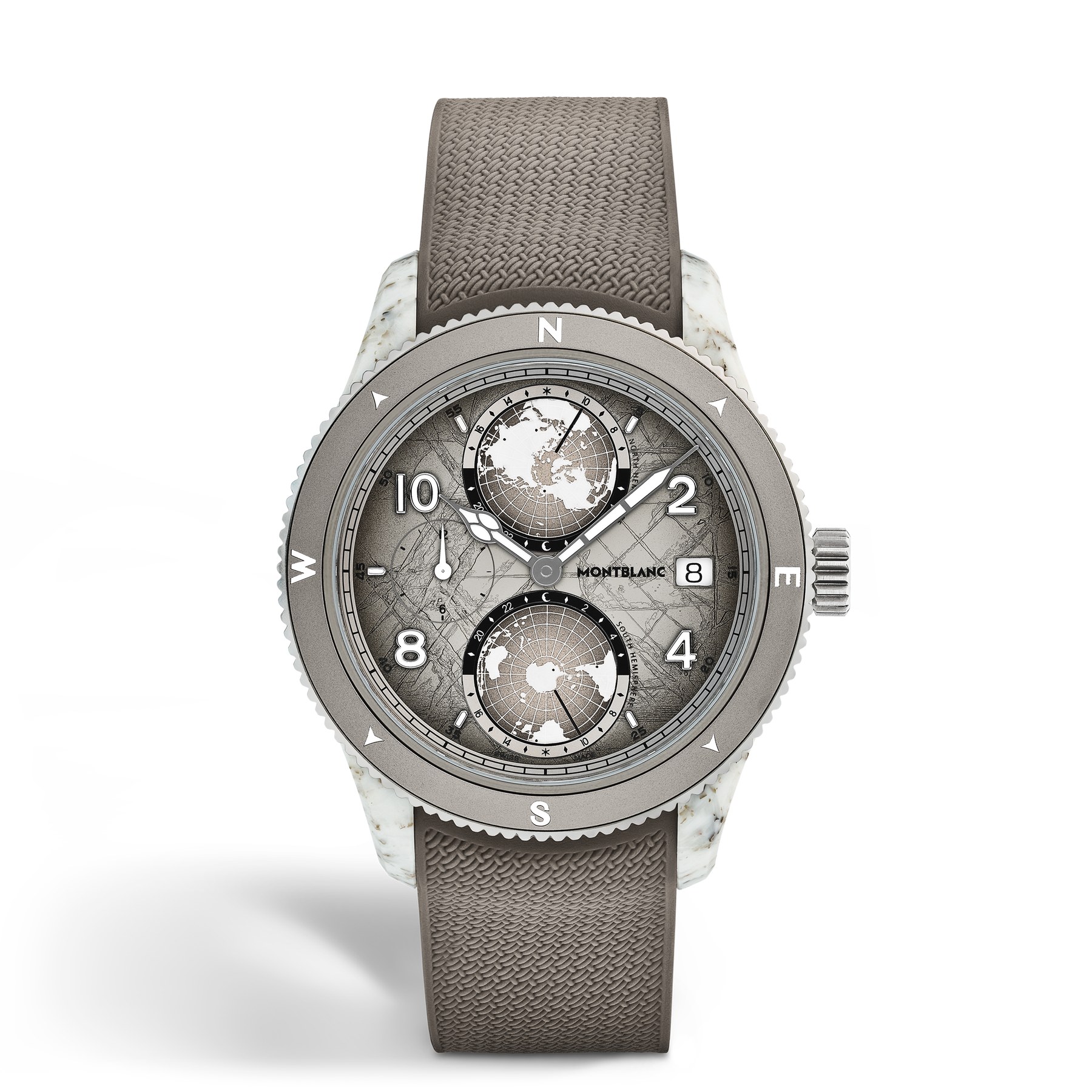
The Montblanc 1858 Geosphere has been in the catalogue since 2018 and its premise has not moved: two domed globes rotating in opposite directions over 24 hours, one hemisphere each, with the Seven Summits marked as dots on the continents. It is a worldtimer that reads like cartography rather than a city ring.
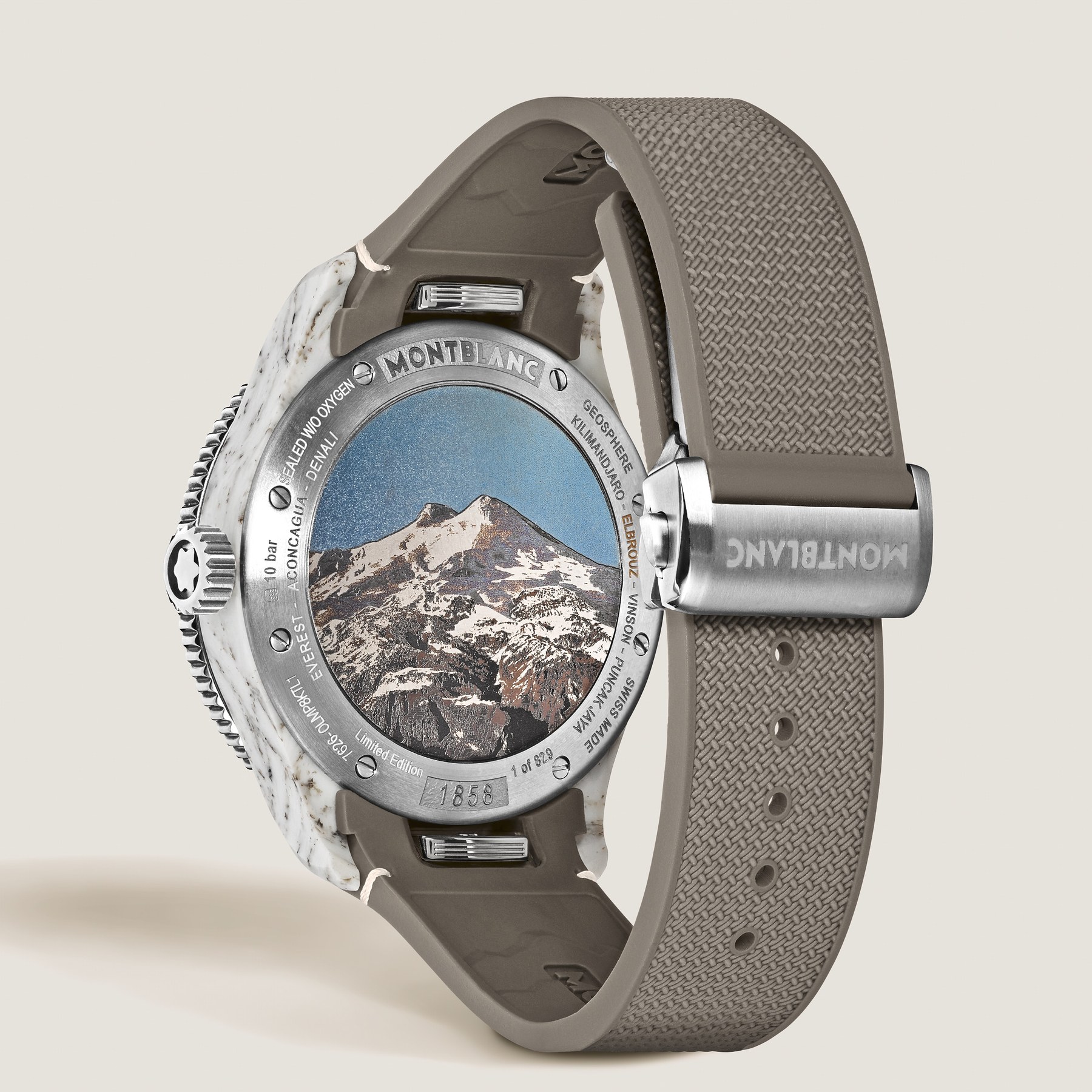
The newest is dedicated to Mount Elbrus, the dormant volcano in the Caucasus that Montblanc describes as Europe's highest peak, and it follows the Mount Vinson edition in the same 0 Oxygen series. It was reported on 9 July as reference 136353.
What "0 Oxygen" actually does
The name sounds like marketing and there is a real process behind it. The case is assembled and sealed inside a nitrogen-filled tank, so the air trapped inside the watch is nitrogen rather than ordinary humid air. Montblanc's claim is that this prevents moisture ingress and stops the crystal fogging when the watch moves between temperature extremes, which is the failure mode that matters when you go from a warm tent to a cold ridge.
That is a solution to a problem mountaineers actually have. It is also a problem most owners of a EUR 10,100 titanium worldtimer will never encounter, and it is worth saying so.
The midcase
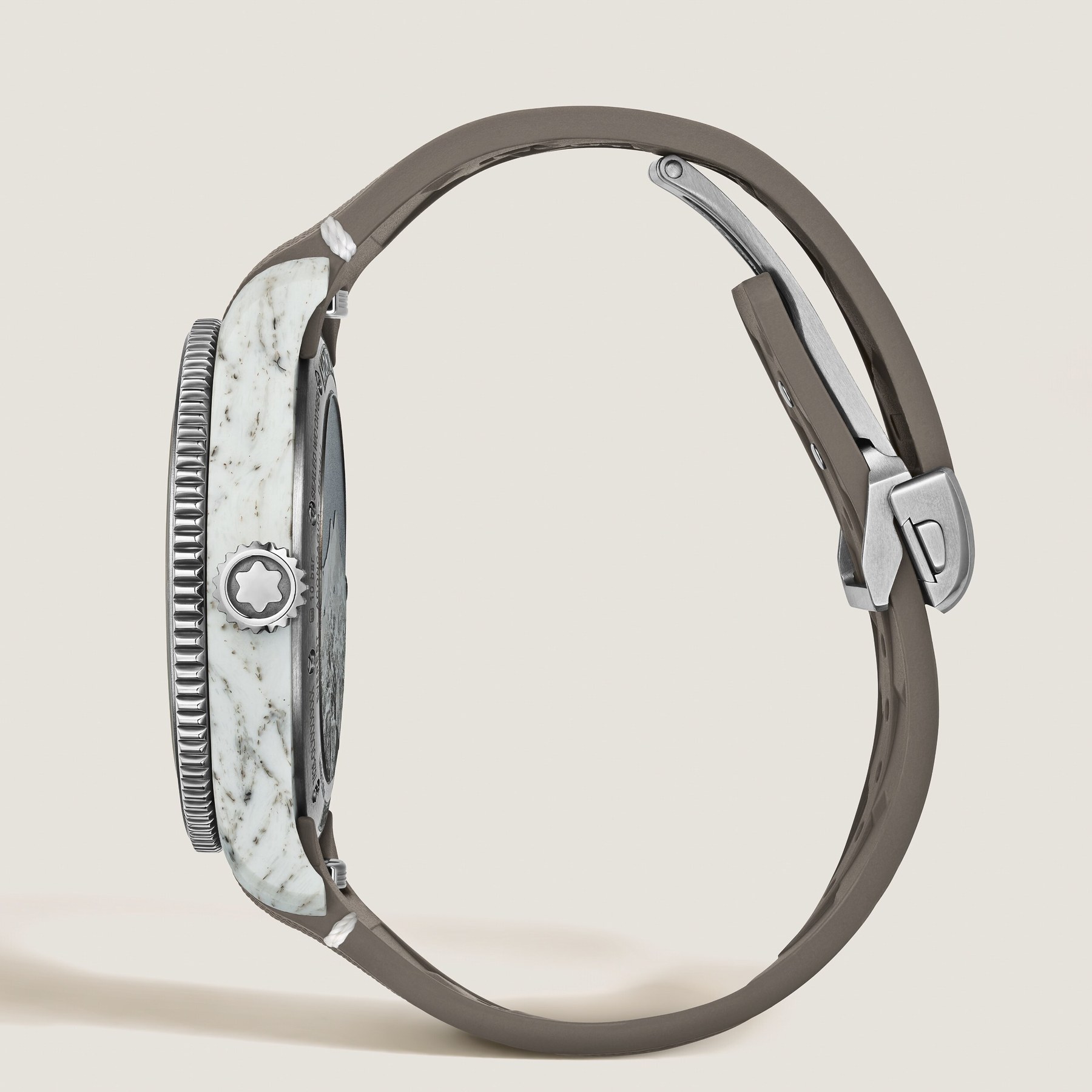
The 43.5mm case is titanium, 13mm thick, water-resistant to 100m. The middle section is not. It is a proprietary composite of volcanic ash, aluminised basalt fibres, calcium carbonate and bio-sourced resin, and in the photographs it reads as mottled white and grey stone. Whether the ash is a structural contributor or a narrative one, Montblanc does not say, but the material is visible from the side rather than hidden under a caseback, which is more than most brands do with a story material.
The left flank carries an engraved outline of the twin peaks of Elbrus, hand-filled with Super-LumiNova that emits orange. The bezel is titanium with a light grey anodised aluminium insert, bidirectional, coin-edged, and marked with cardinal points so it can be used to gauge true north.
Reading it
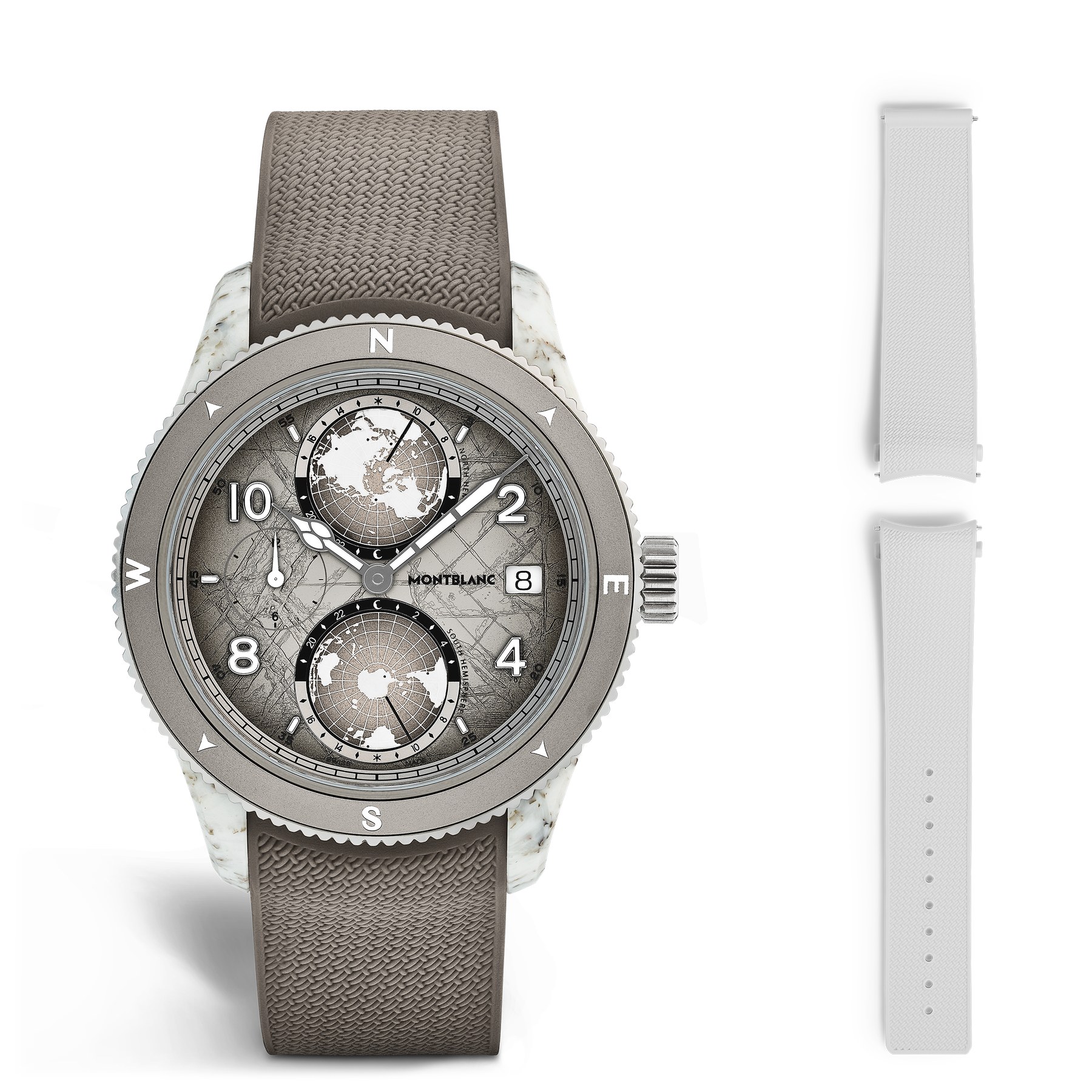
The dial is a white and brown sfumato with a glacier pattern, and it carries a lot of information without collapsing. The two globes show the continents in relief, each with a 24-hour scale and a two-tone day/night indicator, split by a black line for the Greenwich meridian and dotted at the Seven Summits and Mont Blanc. A subdial at 9 o'clock tracks a second time zone, advanced in one-hour jumps by a pusher, and that is what most owners will actually read. The date sits at 3.
The lume is split by function. Orange emission on the hands, numerals and bezel; blue on the continents and the second time zone hand. That is a legibility decision wearing the clothes of a colour decision, and it fits a collection whose design vocabulary comes from Minerva's 1930s military watches, where legibility was the whole brief.
The movement, and the objection
Calibre MB 29.25 is a Sellita SW300 base with a worldtime module developed at Montblanc's Villeret manufacture. It runs at 28,800vph with 42 hours of reserve.
At EUR 10,100 that base will draw comment, and it should be met head on rather than glossed over. What you are paying for is the module, the case material, the nitrogen assembly and the engraving, not the going train. Whether that is a fair trade is the buyer's question to answer, and the answer will depend on how much the two globes are worth to them.
Limited to 829 pieces, a nod to 1829, the year Montblanc cites for the first ascent. Supplied on interchangeable light brown and ivory rubber straps. Details at montblanc.com.