The American watch industry that existed a century ago is not coming back. Waltham and Elgin built movements by the million; nothing in the current revival operates at that scale, and nobody involved is pretending otherwise. What has emerged instead is a small population of workshops making a few dozen watches a year to a standard the old factories never attempted. RGM has been at it longest. J.N. Shapiro and Keaton Myrick followed. The newest name to put a serious watch on the table is 1776 Atelier, and it has chosen a loaded occasion to do it.
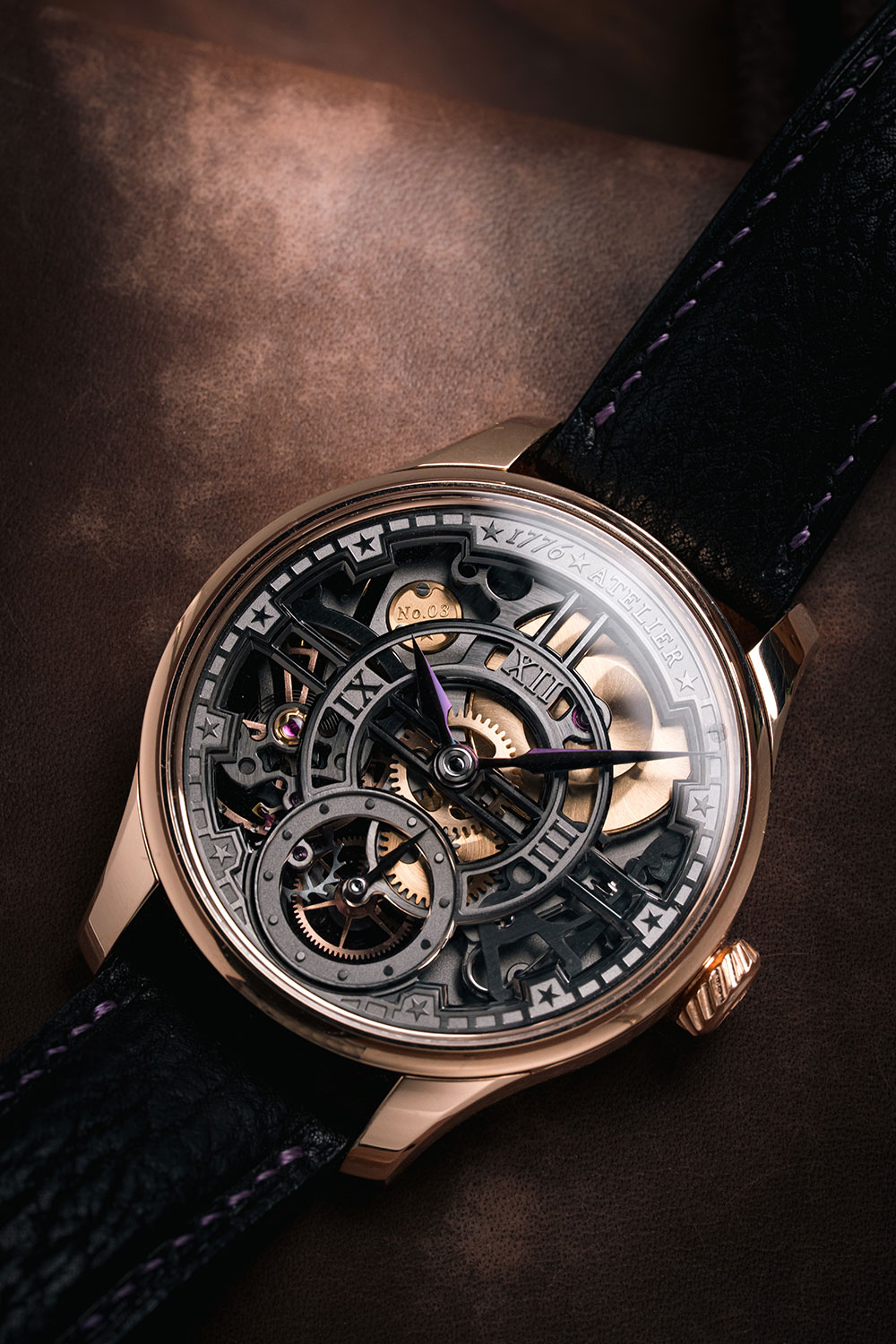
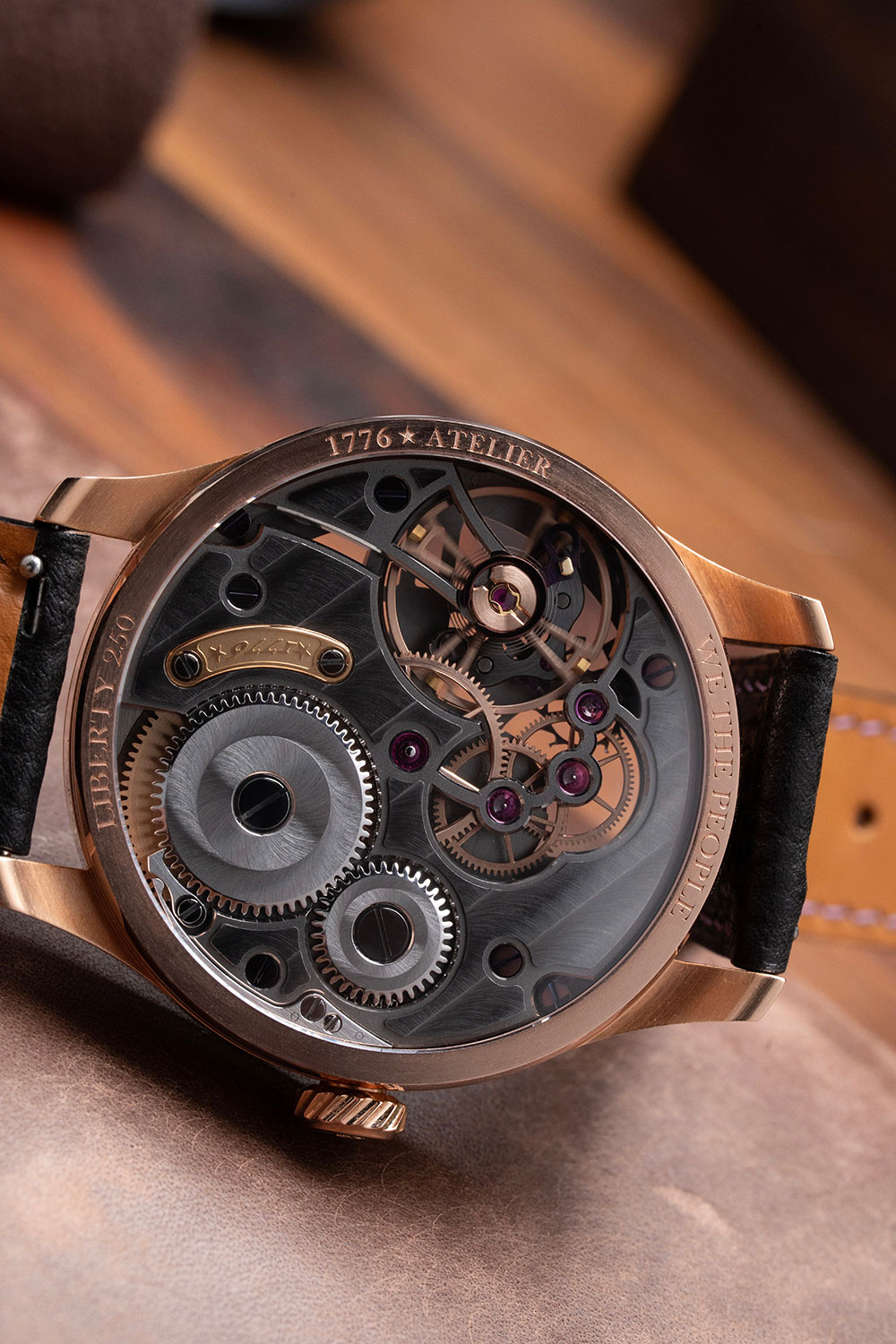
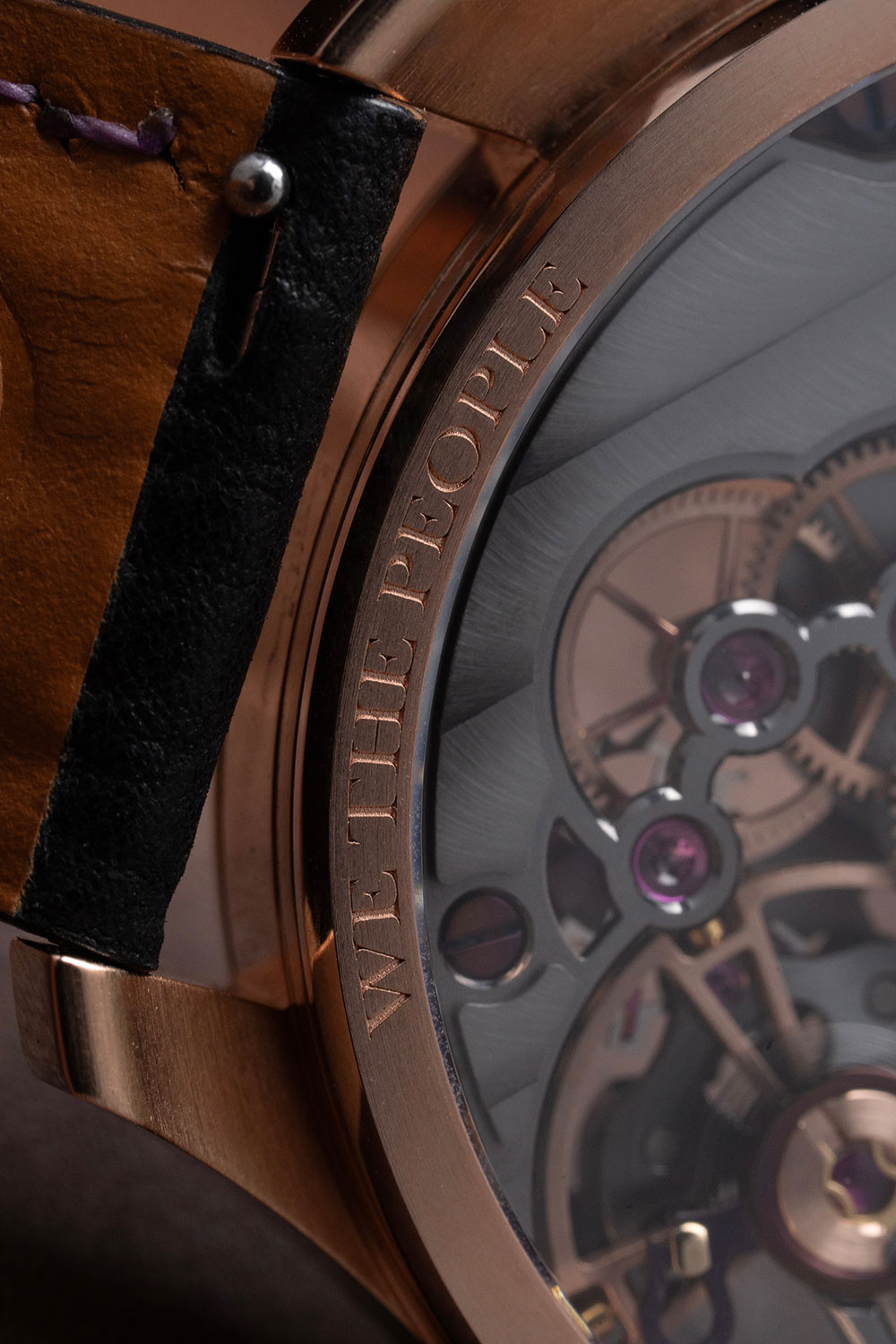
The Liberty 250, introduced on 10 July, is a 25-piece rose gold watch marking the 250th anniversary of American independence. Given the brand name and the occasion, the restraint of the result is the first surprise. There are no stars and stripes, no red and blue accents. The patriotic content is confined to star-shaped hour markers, an engraved case flank reading WE THE PEOPLE, and a caseback marked LIBERTY 250. Everything else is a straight argument about hand finishing.
The people behind it
1776 Atelier was founded by Jason Lu and Zach Smith, working across Texas and Ohio. Lu came to watchmaking sideways, teaching himself through pocket watch restoration before being mentored by Donat Kornagel of DK Precision and by Philippe Narbel. Smith is WOSTEP-trained, an independent watchmaker and precision machinist based in Ohio. The stated brief is high-end watches made in the United States in small quantities, with in-house movement manufacturing, transparent sourcing and hand finishing.
That last phrase is doing a lot of work in this industry, so it is worth being specific about what the brand actually claims.
The movement
The calibre L250 is built on the gear train and calculations of the Unitas 6498, the hand-wound pocket watch movement that half the independent world uses as a starting point. 1776 Atelier does not hide this. What it claims is that more than 90 percent of the movement is manufactured in-house: main plate, bridges, wheels, screws, balance and regulating components. The primary components are produced from raw American-sourced brass, ground to flatness on restored vintage machines before machining.
The base has been changed where it matters. The stock Etachron regulating system is gone, replaced by a free-sprung balance with four screws recessed into the rim. The beat rate stays at the slow 18,000vph the 6498 architecture implies, with 19 jewels and a 48-hour power reserve.
The finishing, in numbers
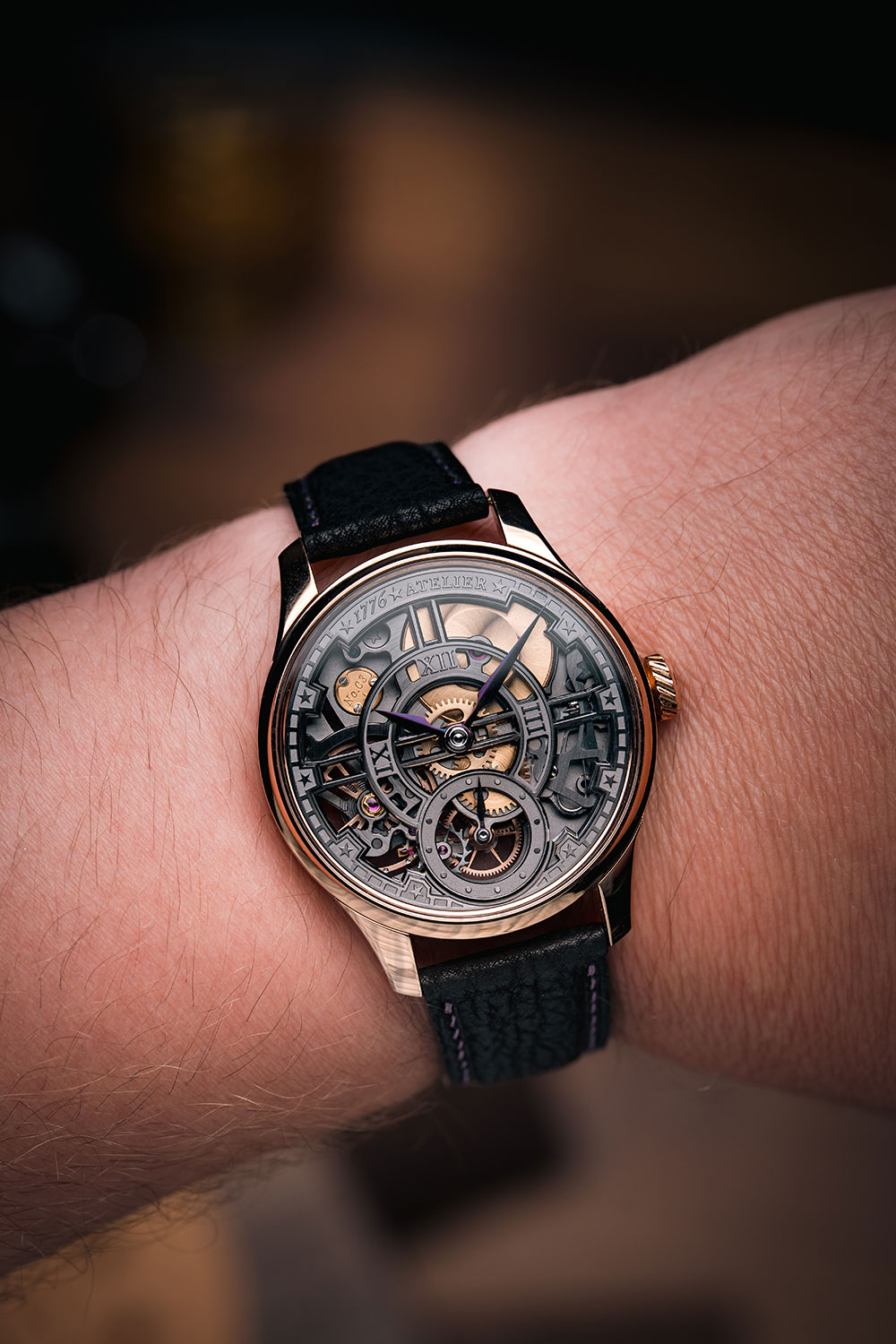
There is no solid dial. What sits under the front sapphire is a layered two-piece openworked construction, scalloped, finished in black rhodium and carrying Roman numerals and star-shaped markers, through which the movement is fully visible. It contributes 62 hand-finished internal angles of its own.
The movement adds considerably more. The brand's technical sheet puts the openworked architecture at 222 hand-finished internal angles, though the launch text cites 224; either way 1776 Atelier quotes more than 200 hours of hand craftsmanship per watch.
The techniques listed are hand anglage on all edges, black polishing, solarisation grinding, hand engraving, thermal colouring and hand-finished steelwork, with Geneva stripes and media-blasted surfaces on the reverse. The hands are made in two pieces and are shaped, fitted, polished, riveted and thermally coloured to a plum tone by hand. The screw heads are chamfered and thermally coloured to match. All of it is done on American soil, which is the entire point of the exercise.
The case, and the box
The case is the one component that crosses the Atlantic. It is 18k rose gold, 41mm across, 10.2mm thick and 49.5mm lug to lug, manufactured by RP Uhrgehäuse in Germany to 1776 Atelier's specifications. Polished on top, brushed on the flanks, concave bezel, sapphire on both sides, 50m of water resistance. Outsourcing the case to a German specialist while insisting on domestic movement production is a defensible division of labour for a workshop this size, though it does slightly complicate the made-in-America framing.
Each of the 25 watches ships in a handmade wooden presentation box built by an artisan woodworker in Arizona. Set into every box is a piece of authenticated wood from a beam originally installed in Independence Hall in 1735, which is a better anniversary gesture than another red-white-and-blue dial would have been.
Price and availability
The Liberty 250 is limited to 25 pieces at USD 44,000 excluding taxes, sold direct through 1776atelier.com or through authorised retailers. That is real money, and it puts the watch in a bracket where the buyer is paying for hours of hand work rather than for a complication. Whether 222 angles and 200 hours justify the number is a judgment each collector makes for themselves. What is not in dispute is that a workshop in Texas and Ohio is now producing finishing work that has to be assessed on the same terms as the Swiss and German independents, and that was not true of American watchmaking ten years ago.