Cutting a watch case from sapphire is a materials problem before it is a design one. Sapphire sits just below diamond on the hardness scale, which makes it punishing to machine and unforgiving of a mistake. Hublot started doing it at scale in 2016 with the first sapphire Big Bang, followed it with the orange version in 2021, and has since produced enough of them that the exercise has stopped being a stunt and become a line. The Big Bang Sapphire Sky Blue, introduced on 10 July, is the newest entry, and it brings a colour rather than a mechanism.
The case
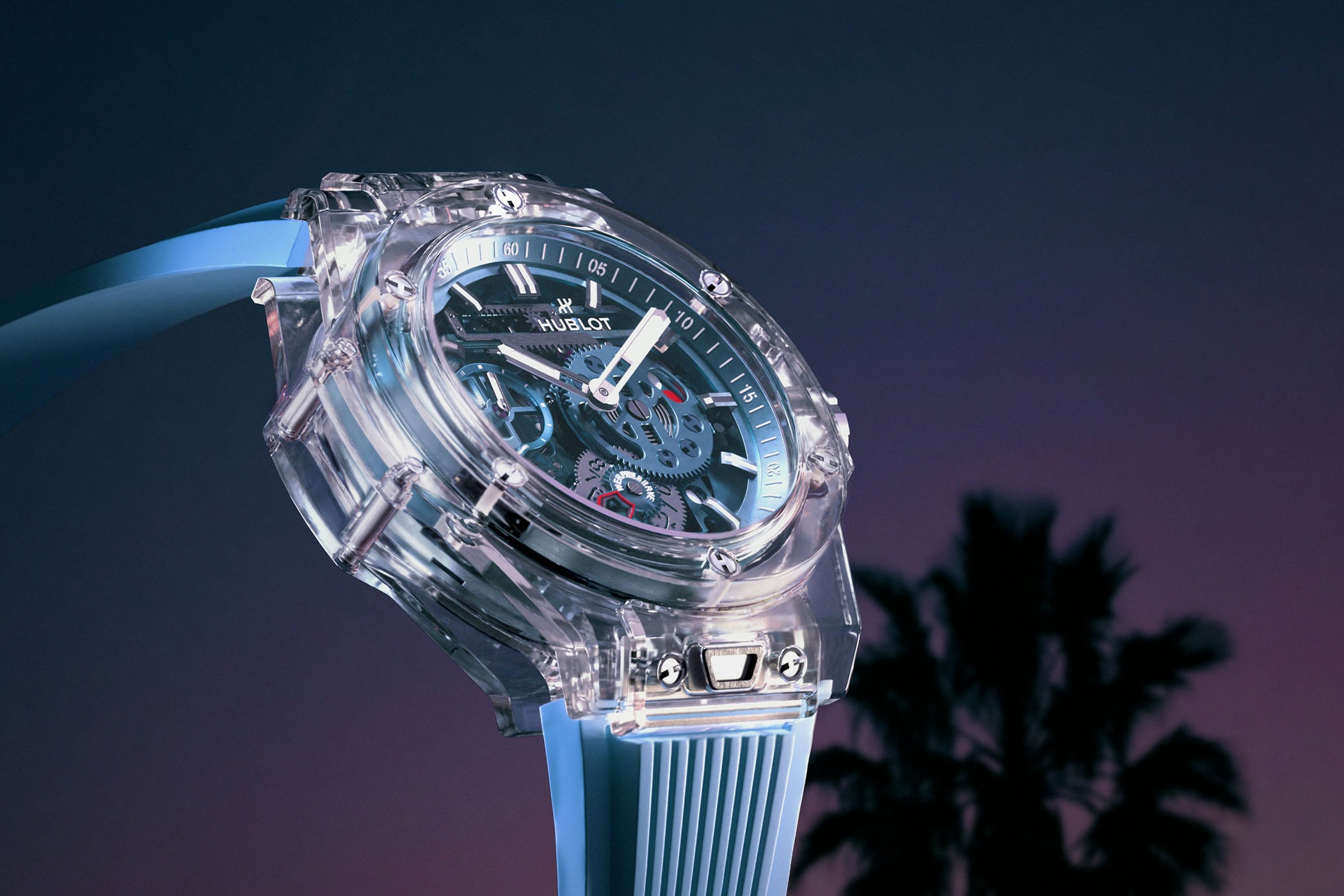
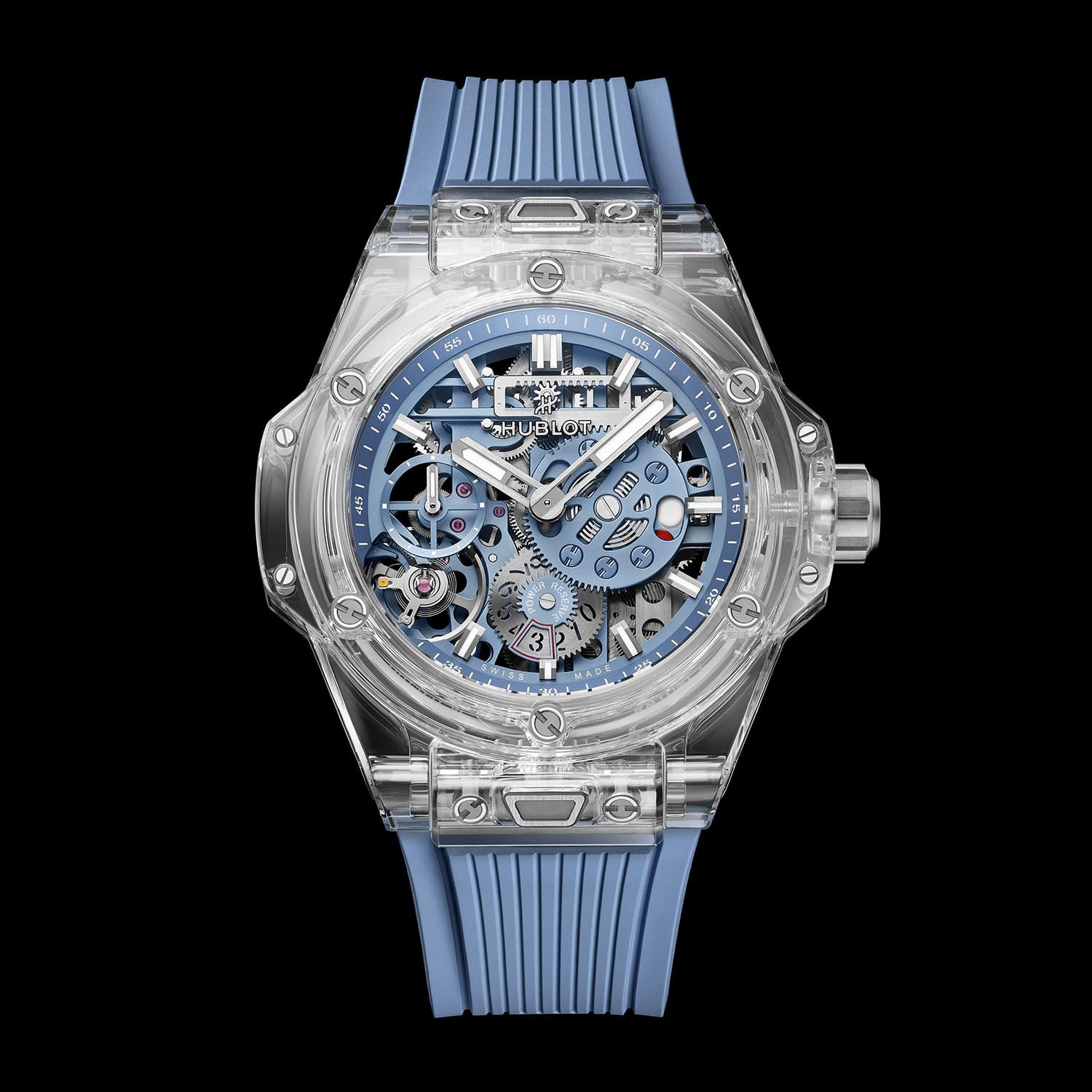
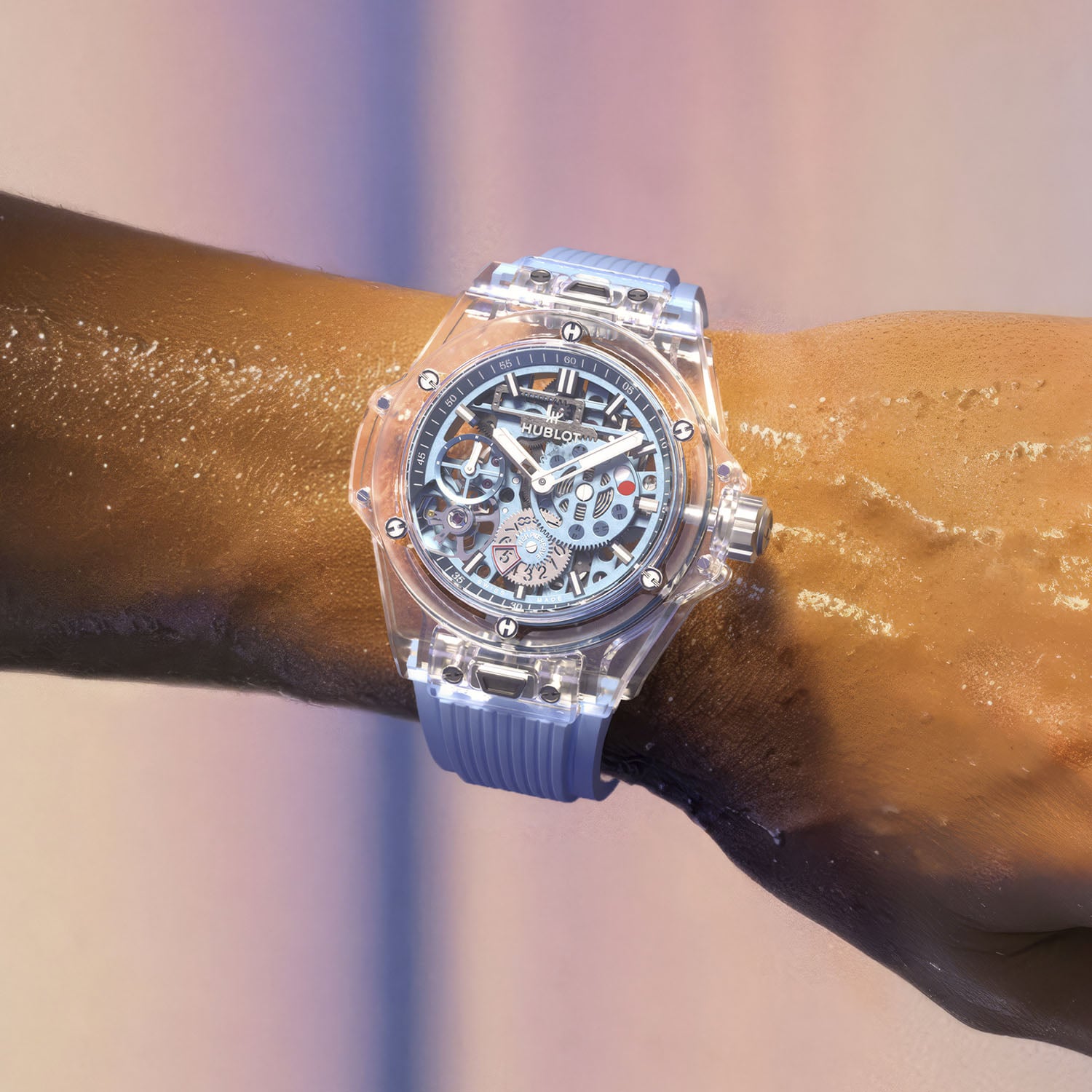
The reference is 424.JX.5120.RX. The case measures 44mm and is fully polished sapphire, as is the bezel, which is held down by Hublot's six H-shaped titanium screws. Both crystals are treated with anti-reflective coating, front and back. Water resistance is 50m, which is the number a sapphire case tends to arrive at, and the strap is fitted with the One-Click quick-change system.
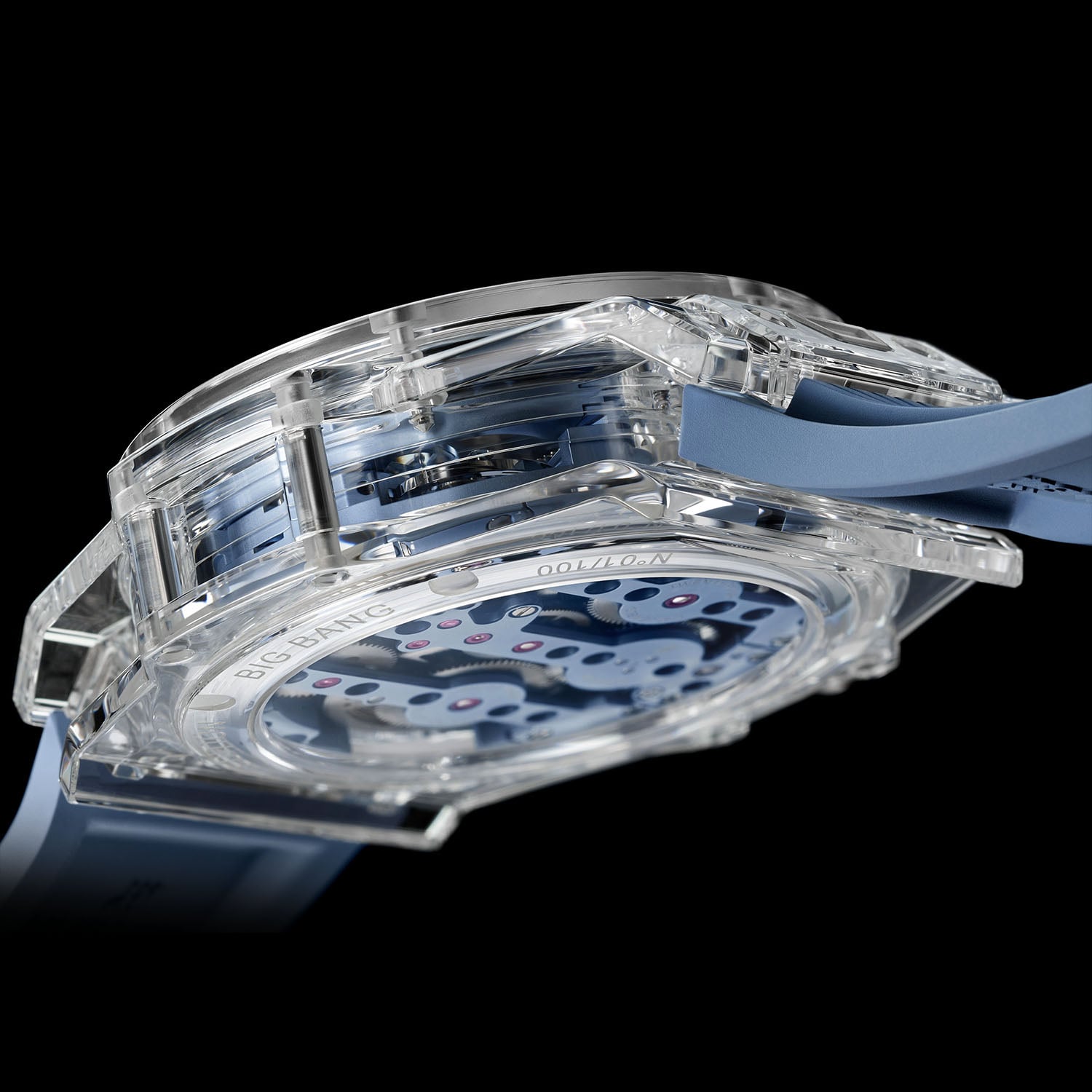
The Big Bang was always a sandwich construction, layers stacked and bolted rather than a single carved block, and that is precisely why it survives translation into sapphire better than most cases would. The architecture was already legible as a set of separate components. Making those components transparent exposes the logic rather than obscuring it.
The dial and the display
The dial is a matte sky-blue skeleton, and the movement bridges are finished to match, which is the actual design decision here. Against the colourless sapphire case, the blue architecture reads as a suspended object rather than a dial with a case around it. Running seconds sit at 9 o'clock. The power reserve indication is at 6 o'clock, and a second indicator at 3 o'clock shows a red field when the movement is down to its final two days.
The Meca-10
The calibre is the HUB1201, the manual-wind Meca-10 that debuted in 2016 in the original 44mm Big Bang Meca-10. It runs 223 components at 21,600vph with 24 jewels, and it is built around twin parallel mainspring barrels that deliver a 240-hour power reserve. Ten days from a hand-wound movement is the headline figure, and it is a real one.
The mechanism behind the display is the reason the calibre has a following. A rack-and-pinion arrangement drives two sliding racks along the 9 to 3 o'clock axis, producing the dual power-reserve indication that gives the Meca-10 its Meccano-set look. The whole thing is skeletonised so that the mechanics are the design, and it is visible through the sapphire caseback as well as the front, which in a fully transparent case means visible from essentially every angle.
Price and availability
The Big Bang Sapphire Sky Blue is limited to 100 pieces at EUR 82,700, which is CHF 70,000 or USD 84,300. It is sold at selected Hublot points of sale and online at hublot.com.
The price is what it is: sapphire case machining is expensive, and the mechanism inside it is a decade old rather than newly developed. What the buyer is paying for is the case and the colour, and Hublot is one of very few manufacturers that can reliably deliver both at this size. That has been the Big Bang Sapphire proposition since 2016. Sky Blue does not change it, it just makes it seasonal.