Hamilton counts more than 500 film and television appearances, and its partnership with Christopher Nolan has produced three watches that were also props: the Khaki Field Murph for Interstellar in 2014, the Khaki Navy BeLOWZERO for Tenet in 2020, and the pieces made around Oppenheimer in 2023. In each case the watch existed on screen first and in the catalogue second.
The Khaki Field Automatic The Odyssey, introduced on 1 July, can't do that. Nolan's adaptation of Homer, shot on IMAX and released on 17 July, is set in the Bronze Age. There is no wrist in that film for a wristwatch to sit on. So the collaboration inverts. Rather than a prop that later becomes a product, this is a product built out of the film's iconography, with nothing on screen to anchor it.
That's a harder brief than it sounds, and it's worth judging the watch on whether the details survive it.
The case is the argument
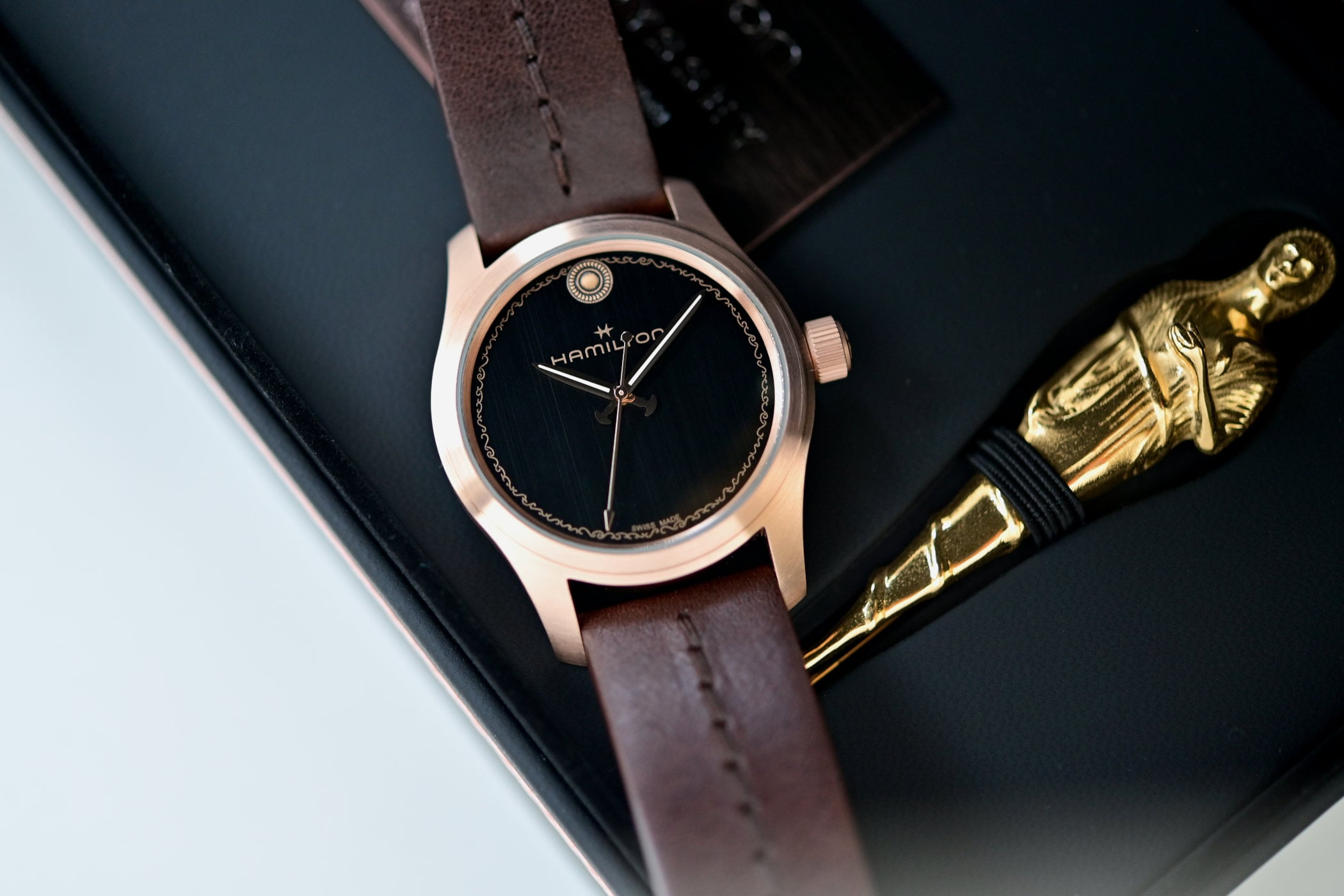
Bronze is the obvious material and, for once, the obvious choice is the defensible one. The film is set in an age named for the alloy, the armour and weapons in it are bronze, and the metal patinates, so the watch changes with wear rather than staying fixed.
The case is 42mm across and 10.9mm thick, circular brushed, with a domed sapphire crystal and double anti-reflective coating. Water resistance is 100m. The caseback is titanium rather than bronze, and it's engraved with Odysseus' helmet, the wording HAMILTON X THE ODYSSEY, IN COLLABORATION WITH, Christopher Nolan's signature, and LIMITED EDITION 2112 PIECES.
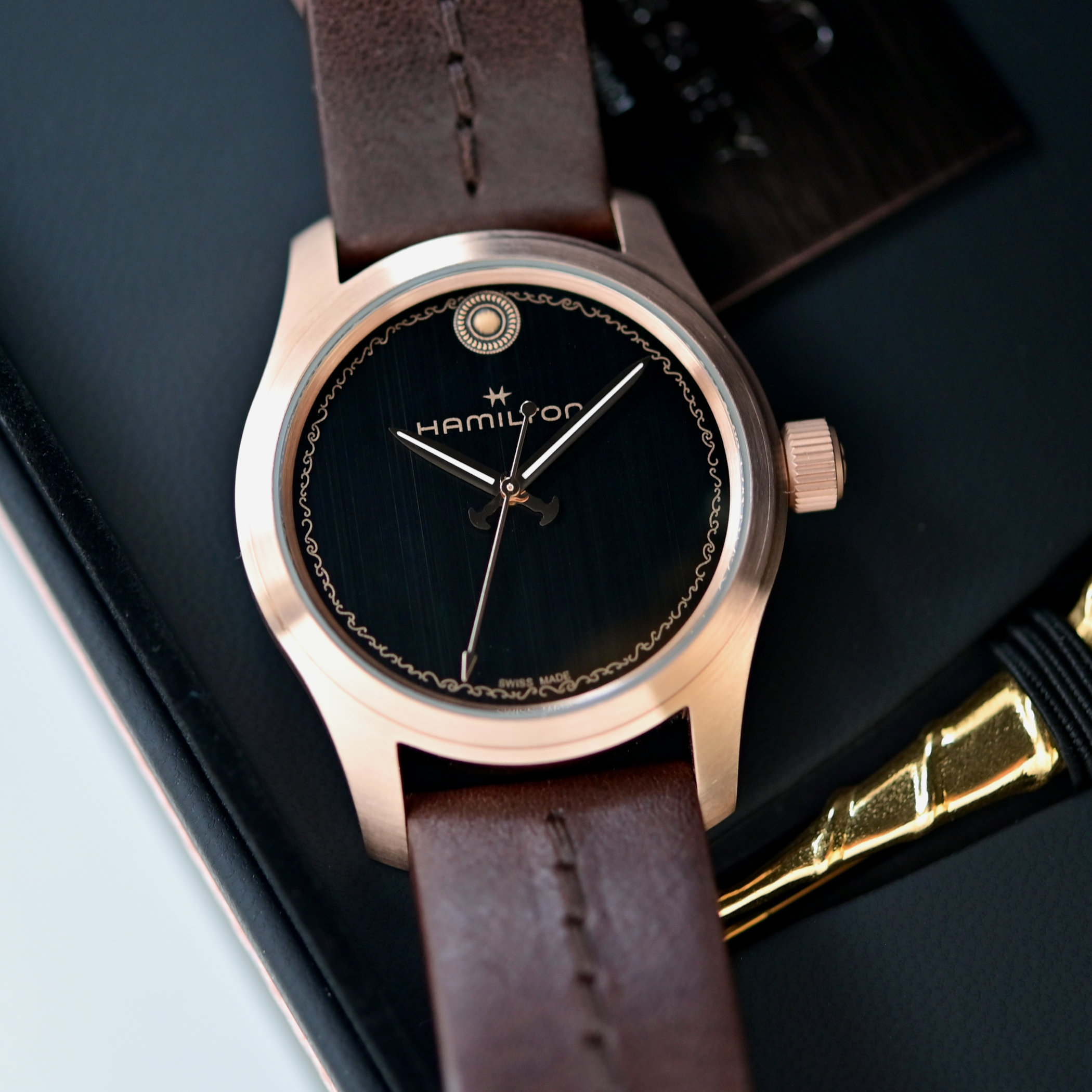
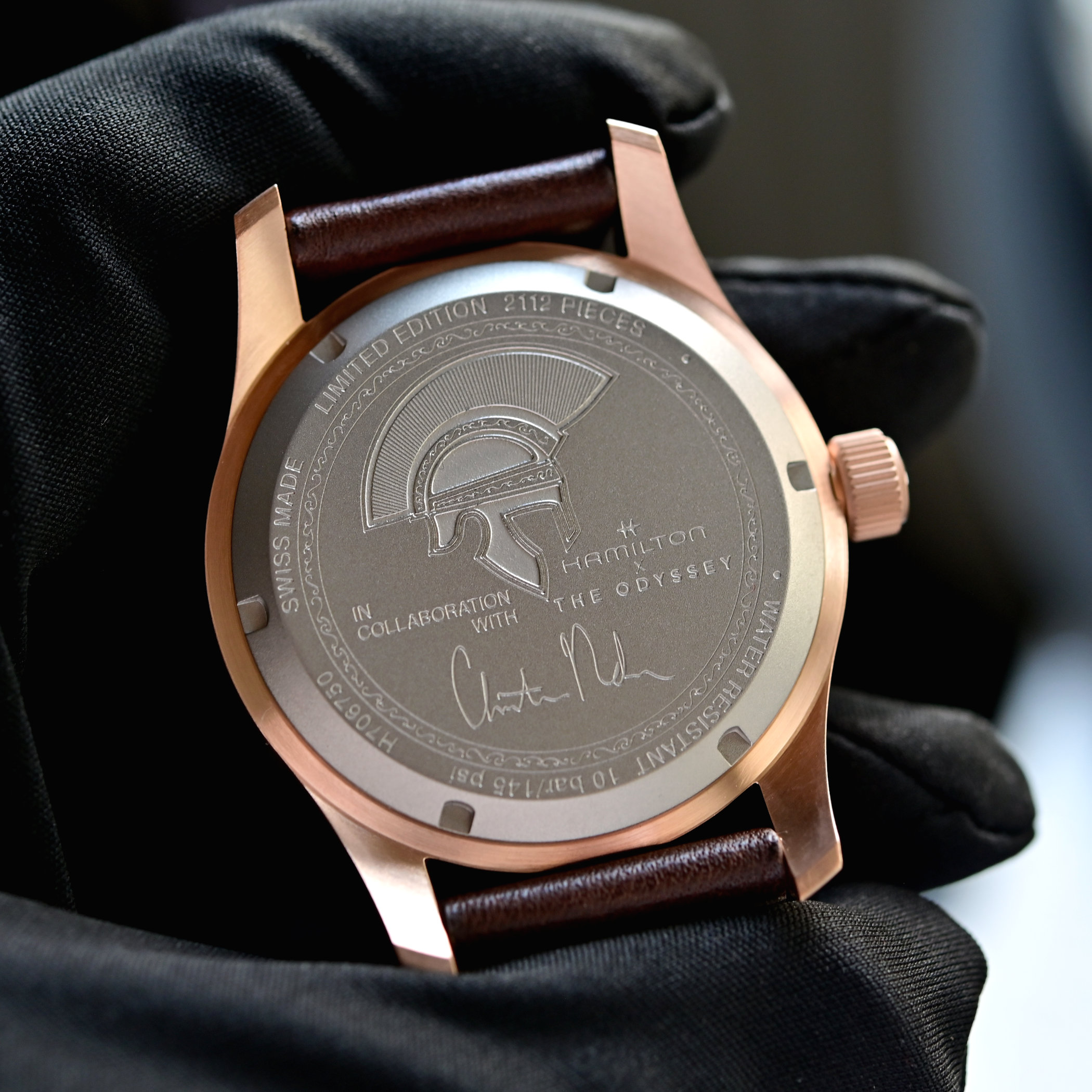
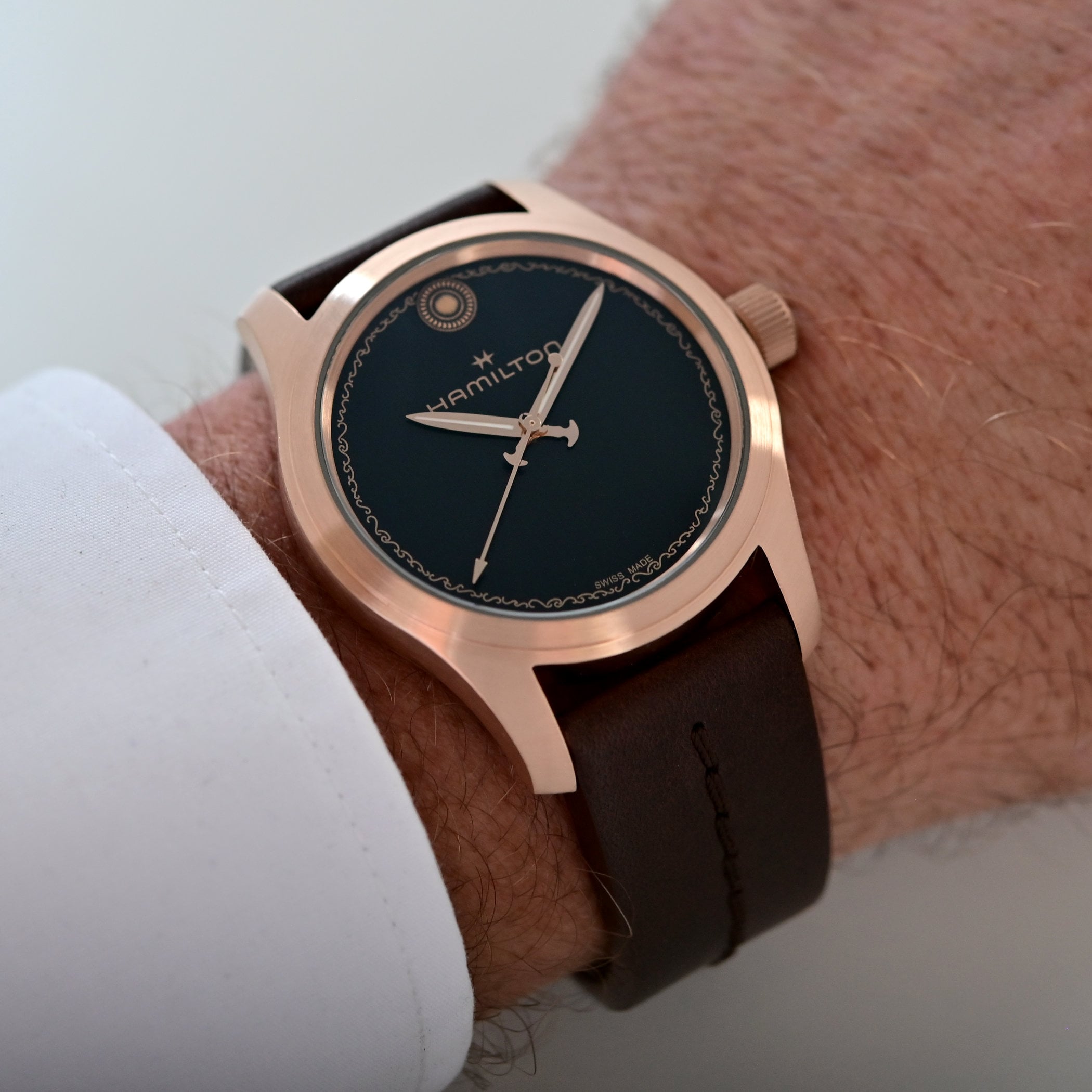
A dial with no hour markers
The black dial is vertically brushed, and the texture is taken from the pattern on Odysseus' helmet. Around the outer edge runs an engraved frieze, a running wave. The hour and minute hands are bronze-coloured and shaped like swords. The central seconds hand is a spear.
The most interesting decision is a subtraction. Hour markers appear in the pre-production sketches and didn't make it onto the finished dial. What survives is a single applied marker at 12 o'clock, modelled on a rivet from the sword's scabbard, and the frieze. The result is a field watch, a genre defined by legibility, with almost nothing to read the time against. Super-LumiNova Grade X1 on the hands keeps it usable in the dark, but the dial is decoration first and instrument second. Whether that's a betrayal of the Khaki Field or an honest admission of what this watch is for depends on how much you were ever going to navigate by it.
The movement is the safe part
Inside is Hamilton's H-10, based on the ETA C07.611, the calibre most people know as the Powermatic 80. It carries a Nivachron balance spring for magnetic and thermal resistance, runs at 21,600vph, and stores 80 hours. It's the same engine as in the standard Khaki Field Automatic, and there's no argument for changing it. The money here is in the case and the dial.
The strap is brown grained leather with prominent central stitching, on a titanium pin buckle, 22mm at the lug.
2,112
Twelve recurs throughout the poem. It runs to roughly 12,000 lines, twelve ships sailed for Troy, and Odysseus proves his identity by firing an arrow through twelve axe heads. Hamilton hasn't explained how 2,112 falls out of that, so the number is suggestive rather than derived, and it's worth saying so. Each owner also receives a replica of Athena's pin, the talisman Penelope gives Odysseus in the film, in a dedicated box.
Price hasn't been confirmed, which is unusual for a Hamilton announcement and is the one genuine gap in the release. Bronze, a titanium caseback and a limited run will place it above the standard Khaki Field Automatic, but by how much is currently unknown.
Details at hamiltonwatch.com.