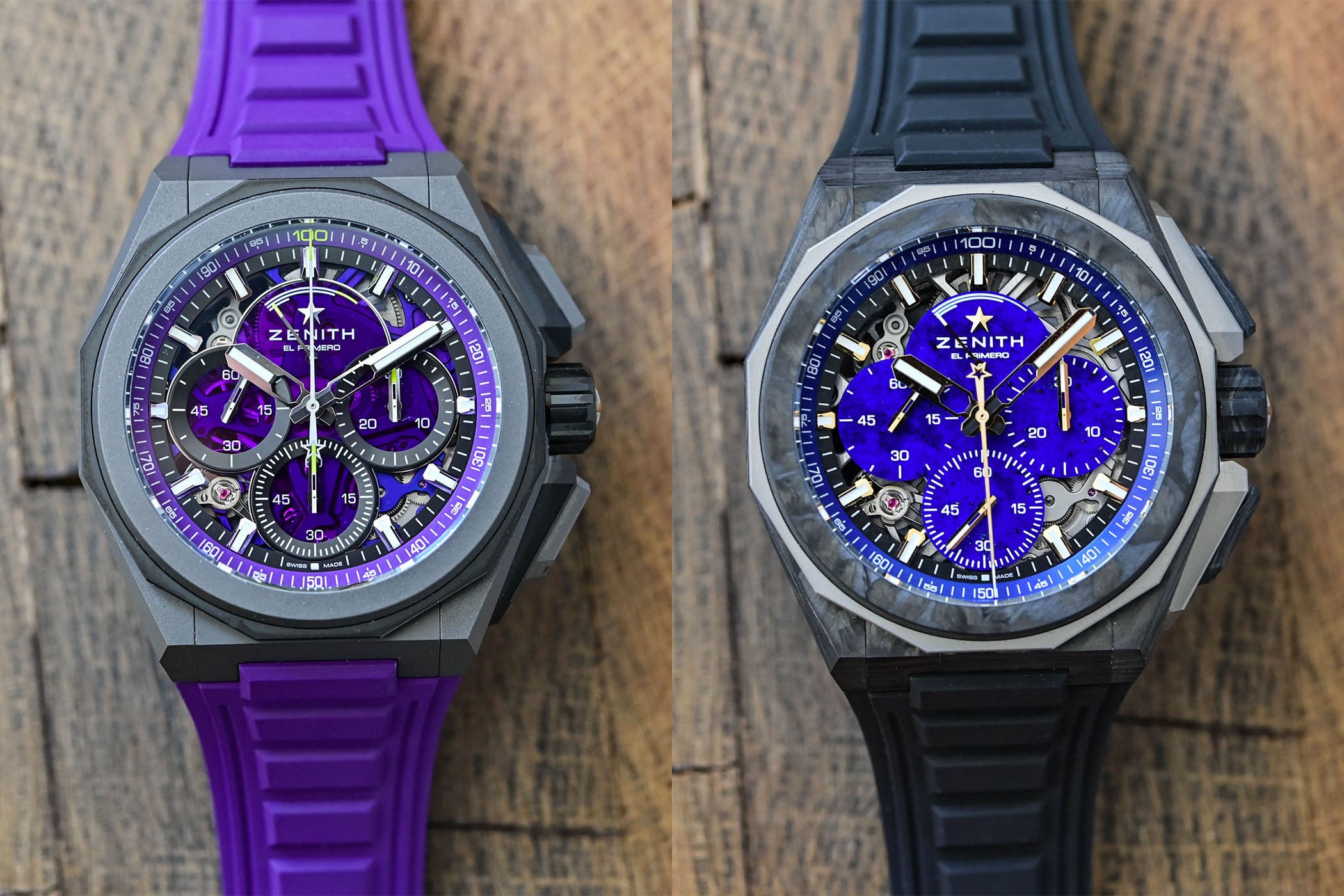
The Defy Extreme is the loudest watch Zenith makes. It takes the El Primero, the high-frequency automatic chronograph the brand introduced in 1969, and sets it inside a 45mm case of stacked angular surfaces with the movement left open to view. The signature is the central chronograph hand, which sweeps a full rotation every second rather than every minute. Zenith has run the platform through a long line of themed editions, from the Pantone and Chroma colourways to the Glacier, Desert and Jungle. The two newest, covered in Monochrome's first look, continue that approach: the Defy Extreme Lapis Lazuli II and the Defy Extreme Ultraviolet.
Two ways to dress the same case
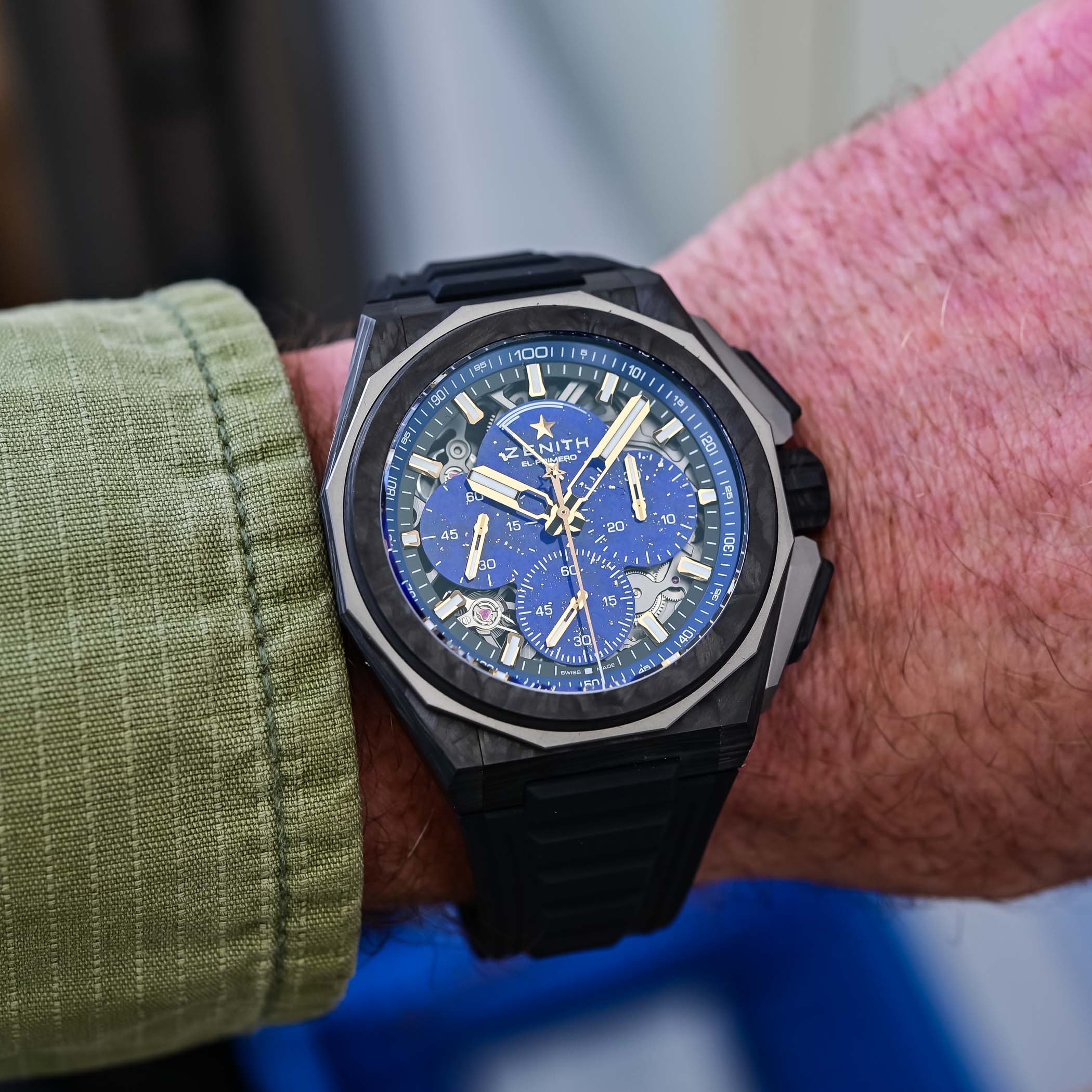
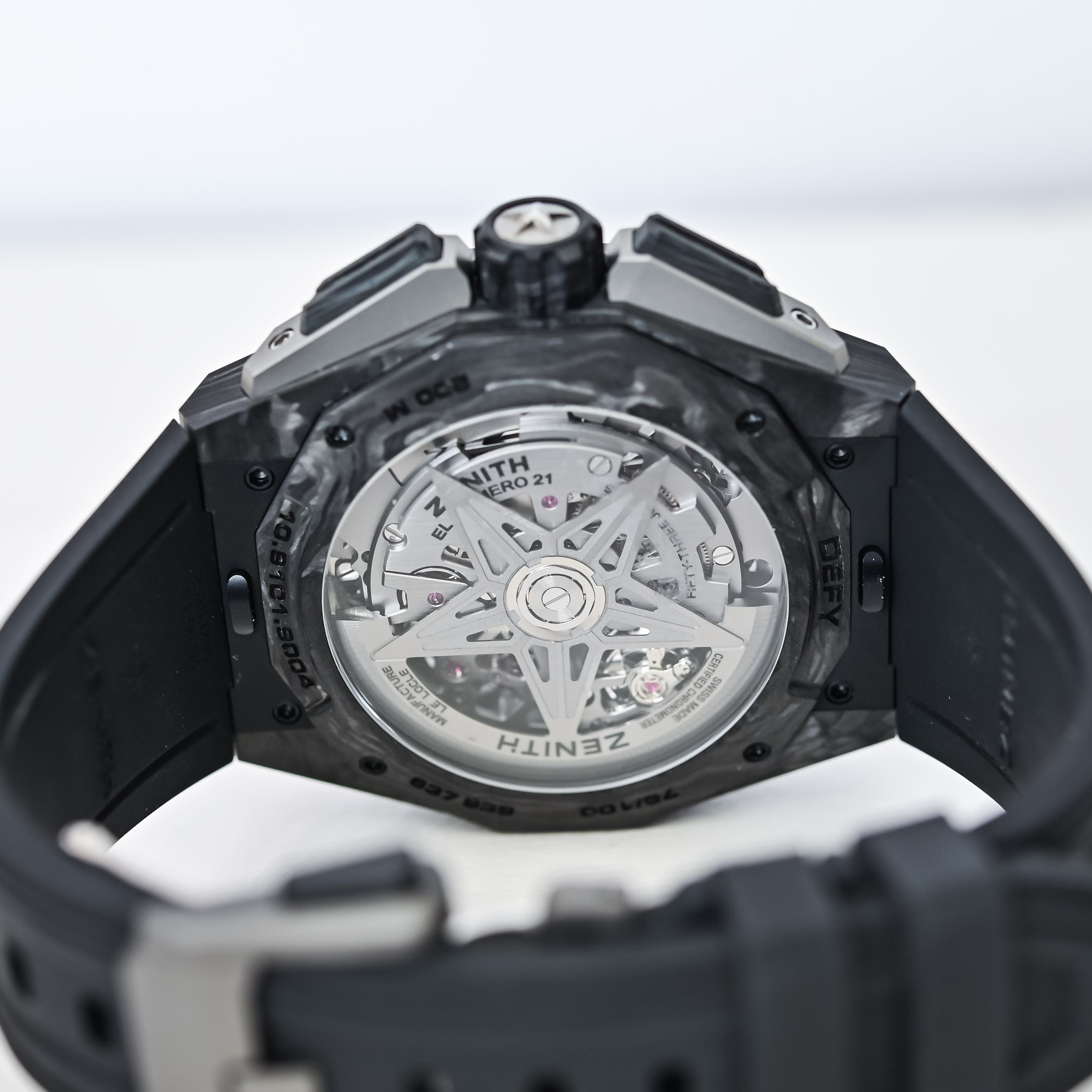
The Lapis Lazuli II follows the steel and yellow-gold Lapis Lazuli that closed out last year. The 45mm case now pairs forged carbon with titanium, 15.4mm thick and 51mm from lug to lug, water resistant to 200 metres. The matte carbon takes the weight down and kills the reflections off the angular case. Its openworked dial carries chronograph counters cut from lapis lazuli, the blue stone shot through with natural pyrite, so the gold flecking falls differently on every example. Yellow gold-plated markers and faceted hands, filled with Super-LumiNova, sit above it. It is limited to 25 pieces.
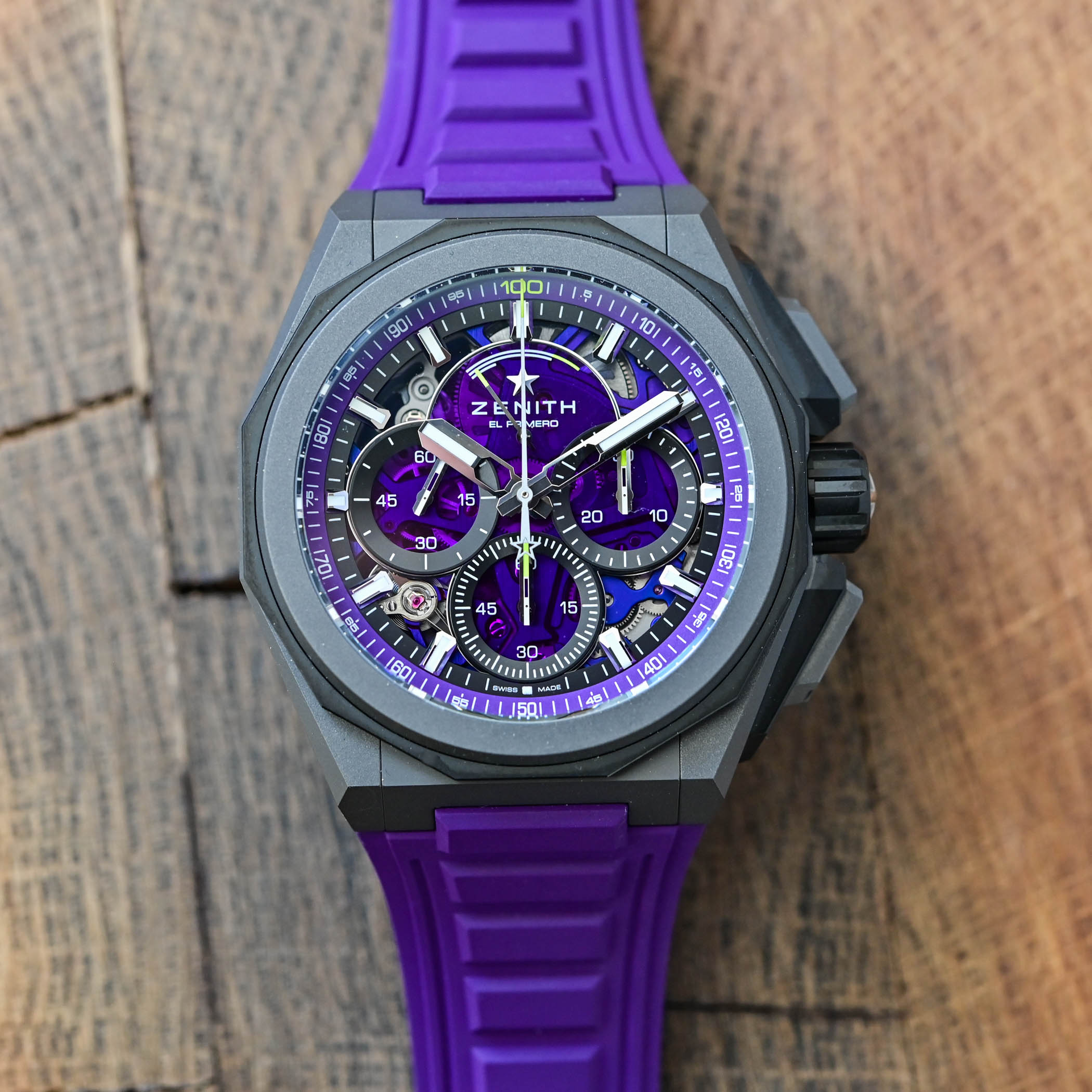
The Ultraviolet keeps the same dimensions but switches to dark grey microblasted titanium and trades the stone for a violet-tinted sapphire dial. The purple counters layer over the movement and leave part of it visible, a return to the idea behind the Defy 21 Ultraviolet of 2020, now inside the more aggressive Extreme case. The star-shaped rotor is finished to match. It is not limited.
What the movement is doing
Both dials read the same way. Hours and minutes run from the centre, small seconds sit at 9 o'clock, the chronograph's 30-minute counter at 3 and its 60-second counter at 6, with the power reserve at 12. The spectacle is that central chronograph hand.
It works because of the El Primero 9004 and its two escapements. One regulates timekeeping at Zenith's traditional 36,000 vibrations per hour, or 5Hz. A second, independent escapement drives the chronograph at 360,000 vibrations per hour, or 50Hz, which is what lets the watch measure to a hundredth of a second and sweep the central hand once around the dial every second. The movement holds 50 hours of running power reserve. The chronograph itself runs for about 50 minutes before it needs resetting.
Splitting timekeeping and timing across two escapements is the harder way to build a 1/100th chronograph, and it is the reason the Defy Extreme reads the way it does. The stone and sapphire dials are the surface. The 50Hz escapement underneath them is the actual argument.
Price and availability
The Defy Extreme Lapis Lazuli II is limited to 25 pieces at CHF 32,900, or EUR 36,800, on a black rubber strap with a second black Velcro strap. The Ultraviolet is a permanent-collection piece at CHF 17,900, or EUR 20,200, and ships with a violet rubber strap, a microblasted titanium bracelet and a black Velcro strap. Both use Zenith's interchangeable strap system. More detail is at zenith-watches.com.