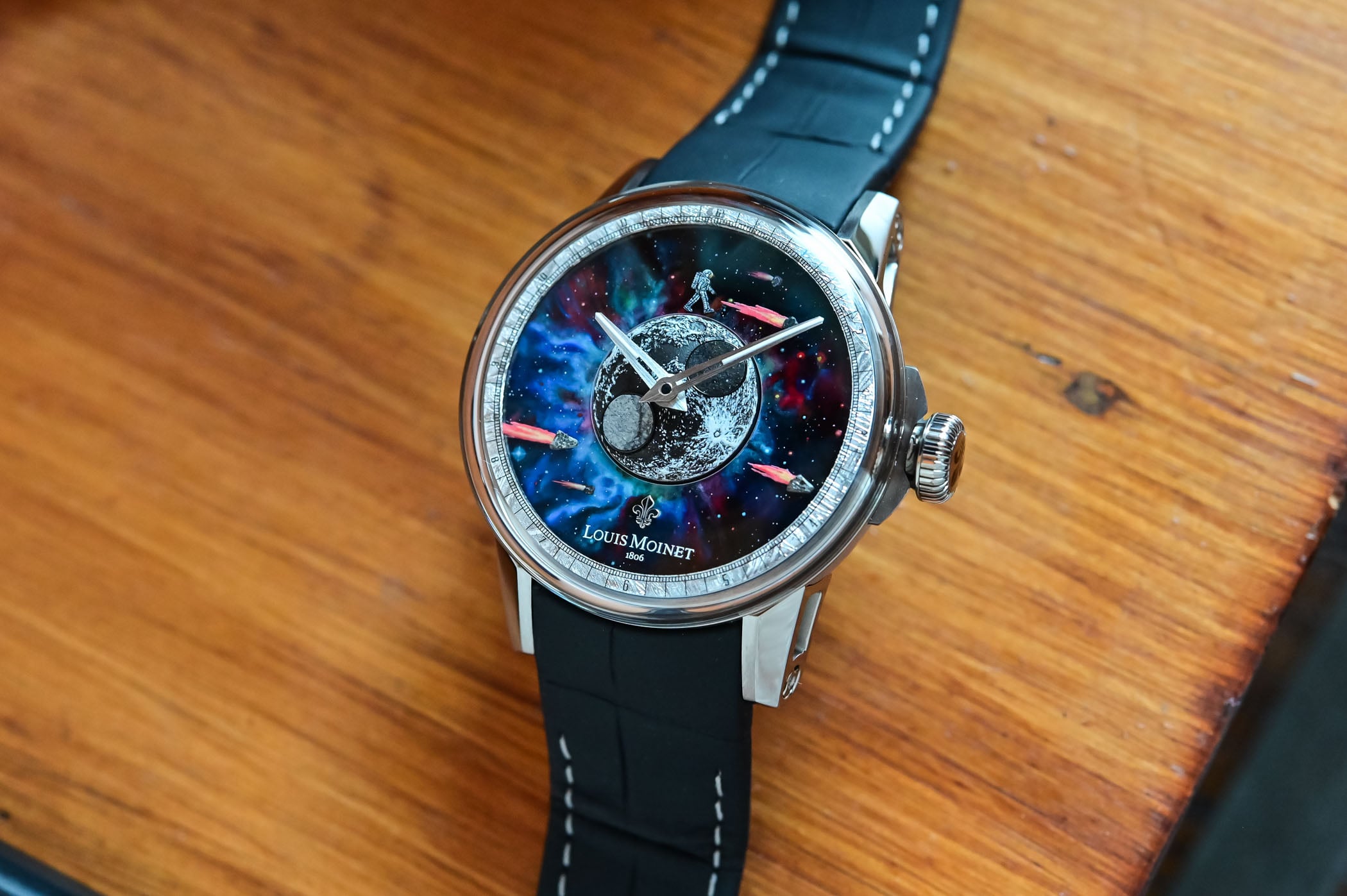
Astronomy runs through Louis Moinet's story. The historical Louis Moinet built the compteur de tierces in 1816, a high-frequency chronograph made to time celestial observations, and the modern brand has returned to space again and again, through the Super Moon, the Space One Chronograph and the Starman. The new Moon Meteor is the most literal reading of that theme yet. It puts a whole sky on the dial, painted by hand and built up from real meteorite, and it hides a second picture inside the first.
A dial you read twice
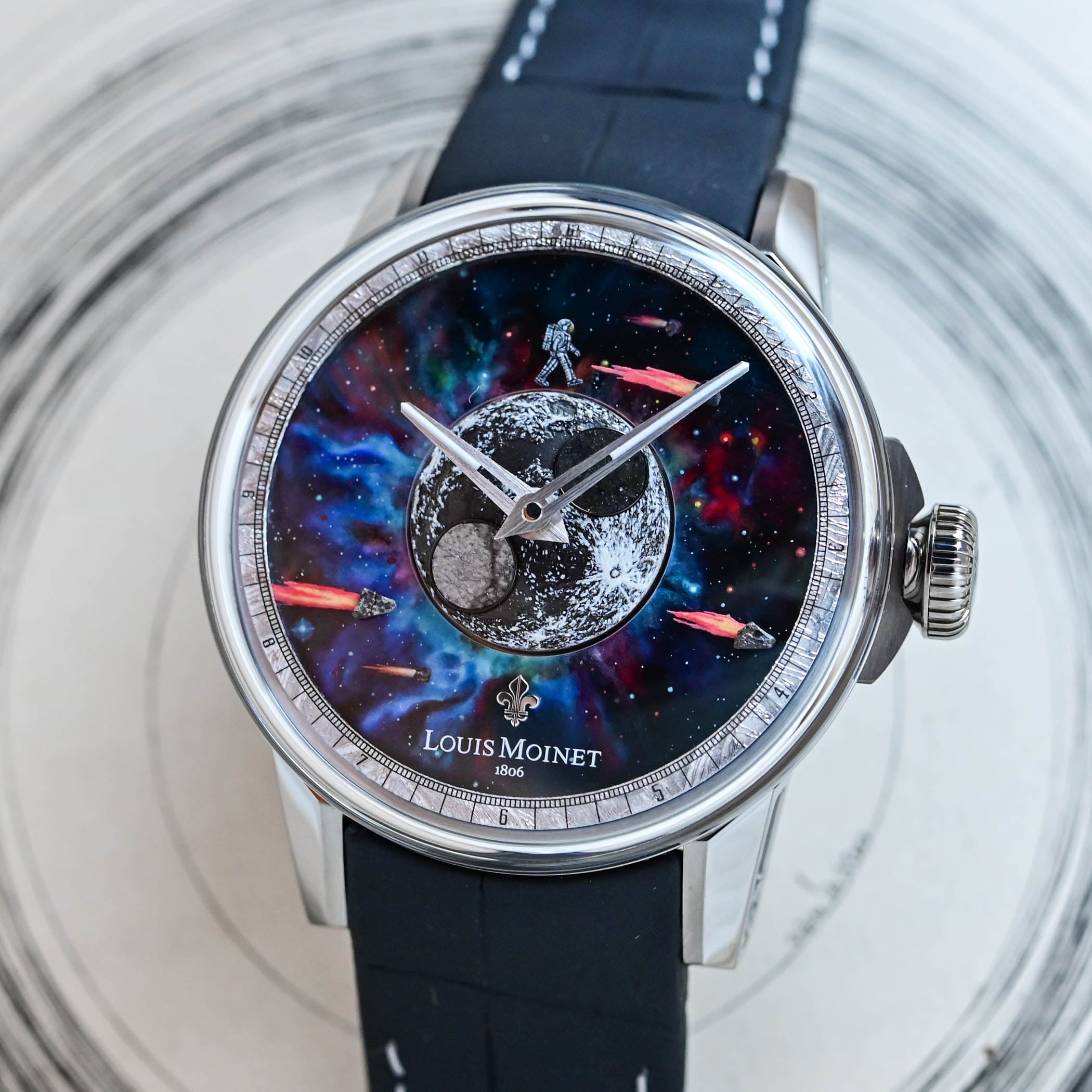
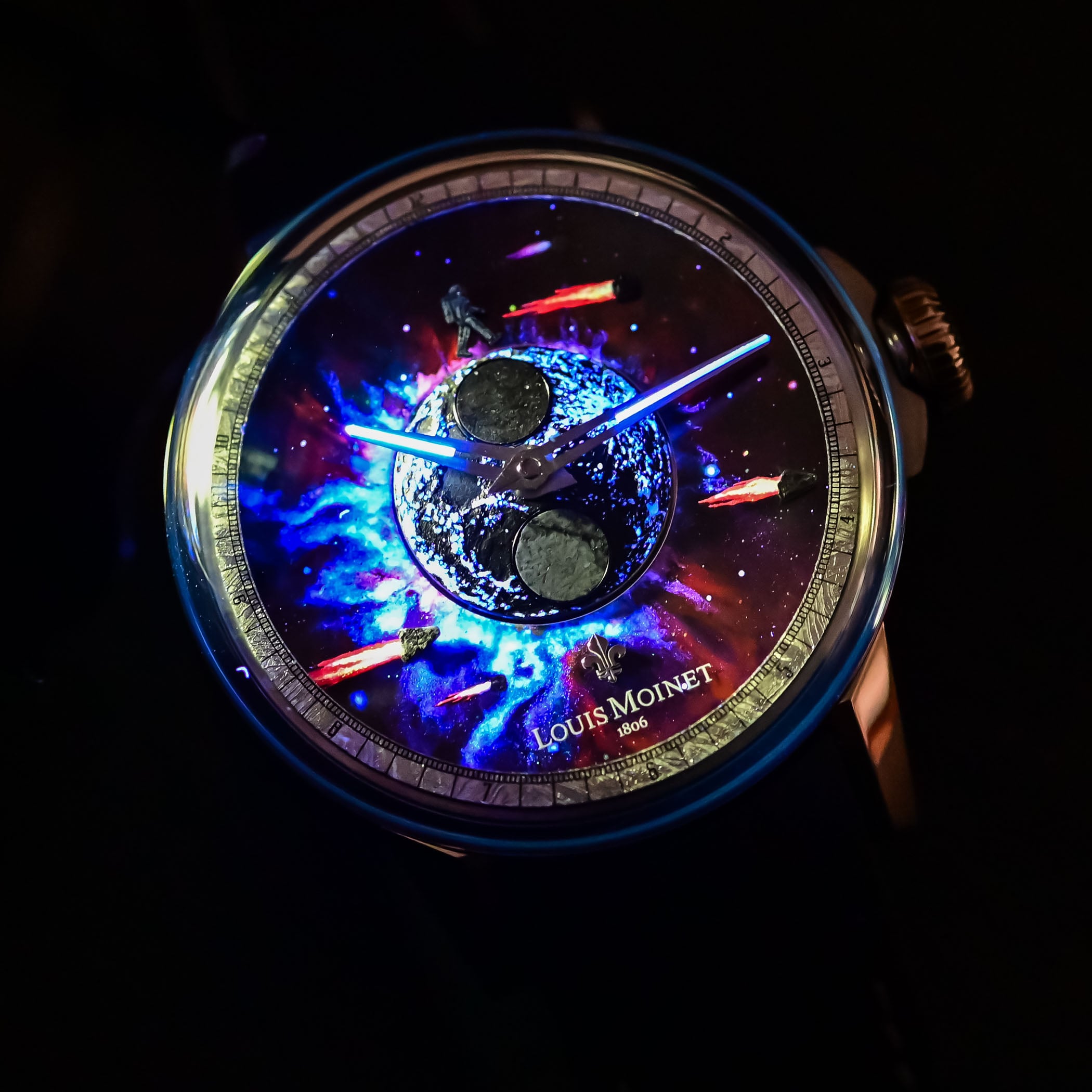
The dial is a miniature painting of a celestial landscape, worked under a binocular microscope with a very fine brush and successive layers of lacquer and varnish. Luminescent material is mixed into the paint, so the scene you see by day is not the scene you see in the dark. After light exposure, different elements glow and a second composition emerges. Time is shown by faceted, skeletonised luminescent hands, which keeps the reading legible against a busy background.
The materials are the point. Three meteorite fragments cross the painted space: a Martian meteorite catalogued NWA 13925, the Jbilet Winselwan carbonaceous chondrite, and Sahara 97093, an EH3 enstatite meteorite that contains microdiamonds of interstellar origin. The flange around the dial is cut from Muonionalusta meteorite and shows its Widmanstätten pattern, the crystalline lattice that only forms over millions of years of slow cooling in space.

The moon at the centre
At the centre of the dial sits a domed lunar disc, engraved and hand-painted to recreate the surface of the Moon crater by crater. Two lunar meteorites are set into it to mark the full and new moon, Gadamis 005 and Dhofar 457. A hand-painted astronaut, shown walking above the disc, acts as the reading index for the phase. The mechanism completes one lunar cycle with a stated accuracy of one day of drift every 122 years, which is far beyond a conventional moon phase and closer to the astronomical versions that only a handful of makers attempt.
Titanium and the LM113
The 40.7mm case is grade 5 titanium, polished and satin-finished, with openworked lugs and a large fluted crown. It is tall at 17.92mm, which the domed dial and lunar disc require, but titanium keeps the whole watch to 18 grams. A box-type sapphire crystal with anti-reflective treatment on both sides sits over the scene, and a display caseback shows the movement. Water resistance is a dress-watch 30 metres.
Inside is the LM113, a self-winding calibre developed with Concepto. It shows hours, minutes and the lunar cycle, runs at 28,800 vibrations per hour, and holds 48 hours of power. The movement measures 30.4mm across and 12.7mm thick and carries 29 jewels. It is a supporting act here, and the brand treats it that way, putting the display and the materials first.
Price and availability
The Moon Meteor comes on a Louisiana alligator strap with a triple-folding clasp and fine adjustment, closed with the Louis Moinet fleur-de-lys. It is a limited edition of 12 pieces, each engraved One of Twelve, priced at CHF 48,000. It is a lot of watch for the money in the literal sense, dense with rare rock and hand-work, and it is aimed at the collector who wants an object that does something when the lights go out rather than a watch to check the time on.
Sources: Monochrome Watches and Louis Moinet.