Urwerk's UR-100 has been the brand's most approachable watch since it arrived in 2019, where approachable means wearable rather than cheap. It takes the satellite wandering-hours display that Urwerk is known for and folds it into a case that behaves itself on the wrist. The new UR-100V Lightspeed Ceramic keeps that wearability and adds two things: a case material Urwerk developed in-house, and a dial that has stopped measuring distance and started measuring time itself. Monochrome published a hands-on on 5 August 2026, with full specifications and pricing.
A ceramic Urwerk made itself
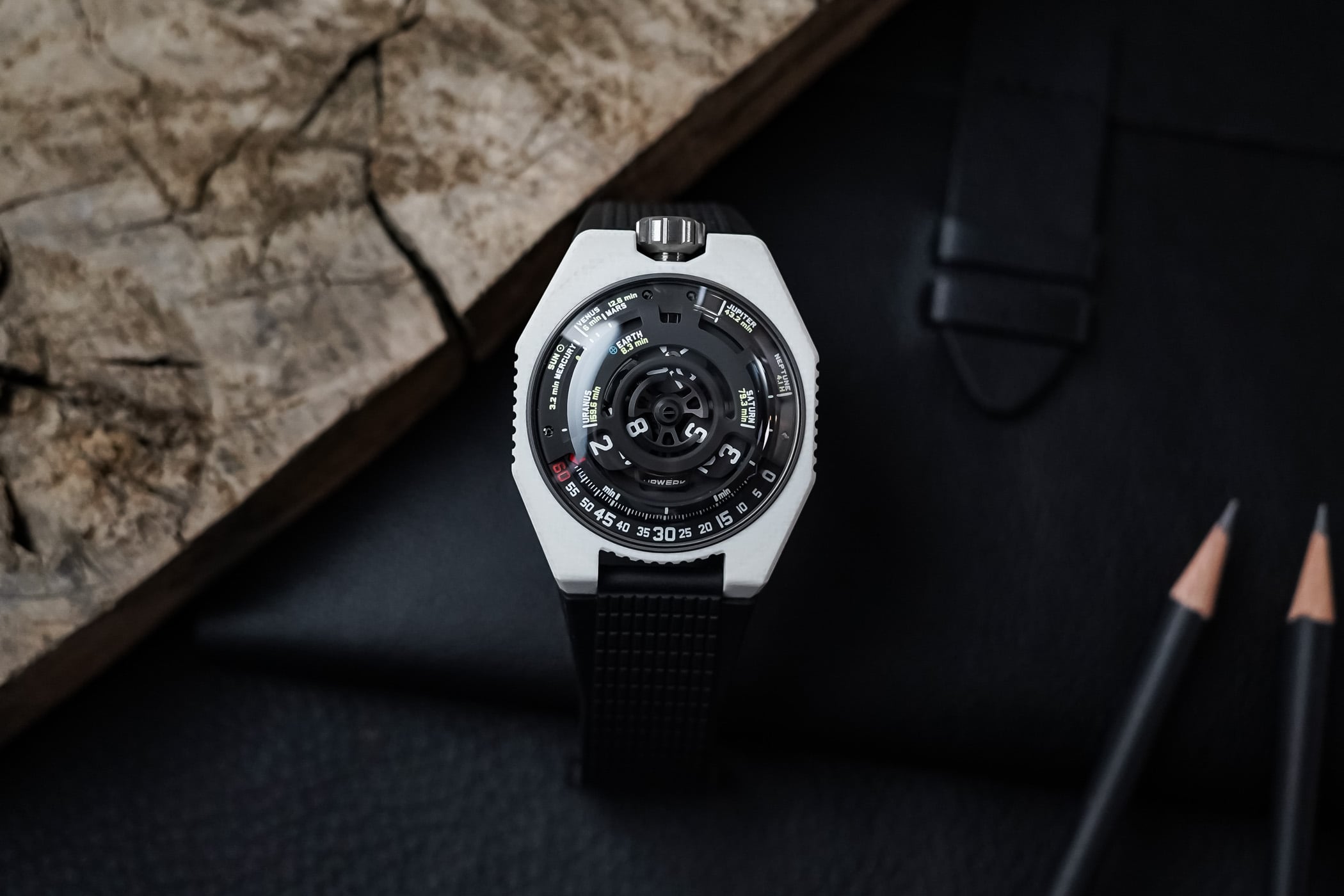
Ordinary ceramic is very hard and fairly brittle, and Urwerk did not want the second half of that trade. So it built its own composite instead, layering glass and carbon fibre inside a white polymer matrix reinforced with ceramic. The result is a material that keeps ceramic's scratch resistance but is less likely to shatter under a hard knock. It also looks unusual. Depending on the light it shifts between glossy and matte white, with faint silver-grey striations running under the surface where the reinforcing layers sit, so the case reads as almost organic rather than clinical.
The familiar asymmetric UR-100 case is unchanged in shape, measuring 43mm wide, 51.73mm long and 14.55mm thick. Those numbers suggest a slab, but the curved profile, integrated rubber strap and crown at 12 o'clock keep it wearing better than the spec sheet implies. The caseback is DLC-treated grade 5 titanium, there are sapphire crystals front and back, the screw-down crown sits at noon, and water resistance is a sensible 50 metres.
Reading the speed of light
Time is still told by three rotating satellite cubes, each carrying an hour numeral that travels a 120-degree, 60-minute arc across the scale at 6 o'clock before handing off to the next. That part is pure UR-100. What has changed is the outer track. Earlier SpaceTime models used it to show how far the Earth had travelled on its axis and around the Sun. The Lightspeed drops the terrestrial readouts and replaces them with something stranger: a small blue and green hand, fixed to one of the carousel arms, completes a full turn every three hours and points in turn to each of the eight planets, with the number of minutes sunlight needs to reach each one printed alongside. Earth reads 8.3 minutes.
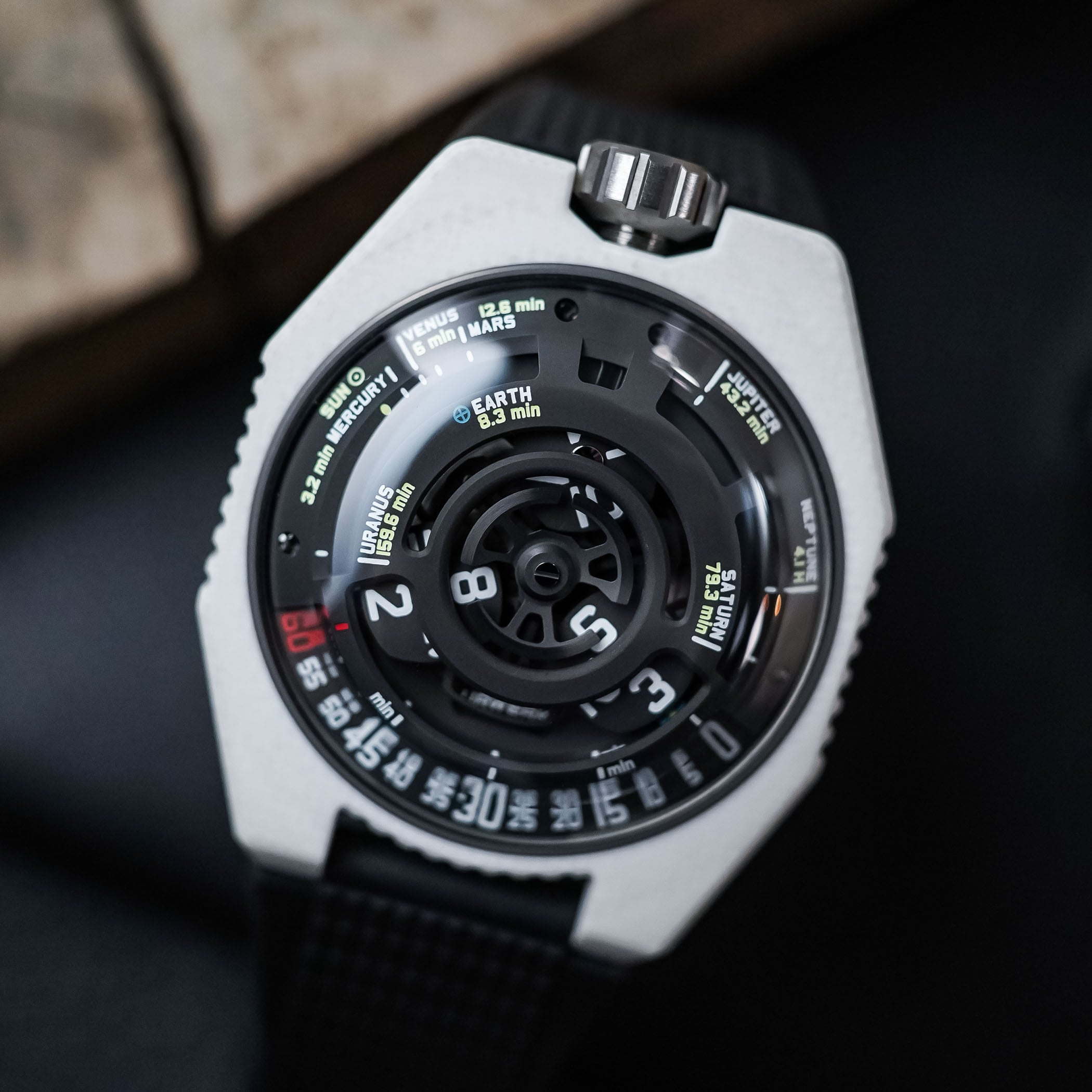
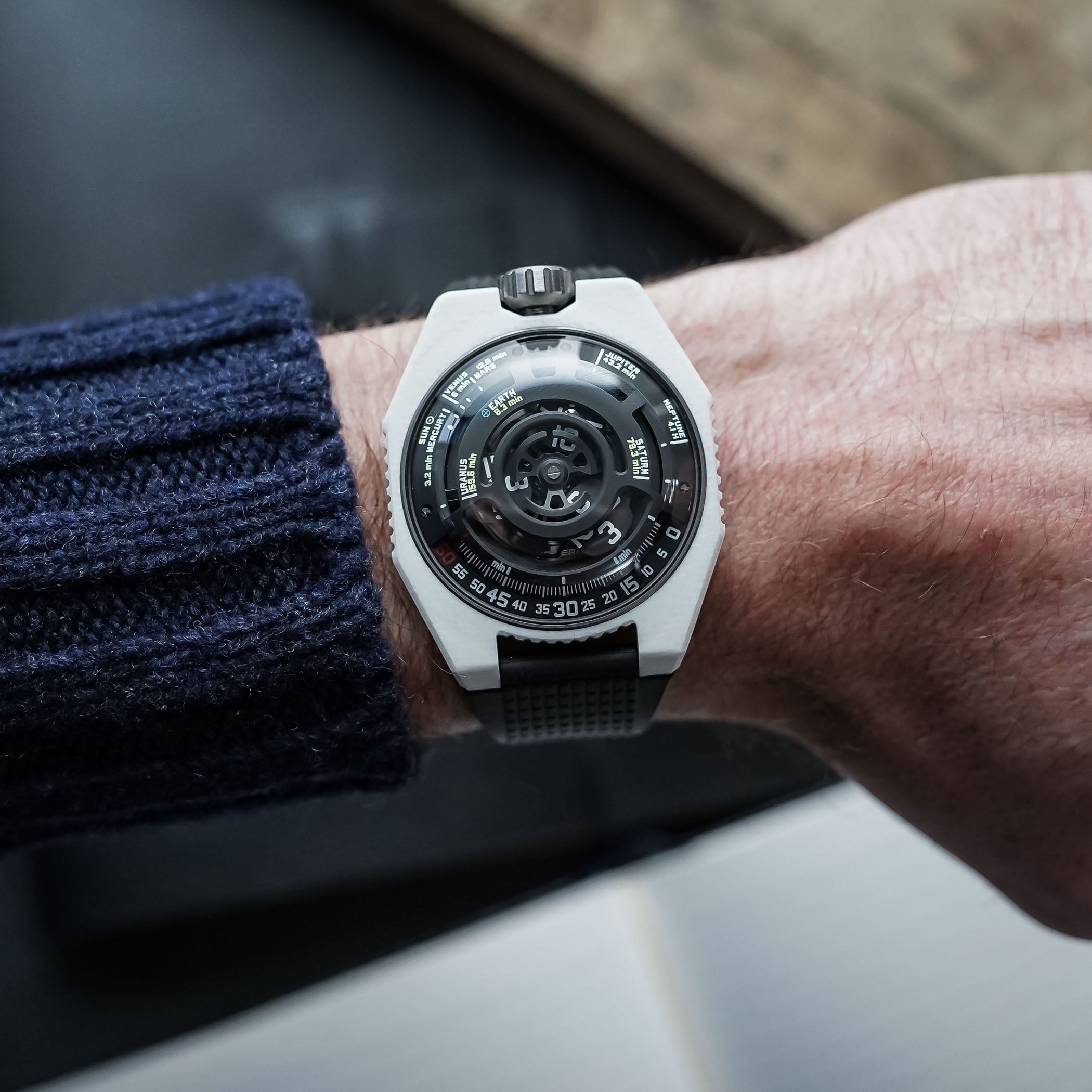
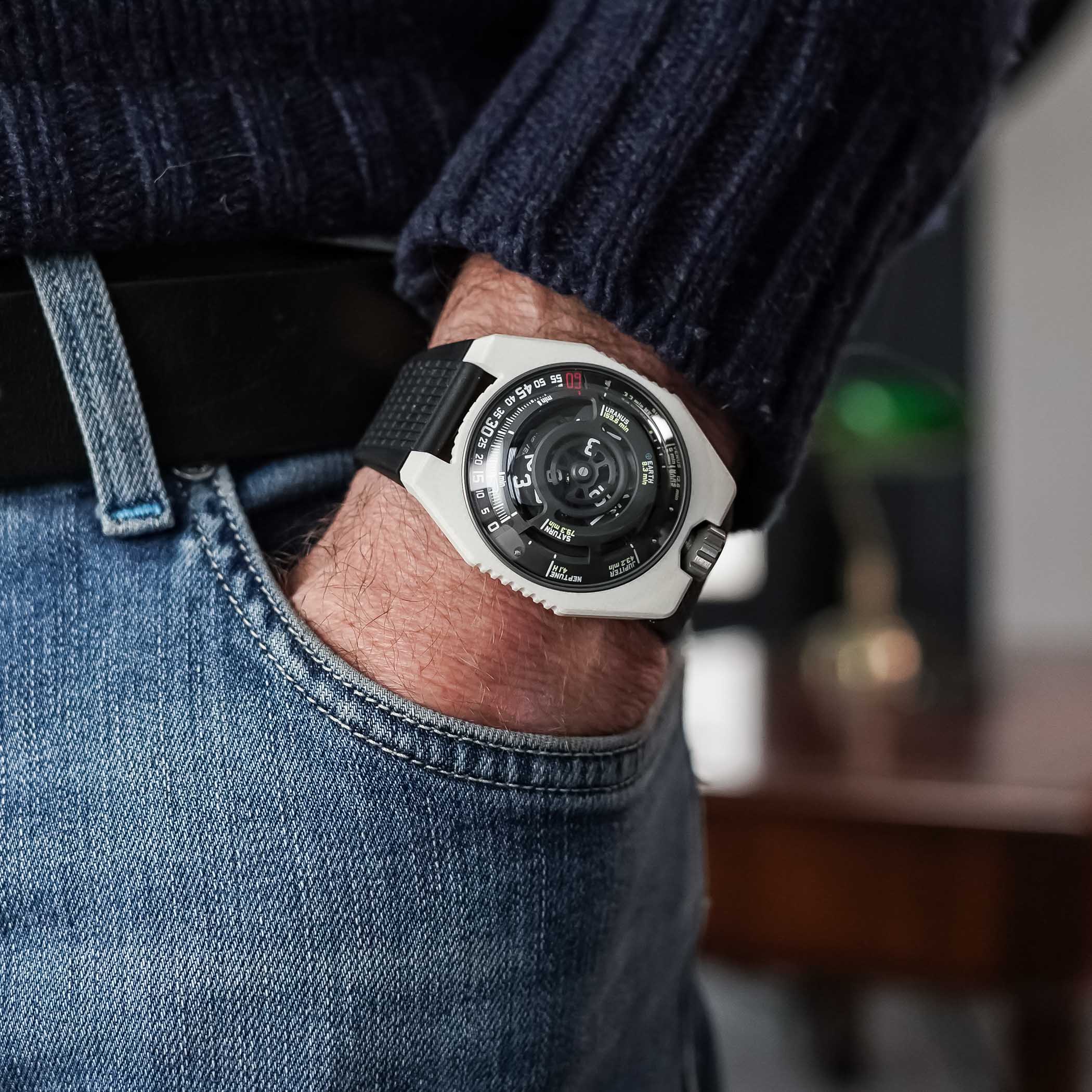
It has, as Urwerk cheerfully admits, no practical use at all. What it has is a point of view. Looking at the dial becomes a reminder that everything we see in the sky is already history, since the sunlight reaching Earth left its source more than eight minutes ago. The brand has always treated a watch as an object for thinking about time rather than merely checking it, and the Lightspeed turns a scientific fact into a small mechanical story.
The turbine underneath
Power comes from the automatic calibre UR-12.02, developed with Vaucher and carried over largely intact from earlier UR-100 generations. It runs at 28,800vph with 40 jewels and a 48-hour reserve, with aluminium satellites mounted on beryllium-bronze Geneva crosses and baseplates in ARCAP alloy. The signature detail is still there: the Windfänger airscrew, a turbine on the black PVD rotor that uses air resistance to slow the winding mass and reduce wear. Finishing is industrial rather than decorative, with circular graining, satin surfaces and shot-blasting.
Little has changed mechanically since the first UR-100V Lightspeed of 2024, and Urwerk does not pretend otherwise. The story here is the material and the idea rather than the movement. At CHF 67,000 before tax, delivered on both a black and a white rubber strap with a deployant clasp, it is not a watch that argues for universal appeal. It does not need to. Urwerk still occupies a category more or less of its own making, and the Lightspeed Ceramic is one of the more likeable things it has done inside it.