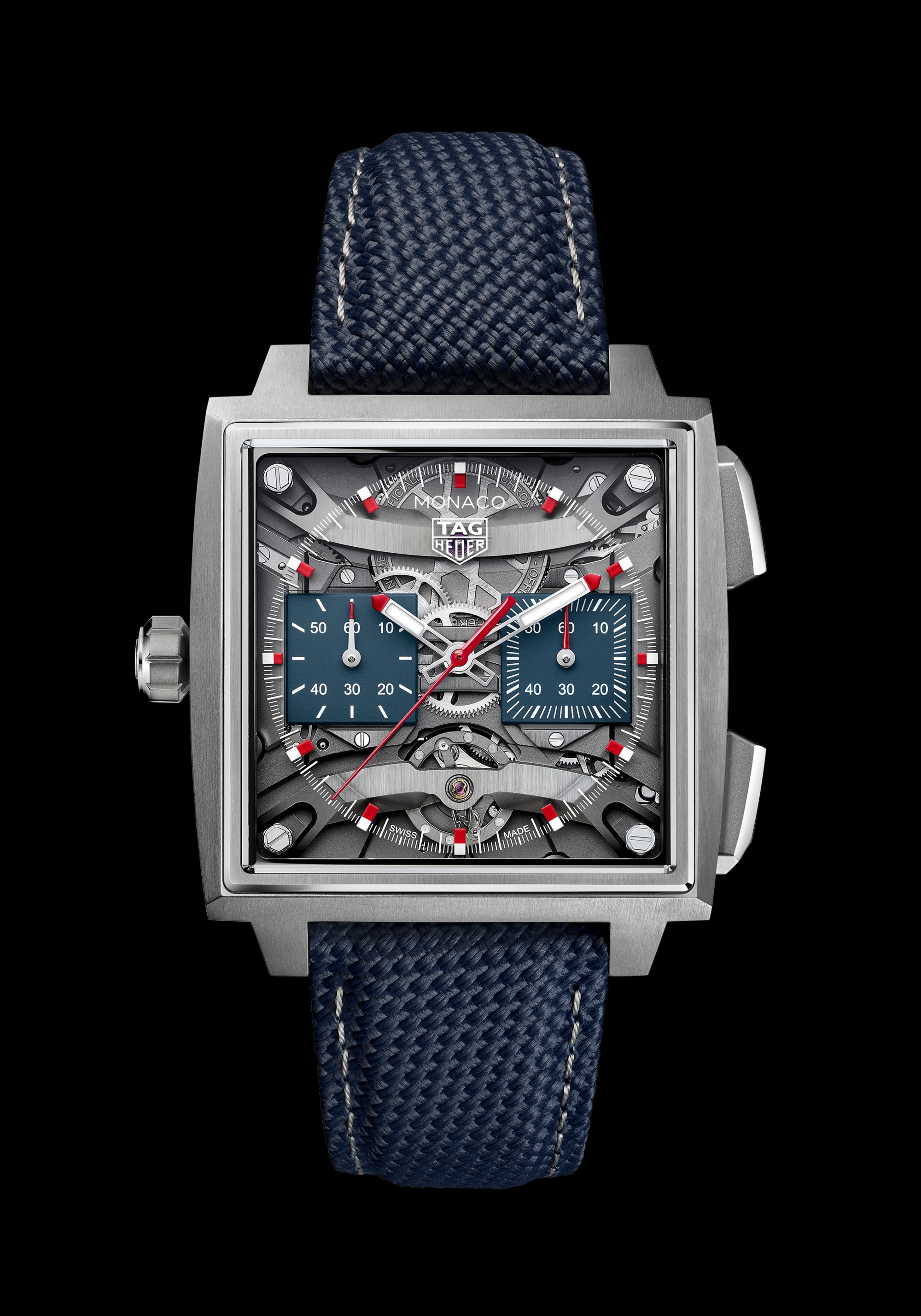
A traditional chronograph control system has between forty and eighty individual parts. Levers, springs, jumpers, eccentrics, and either a column wheel or a cam switch between start, stop, and reset. TAG Heuer's new Calibre TH80-00 has two. That, in summary, is the point of the Monaco Evergraph, which the brand launched at Watches and Wonders 2026 under reference CEW5181.FT8123 at a retail price of 25,000 euros.
The compliant mechanism, in plain terms
A compliant mechanism transmits motion not by articulating one part against another, but by flexing a single part. A paper clip is a compliant mechanism. So is the lid hinge on a shampoo bottle. In mechanical watchmaking the idea has existed since Wittwer and others proposed flexure-based escapements in the 2000s, but it has almost never been productionised inside a chronograph control system, because the precision required to snap cleanly between the "start," "stop," and "reset" states without creep is very difficult to achieve in steel.
TAG Heuer's solution, developed in partnership with Vaucher Manufacture Fleurier and described in detail in Monochrome Watches' in-depth introduction, is to make the compliant parts out of LIGA-grown nickel. LIGA is a lithography process that builds components layer by layer in a galvanic bath, producing parts whose tolerances are determined by a mask rather than by a cutting tool. That is how you get a single monolithic part whose geometry dictates its spring rate with enough consistency to land reliably between two bistable positions. The Evergraph uses two of them: one controls start and stop, the other controls reset.
Because those two parts replace the levers, springs, and column wheel of a traditional control system, the Calibre TH80-00 has no play between control components, no sliding friction at the transition surfaces, and no wear points in the classical sense. Revolution Watch, covering the launch, estimates the part count reduction at more than twenty components across the control system. TAG Heuer has not published the full net saving.
What else is in the movement
The base architecture is a 5Hz automatic chronograph with seventy hours of power reserve. It is COSC-certified. It uses TAG Heuer's TH-Carbonspring hairspring, first shown in the Monaco Flyback Chronograph TH-Carbonspring in 2024 and carried into this calibre for magnetism resistance and rate stability. Vaucher Manufacture Fleurier, owned by the Sandoz Family Foundation and the same movement supplier used by Parmigiani Fleurier, Hermès, and Richard Mille, handled the industrialisation of the base calibre. TAG Heuer developed the compliant mechanism itself.
The TAG Heuer magazine's own briefing on the calibre confirms that the TH80-00 is exclusive to the Evergraph for now and that the movement is built on a modular platform that will, the brand implies without promising, carry future variants.
The watch around the movement
The case is a 40mm Monaco in Grade 5 titanium. Two versions launch: natural titanium with blue opaline chronograph counters and red accents on the hands, and a black DLC-coated version with darker counters. The reference cited here, CEW5181.FT8123, is the natural titanium configuration on a blue textured rubber strap.
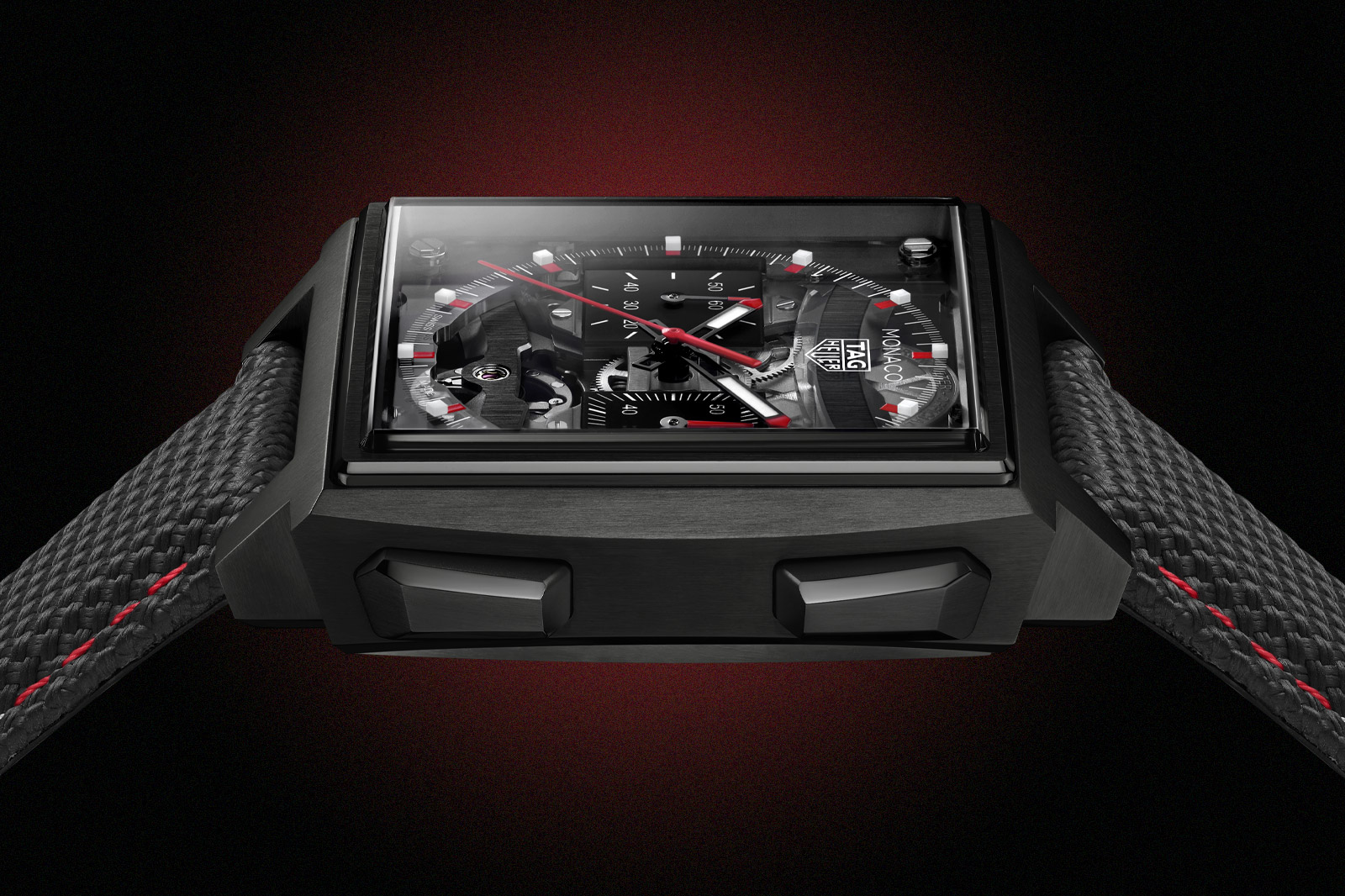
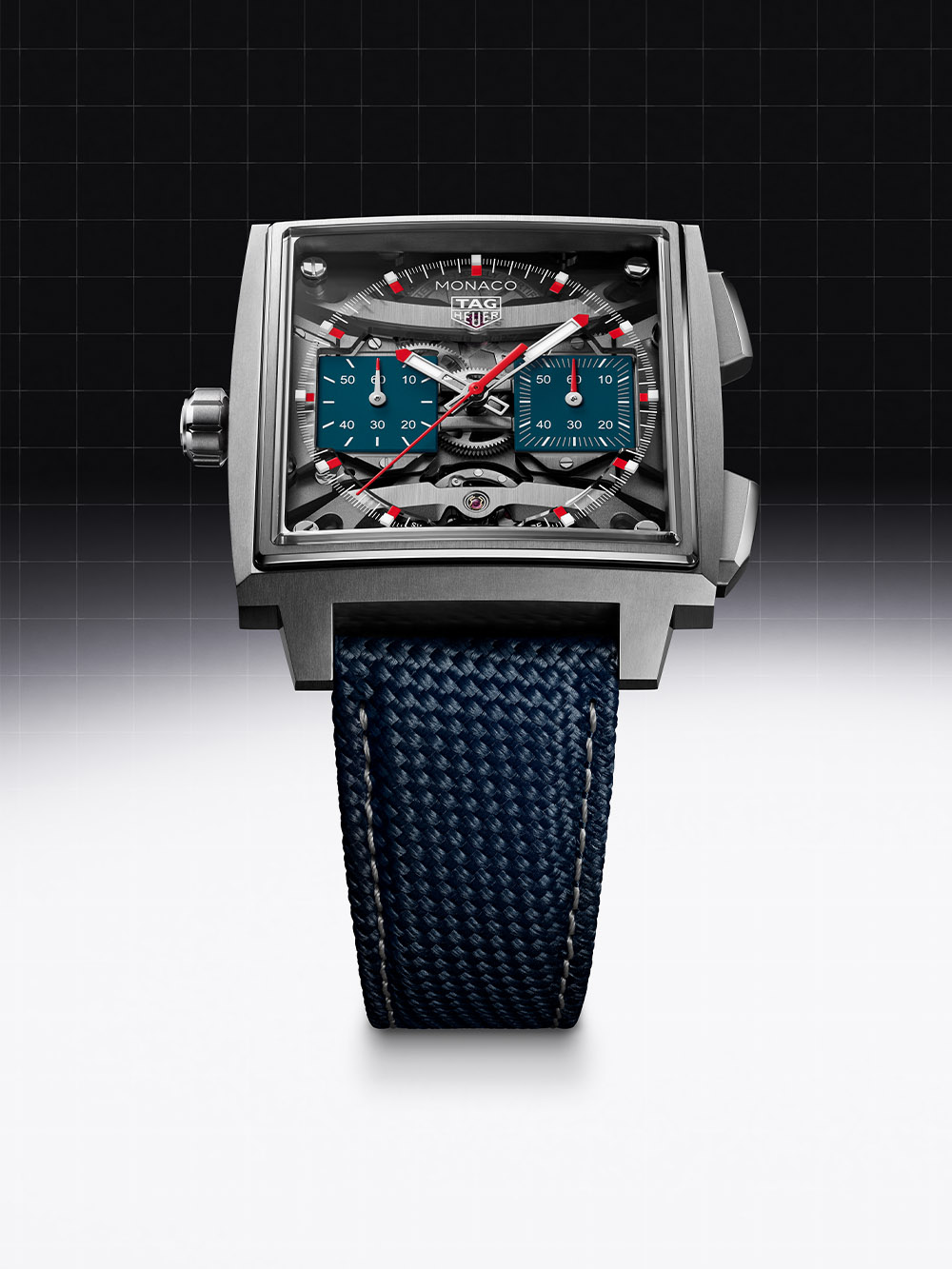
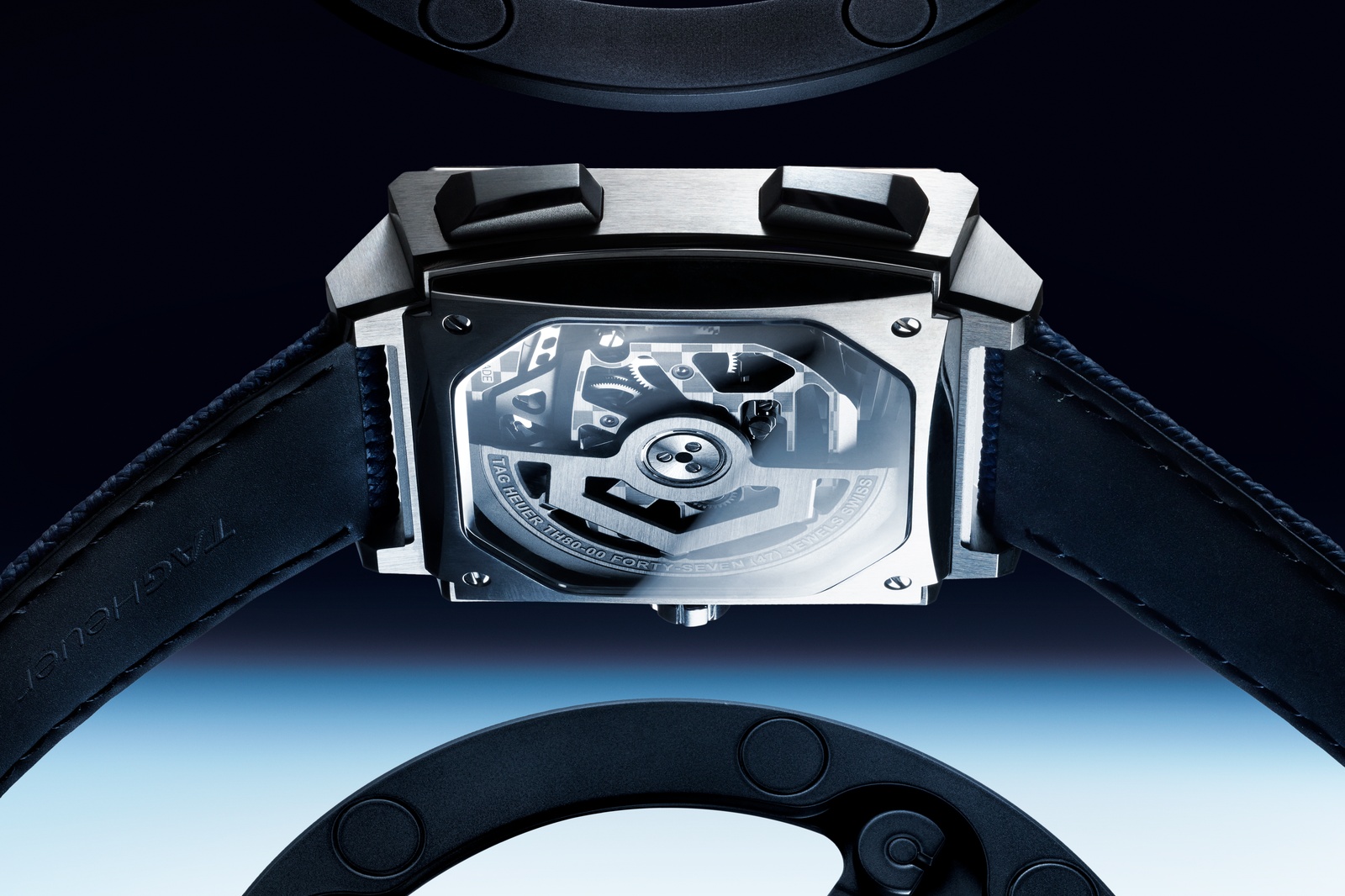
The dial is skeletonised at the centre, which is what lets the owner see the compliant structures operating. Pressing the chronograph pusher produces a visible flex through the sapphire rather than the rotation of a column wheel. Fratello, hands-on in Geneva, commented that the visual result is one of the strongest arguments for the watch: unlike a traditional chronograph, where you can see the column wheel but cannot see why it is doing what it is doing, the Evergraph shows the cause as well as the effect.
The two chronograph counters are at three and nine, laid out in rectangular windows that echo the original 1969 Monaco Calibre 11. The hour and minute hands are facetted and filled with white Super-LumiNova. The chronograph seconds hand is red, tipped to match the accents around the counter rings. The crown sits on the left side of the case, as it does on the historical Monaco, because the original Calibre 11 movement placed the winding stem there. The Evergraph's automatic calibre does not require that layout. TAG Heuer has kept it for continuity with the line.
The pricing decision
25,000 euros puts the Evergraph above the TAG Heuer Carrera Plasma Diamant d'Avant-Garde but below the Monaco Flyback Chronograph TH-Carbonspring's launch price. It also, notably, is not a limited edition. As reported by Fratello and Time and Tide Watches, TAG Heuer is producing the Evergraph as a regular production model from April 2026 onward. The TAG Heuer Magazine's calibre page describes the TH80-00 as "available immediately," which in watchmaking is a way of saying the brand expects to make enough of them to place in boutiques rather than allocate through a waitlist.
The decision not to cap production is, by itself, a signal. Brands that introduce novel complications frequently hide them in limited editions to hedge against manufacturing risk. TAG Heuer has decided that the compliant mechanism is stable enough, and its supplier partner capable enough, to put into a production line. If that holds through the first year, the Evergraph becomes the first mass-produced compliant-mechanism chronograph on the market.
What it changes
Compliant mechanisms have sat in the margins of watchmaking research for about fifteen years. TAG Heuer has just put one in a boutique. If the movement behaves in the wild the way TAG Heuer's partner built it to behave in the lab, the significance of the Evergraph is not that it does something a conventional chronograph cannot. A conventional chronograph starts, stops, and resets just fine. The significance is that it does those things without the twenty-odd parts that have historically needed to be oiled, adjusted, and eventually replaced. The maintenance curve, over a thirty-year ownership horizon, should be flatter. That is the claim. The watches that ship this year will, in time, say whether it holds.
Sources: Monochrome Watches in-depth review of the Monaco Evergraph; The 1916 Company Watches and Wonders 2026 report; Deployant introduction article; WatchTime brand coverage of the Calibre TH80-00; TAG Heuer Magazine's own briefing on the movement; Revolution Watch introduction; Time and Tide Watches hands-on coverage; Fratello Watches launch report; TAG Heuer product page for reference CEW5181.FT8123.