The 2020 Santos de Cartier Chronograph was a watch with a design problem at its centre. Cartier put the chronograph start-stop pusher at nine o'clock and integrated it into a quick-release bracelet tab rather than giving it a traditional tube next to the crown. The watch looked very clean on photography, but the control layout asked the wearer to operate the chronograph from the wrong side of the case, and the reset pusher was hidden behind the crown. The 2026 reference abandons that idea. As Revolution reports, the Santos Chronograph for Watches and Wonders 2026 returns the pushers to the right side of the case and redraws the dial as a tricompax.
That sounds minor until you look at the rest of what changed.
Case: the XL size stays, the layout gets stricter
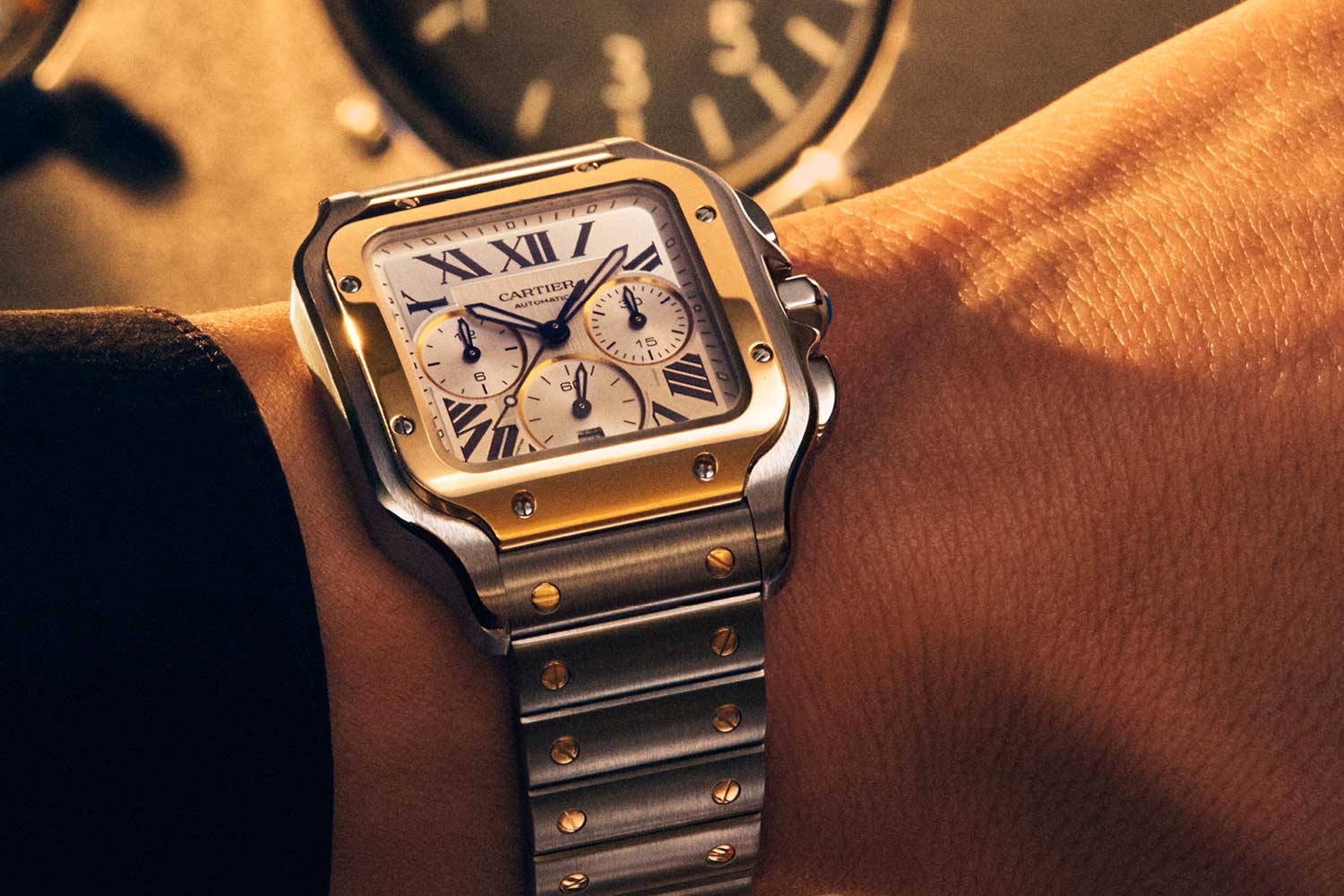
The case is the large Santos XL at 47.5mm lug-to-lug by 39.8mm wide, 11.6mm thick, with the same exposed screws on the bezel and bracelet links that have defined the line since 2018. Water resistance is 10 bar, or 100 metres. The crown still carries a sapphire cabochon, blue on steel, yellow on gold.
Four variants launch at once. The full steel version has a silver sunburst dial with rhodium-toned subdial borders. The two-tone version pairs a steel case with a yellow gold bezel and rhodium-bordered counters, as WatchTime describes. The full yellow gold version carries gold-bordered counters. A fourth model pairs a steel case with a black ADLC bracelet and dial accents. Cartier's QuickSwitch system remains, so each variant ships interchangeable with leather straps that release without tools.


Dial: the tricompax puts every register on the dial
The new dial runs a classic three-counter chronograph layout. Small seconds sit at 6 o'clock. A 30-minute counter sits at 3. A 12-hour counter sits at 9. A date aperture lives at 6 inside the running seconds register. The hands are sword-shaped, finished with green Super-LumiNova for low-light legibility. The Roman numerals are the same oversized black Arabic-style Romans that the Santos has always carried. The railroad minute track runs the outer edge.
The subdial diameters are larger than they were on the 2020 version, which is a quiet correction to one of the earlier watch's other problems. The 2020 chronograph had counters small enough to read only from close range, and the layout asked the dial text to share space with three pusher openings. The 2026 watch drops that design constraint and the counters grow to fill the space they need.
The result is a chronograph dial that reads like a chronograph dial, not like a Santos with three decorative circles added after the fact.
Movement: Calibre 1904-CH MC stays
Inside sits the Calibre 1904-CH MC, Cartier's in-house two-pusher chronograph movement. It is a column-wheel, vertical-clutch architecture that the brand has used across Santos and Drive chronographs since 2013. Power reserve is 47 hours. Balance frequency is 4Hz. The rotor is visible through a sapphire caseback. The Cartier product page confirms the same 1904-CH MC base carries over from the 2020 execution, but the module that drove the single-pusher layout is gone, replaced with the traditional two-pusher actuation that the movement was originally designed for.
A quiet note: keeping the 1904-CH MC means the Santos Chronograph stays at 4Hz with a flat 47-hour reserve, which is slightly short of the 70-hour target most manufacture calibres aim for in 2026. Cartier has not announced an updated movement in this family, and the 1904-CH MC will likely get a reserve extension in a future generation. For now, the priority was the user-facing geometry.
What this tells you about where Cartier is going
The 2020 Santos Chronograph was a design experiment. It made a point about integration, about removing the visible tube for the pushers and cleaning up the case flank. As a piece of industrial design it was coherent. As a watch it was harder to live with. The reviews at the time flagged the reset-pusher location, the subdial size, and the chronograph operation as the three things the wearer noticed.
The 2026 version reads as a correction. Pushers return to the crown side. Counters grow. The tricompax layout standardises a chronograph geometry that has worked since the 1940s. Cartier has done something similar across the rest of its 2026 catalogue: the Roadster returned with a more conventional layout than the 2001-2006 original, and the Privé programme has been re-releasing archive pieces rather than introducing fresh shapes. The through-line is that the brand is editing its own catalogue rather than expanding it.
Prices have not been formally announced. WatchTime estimates steel pricing around 10,000 to 12,000 euros, with the two-tone and full gold versions stepping up proportionally. Boutique availability is expected from late spring 2026 through the Cartier network.
The Santos Chronograph is now a conventional chronograph in an unconventional case. That is, in the end, what the Santos has always been.
Sources: Revolution on the 2026 Santos Chronograph upgrade; WatchTime coverage of Cartier's 2026 releases; WatchPro on the Roadster relaunch; Oracle of Time on Cartier's Watches and Wonders 2026 novelties; Cartier Santos de Cartier collection page.