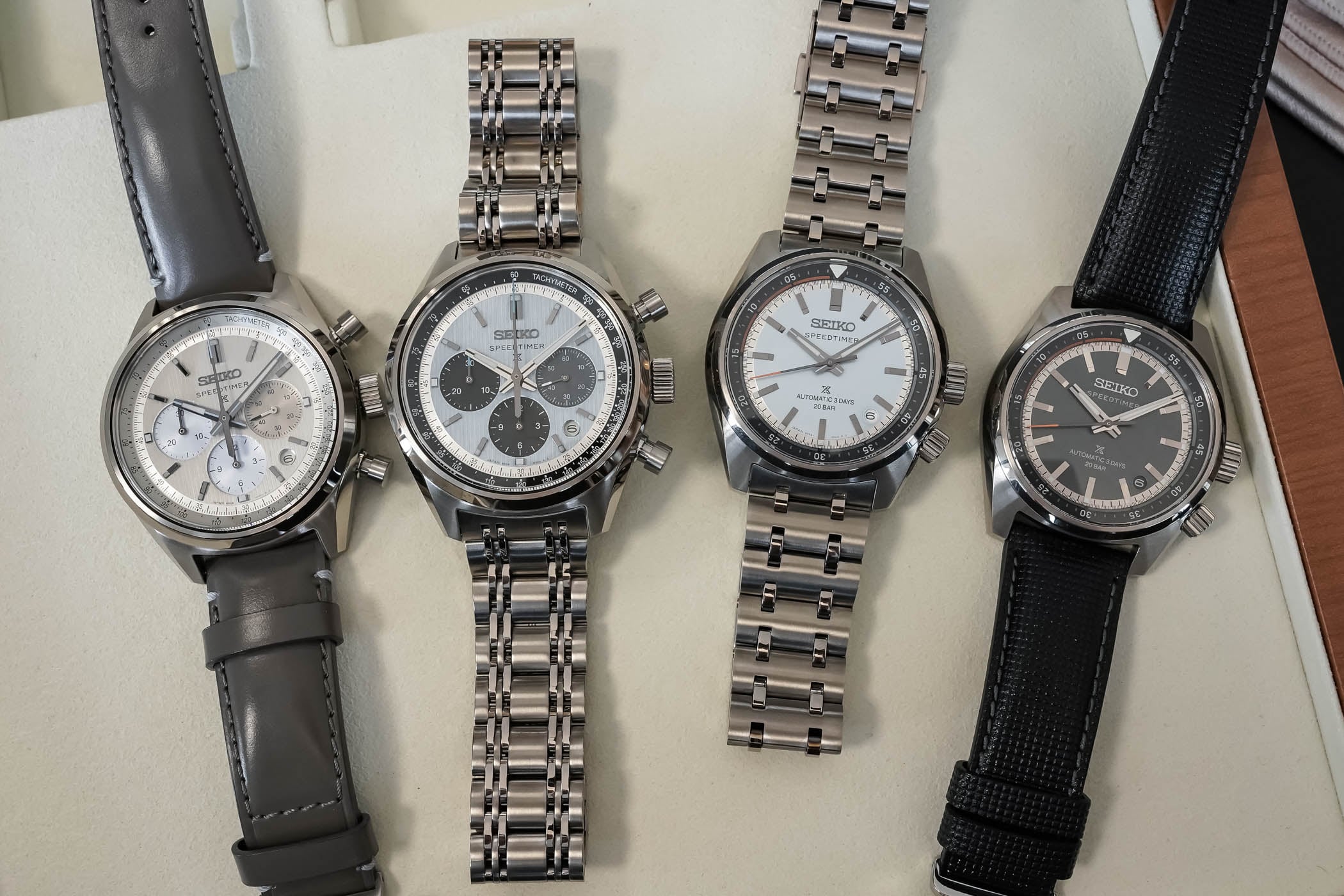
The Speedtimer name carries real history at Seiko. It belonged to the automatic chronographs the brand introduced in 1969 with the calibre 6139, when Seiko was one of the first three watchmakers, alongside Zenith and the Heuer-Hamilton-Breitling venture, to build a self-winding chronograph. In recent years the name has been stretched across both chronographs and simpler time-and-date watches, turning it into a broader motorsport-themed range. For Seiko's 145th anniversary, the collection gains four references: the HBD001, HBD002, HBC003 and HBC004.
The chronographs: HBD001 and HBD002
The two chronographs share their architecture with the SRQ047 and SRQ049 from 2023, with a retro design that looks to the early-1970s Speedtimers. The steel case has a super-hard coating and measures 42mm across and 14.6mm thick, with brushed and polished surfaces and an almost helmet-like centre section. There is a sapphire crystal on top and, for once, a closed caseback: solid steel with engravings rather than a display back. Water resistance is 100m, which is generous for a chronograph.
The dials are where the anniversary money went. The HBD001 has a sky-blue base with the tachymeter scale and the 6 and 9 o'clock counters picked out in black, separating the chronograph indications from the rest of the dial, while the small-seconds register at 3 o'clock takes a lighter tone to blend in. It comes on a hard-coated steel bracelet at EUR 2,780. The HBD002 is the quieter of the two, with a warm silver base and sky-blue counters, worn on a grey leather strap at EUR 2,680.
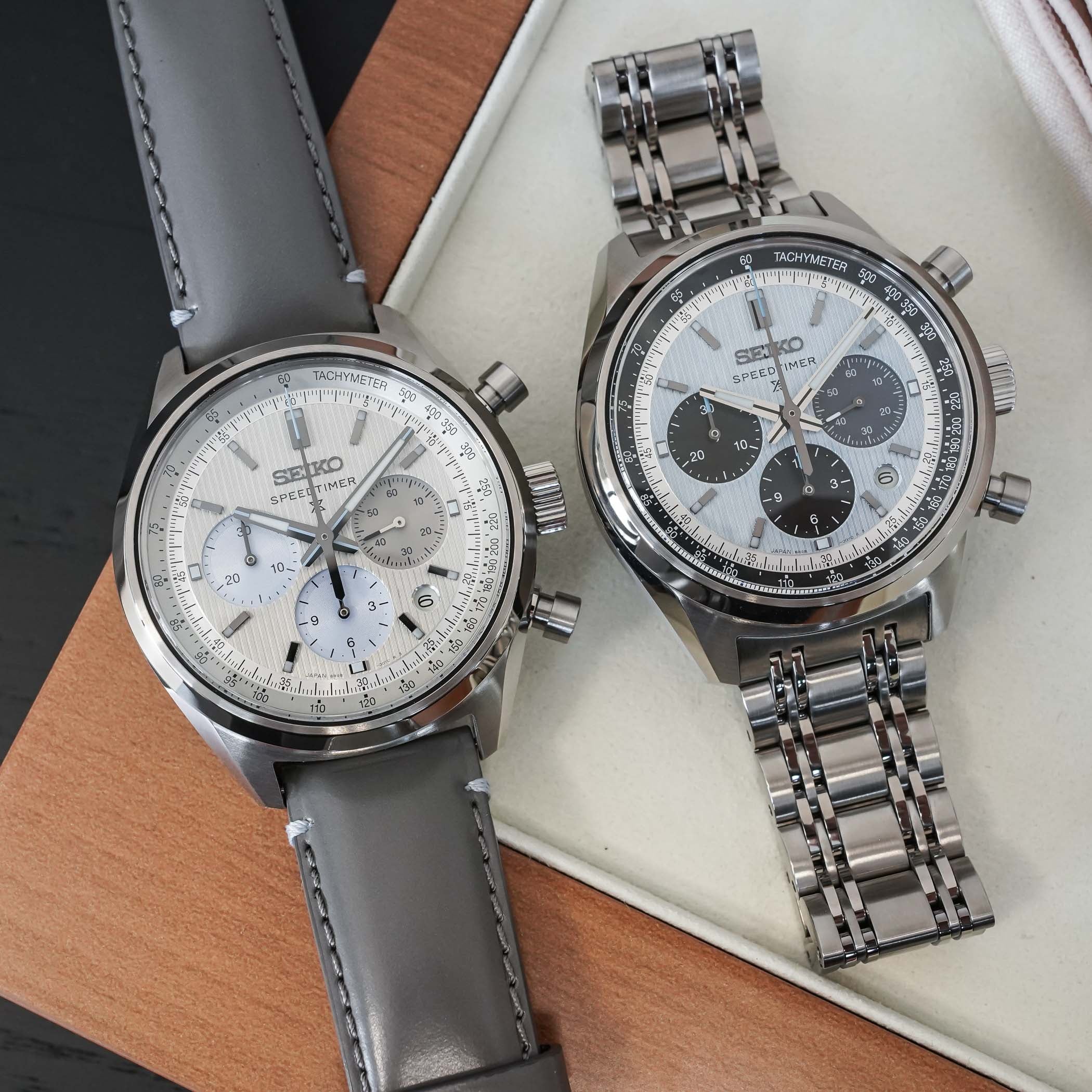
Both run the calibre 8R48, an in-house automatic chronograph with a vertical clutch and a column wheel, the combination that gives a clean pusher action and a crisp start to the central seconds hand. It beats at 4Hz, holds 45 hours, runs on 34 jewels, and uses an escapement made lighter and stronger with Seiko's MEMS manufacturing. This is a serious chronograph movement at a price where most rivals fit a modular or hand-wound base.
The time-and-date pair: HBC003 and HBC004
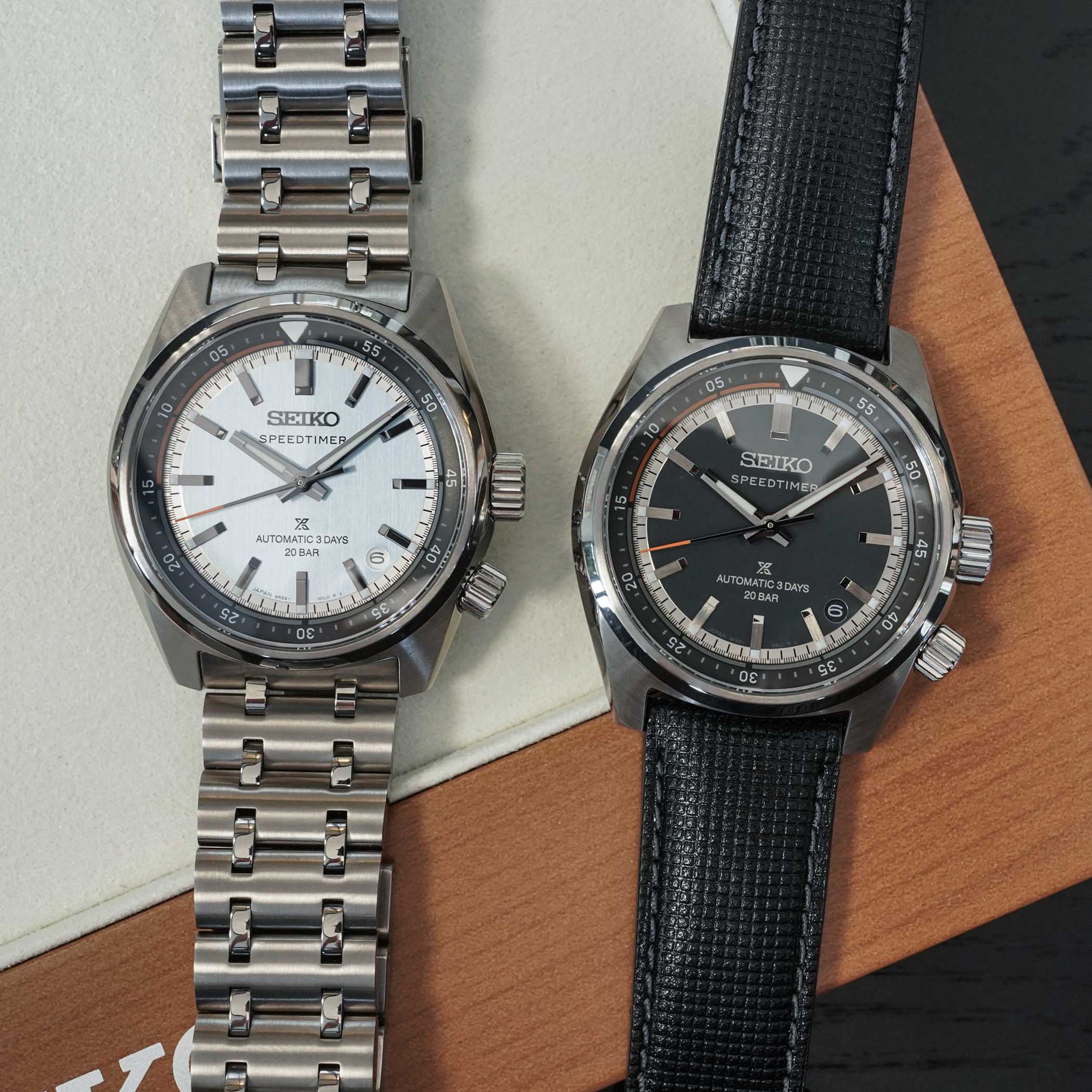
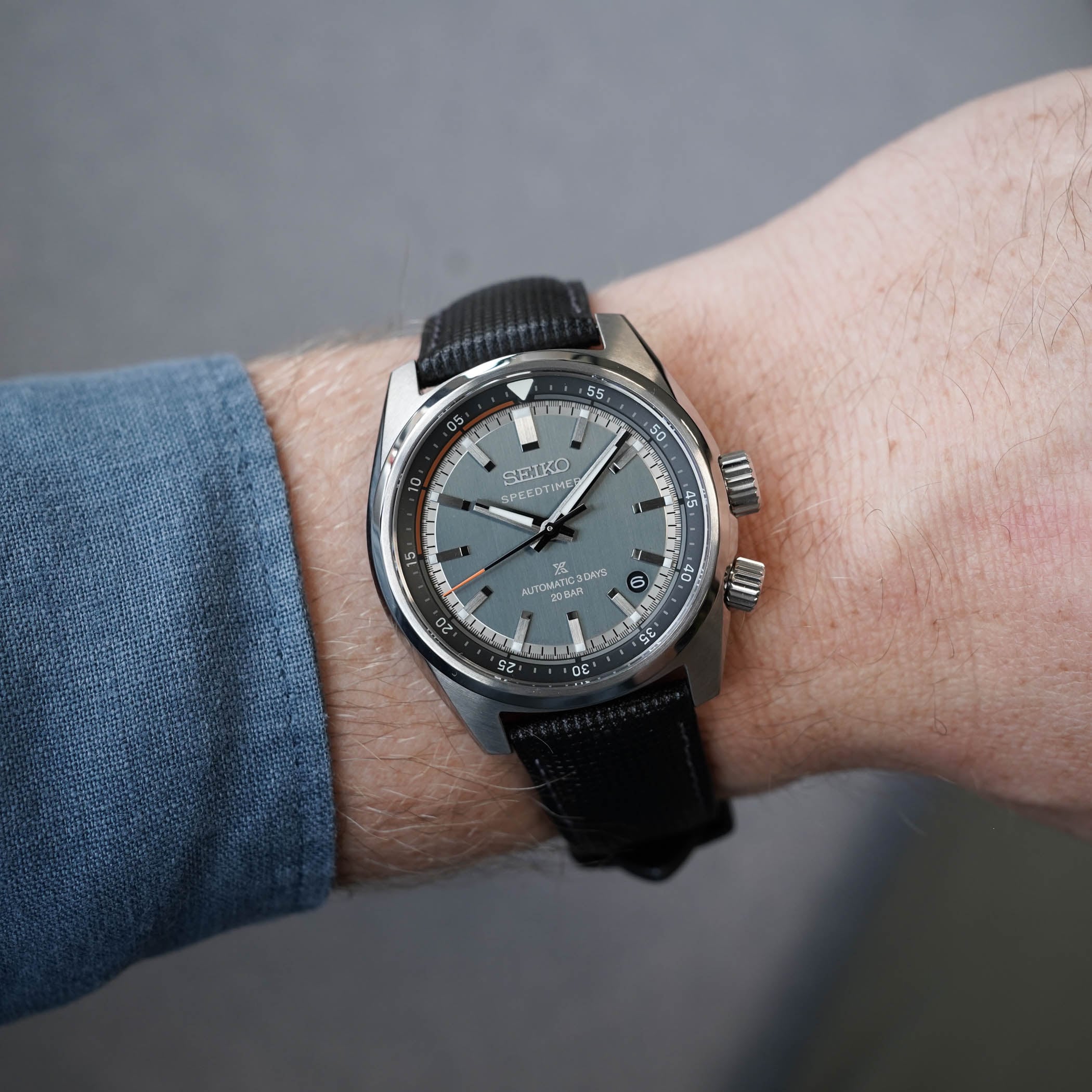
The other two references drop the chronograph. They descend from the SPB513 and SPB515 that joined the range in 2025, themselves born from a Datsun-themed limited series. The motorsport cues remain, most obviously an internal rotating bezel worked by a second crown, and the proportions are close to ideal: a 39.5mm case, 12mm thick, with sapphire, a solid steel back, and a strong 200m of water resistance. New for this year, the HBC003 introduces a light blue vertically brushed dial with orange accents on a steel bracelet, at EUR 1,030, while the HBC004 pairs a dark, near-black dial and orange accents with an embossed leather strap, at EUR 1,000.
Inside both is the calibre 6R55, a modern automatic with 72 hours of reserve, running at 21,600 vibrations per hour on 24 jewels with 4,800 A/m of magnetic resistance. It is the workhorse Seiko uses across much of its mid-range, and it suits a watch built for daily wear rather than the track.
None of the four is a new mechanism, and Seiko is not pretending otherwise. What the anniversary brings is colour and a bit of finishing, spread across a range that now reaches from a thousand euros to just under three. Full specifications are at seikowatches.com and in Monochrome's first look. For a name that started with one of the first automatic chronographs ever made, a column-wheel 8R48 under EUR 2,800 is a reasonable way to keep the story going.