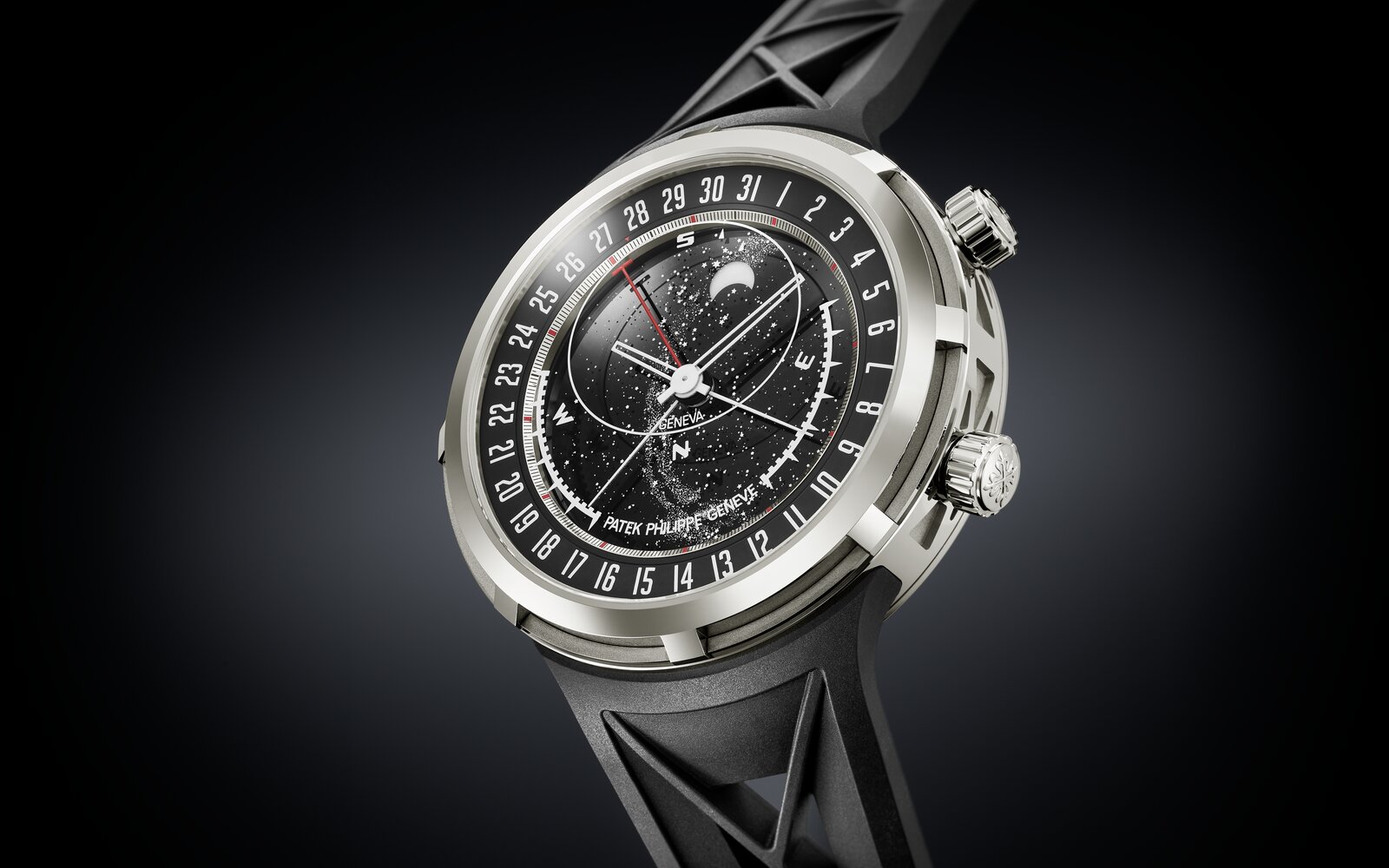
Patek Philippe has spent five years building a wristwatch that shows you when the sun will come up and when it will set. The result, revealed at Watches and Wonders 2026 under reference 6105G-001, is a 47mm white gold Celestial with a black composite strap and a movement that packs six patents into a 7.93mm base calibre.
This is not a Celestial in the historic Patek sense. The existing 6102R, based on the calibre 240 LU CL C, shows a rotating sky chart of the Geneva night sky, a moonphase, and the date. The 6105G keeps all of that, but adds a sunrise and sunset indication that automatically shifts by one hour between summer and winter time, driven by a single pusher. According to Patek's own technical sheet on the product page for 6105G-001, this is the first serial wristwatch from the brand to display the solar times.
Why this is a technical first
Wristwatches that show sunrise and sunset are rare, and the reason is mechanical. A sunrise indication depends on both latitude and the day of the year. Patek's solution is to pair two discs: one displays the date and doubles as the scale for sunrise and sunset, the other marks the current time. The sunrise and sunset times are read at the intersection of those two scales.
The complication only becomes practically useful if it stays accurate when clocks change. In most of Europe, that happens twice a year, and watches that show solar times are usually set to one or the other. The 6105G adds a synchronised daylight saving system that shifts the entire display by one hour with a single press of a corrector. A press forward in March, a press back in October, and the watch tracks the local sunrise and sunset through the seasons.
That mechanism is, by Patek's own count, the subject of six patent applications. The base movement is calibre 240 C LU CL LCSO, 27.5mm across and 7.93mm thick, with 426 components and 51 jewels. It is a self-winding platform built around the brand's ultra-thin 240 micro-rotor, already used in the existing Celestial. The 6105G adds the sunrise-sunset cam, the synchronised DST system, and the new readout.
The case and the design
Patek has given this movement an unfamiliar body. The case is 47mm of 950 white gold, 12.39mm thick, and has no lugs. In their place, an integrated black composite strap runs under the crystal, held against the caseband with an X-shaped decor that is cut in relief into the gold. The design language is closer to the 5740 Nautilus Perpetual or the newer 5520 Alarm Traveler than to any previous Celestial. It is the first Celestial that looks like sports Patek.
The dial charts the northern sky above Geneva. Stars are printed on a dark sapphire disc that rotates in sidereal time, meaning the chart completes one revolution every 23 hours, 56 minutes, and four seconds. The moonphase is printed on the same disc and is accurate to one day in 122 years. The sunrise and sunset indications sit on a separate scale at the dial edge, opposite the date.
Fratello and The 1916 Company, covering the launch from Geneva, both described the legibility as better than any Celestial Patek has released to date, with the new scales sitting outside the sky chart rather than crossing it. Time and Watches confirmed the caliber reference and the 47mm case dimensions from Patek's own press material.
The number that matters
The retail price is 415,795 euros, confirmed in the specifications on Patek's product page for reference 6105G-001 and reported by WorldTempus, The 1916 Company, and Fratello. That puts the 6105G in the same territory as the brand's ultra-thin Minute Repeater and above the 5208P perpetual chronograph minute repeater. It is, for the moment, the most expensive single-dial complication Patek has released at Watches and Wonders 2026.
Production has not been capped. Patek has not confirmed annual volume for the 6105G, but the company's Celestial references historically ship in very small numbers, and the new movement architecture suggests the same pattern here. Allocation will almost certainly go through authorised dealers with existing Patek relationships.
What this changes
Solar time indications are slowly moving from small independents into the large Geneva houses. Vacheron Constantin's Celestia Astronomical 3600 showed a version in 2017, and Arnold & Son and Krayon have offered sunrise and sunset complications in much smaller runs. Patek's contribution is the daylight saving correction, which is the first to solve the twice-a-year problem with a single push of a button rather than a re-setting of the complication.
For a wrist that spends most of its year in Europe, the feature is not decorative. For collectors who read a Celestial primarily as a statement of Patek's astronomical craft, the 6105G is a rewrite of how the line is positioned. The price, the case design, and the new complication together suggest Patek intends this as a new pillar of the Grand Complications range, not a one-off.
Sources: Patek Philippe product page for 6105G-001 on patek.com; Fratello Watches launch coverage; The 1916 Company Watches & Wonders 2026 report; WorldTempus reference article; Time and Watches hands-on notes; Monochrome Watches first-look coverage.