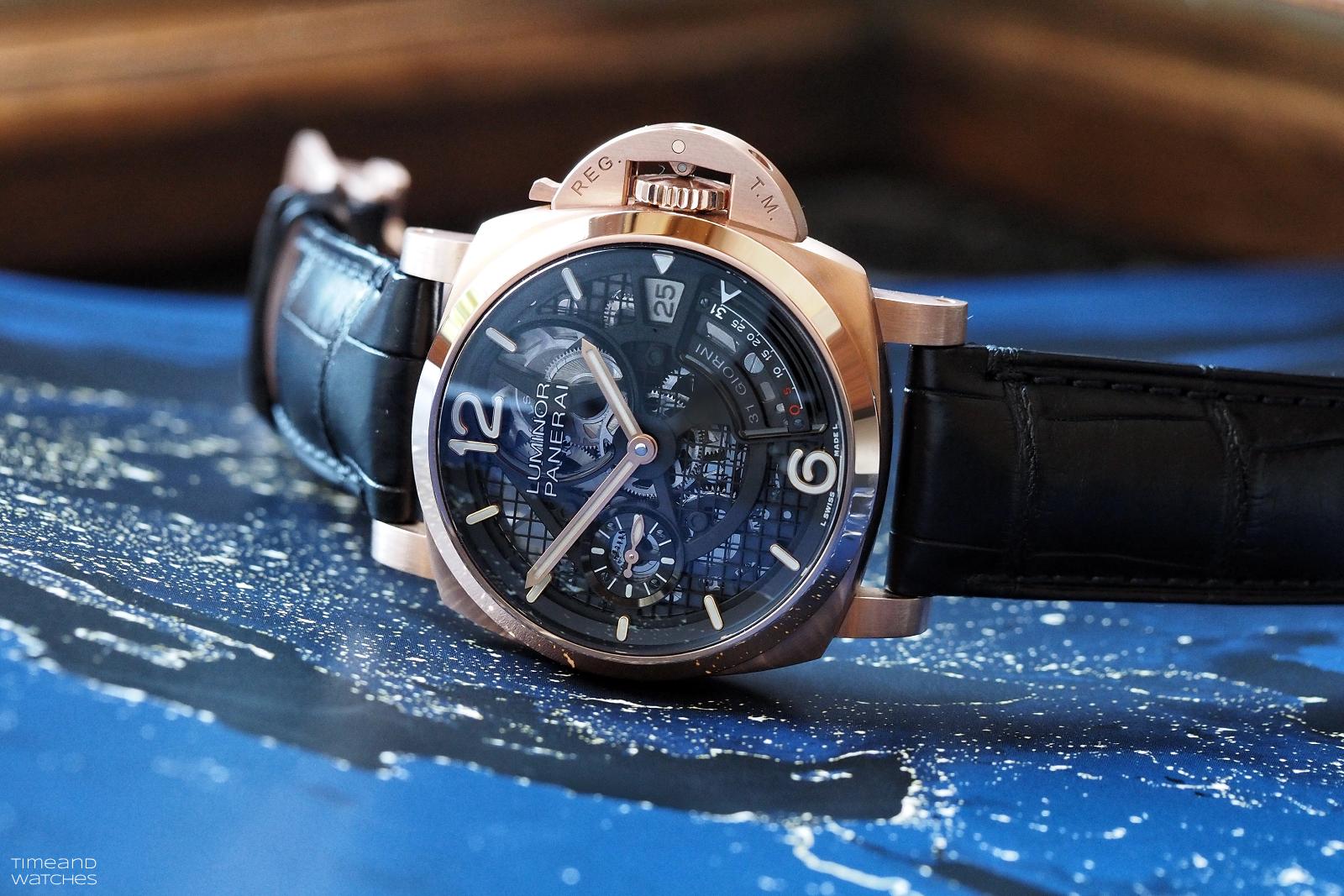
Panerai has used Watches and Wonders 2026 to put the longest power reserve the maison has ever produced inside its most recognisable case. The Luminor 31 Giorni, reference PAM01631, runs for thirty-one days on a single full wind. It is 44mm across, in Panerai's proprietary Goldtech alloy, and limited to two hundred pieces. The boutique-exclusive retail price is 95,000 euros, per Time and Watches' introduction article.
Where the month comes from
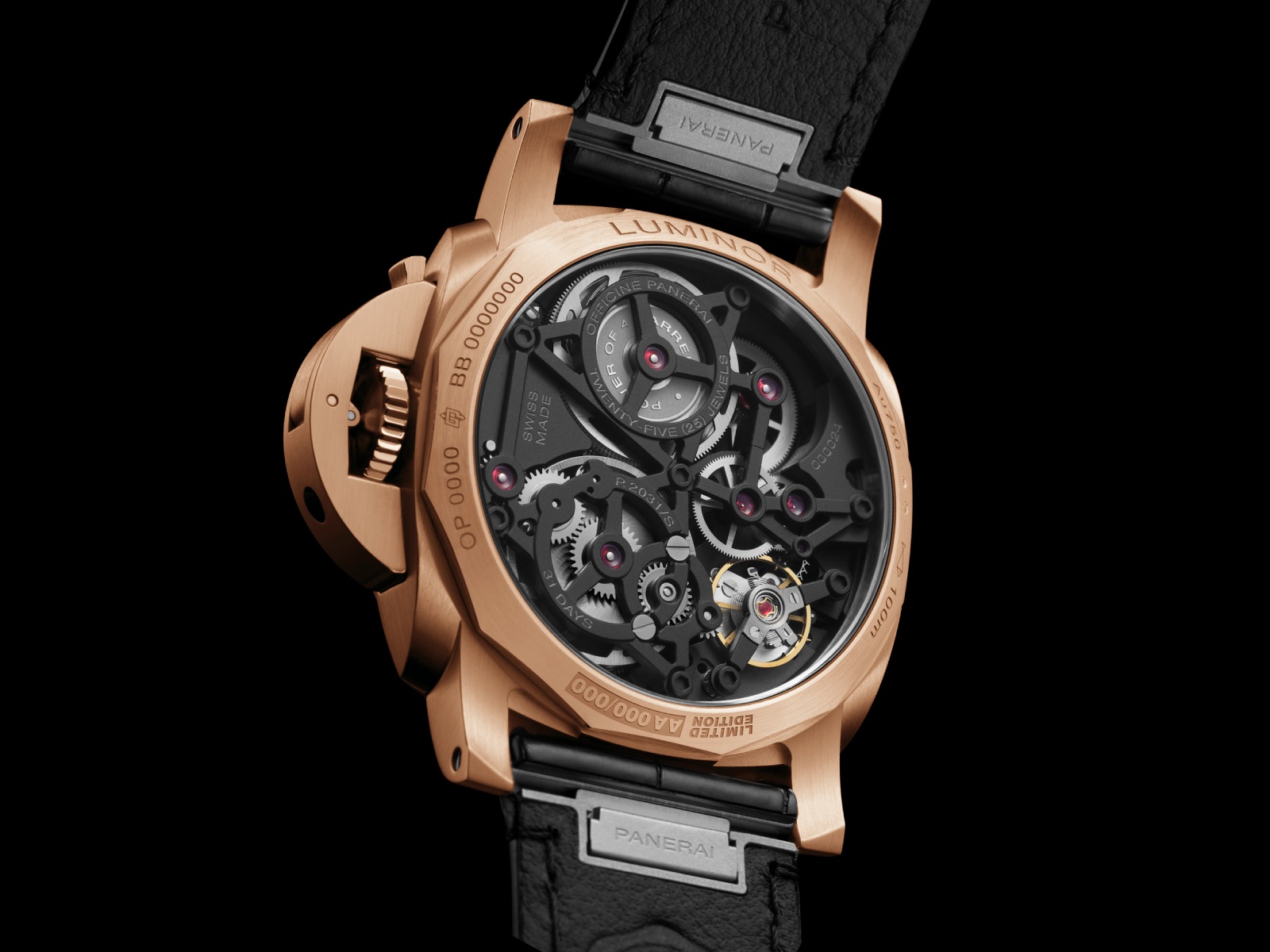
Most long-power-reserve watches chase their autonomy by adding barrels. Panerai has done the same, but more of it. Inside the new calibre P.2031/S, four mainspring barrels sit in series, carrying a combined 3.3 metres of mainspring. WatchTime, covering the launch under the headline "a month-long power reserve," reports that the crown needs 128 turns from stop to fully wound. That is roughly ten minutes of winding if you take your time, and it is, per Panerai's own statements to the press, the output of seven years of R&D inside the Laboratorio di Idee.
Raw mainspring length is not, by itself, the interesting part of this movement. Adding barrels tends to make the rate of a mechanical watch worse, because a wound mainspring delivers much more torque at the top of its charge than at the bottom, and a train sitting across that range tends to gain and lose depending on where it is in the cycle. Panerai's answer is a patent-pending element it calls a Torque Limiter.
The torque limiter
As reported in the same WatchTime piece and in Revolution Watch's introduction, the P.2031/S actually has thirty-six days of wound mainspring inside it. The movement is engineered to stop at thirty-one. The top few days, where torque is highest and the balance wheel tends to overbeat, are clipped off and never reach the gear train. The bottom stretch, where amplitude falls and the rate starts drifting, is also not used. What you get on the wrist is the middle of the curve, the range where a balance wheel behaves most consistently. The watch runs for the advertised 31 days, but it is doing it inside a usable torque window rather than across the full mainspring.
The oscillator is Panerai's own, beating at 4Hz. Panerai has not published a chronometry certificate for the calibre at the time of writing. The company is, however, positioning the 31 Giorni as a rate-stability achievement rather than a duration stunt. That claim should be verifiable from movement reports when independent reviewers have the watch on a timegrapher for longer than a few days.
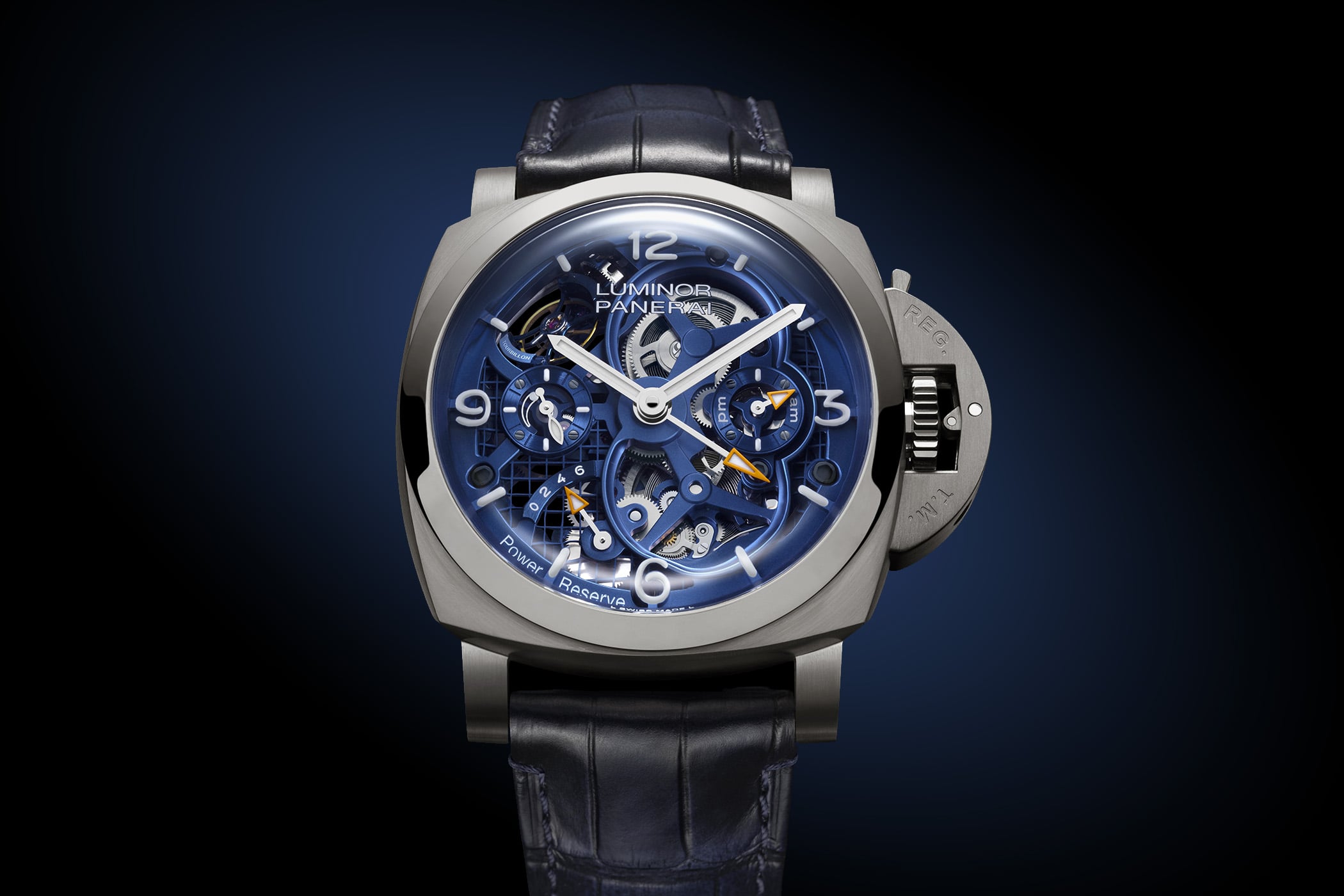
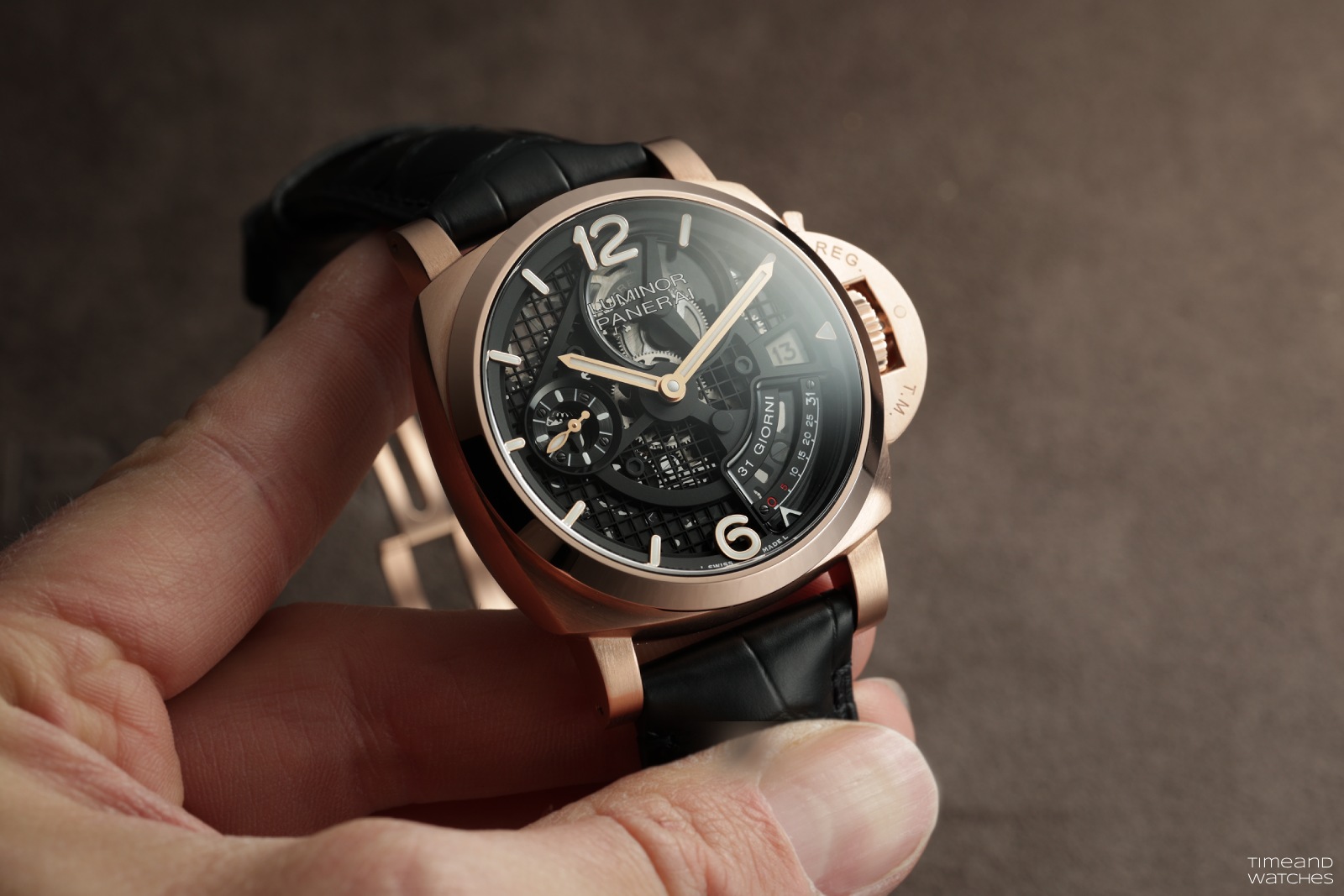
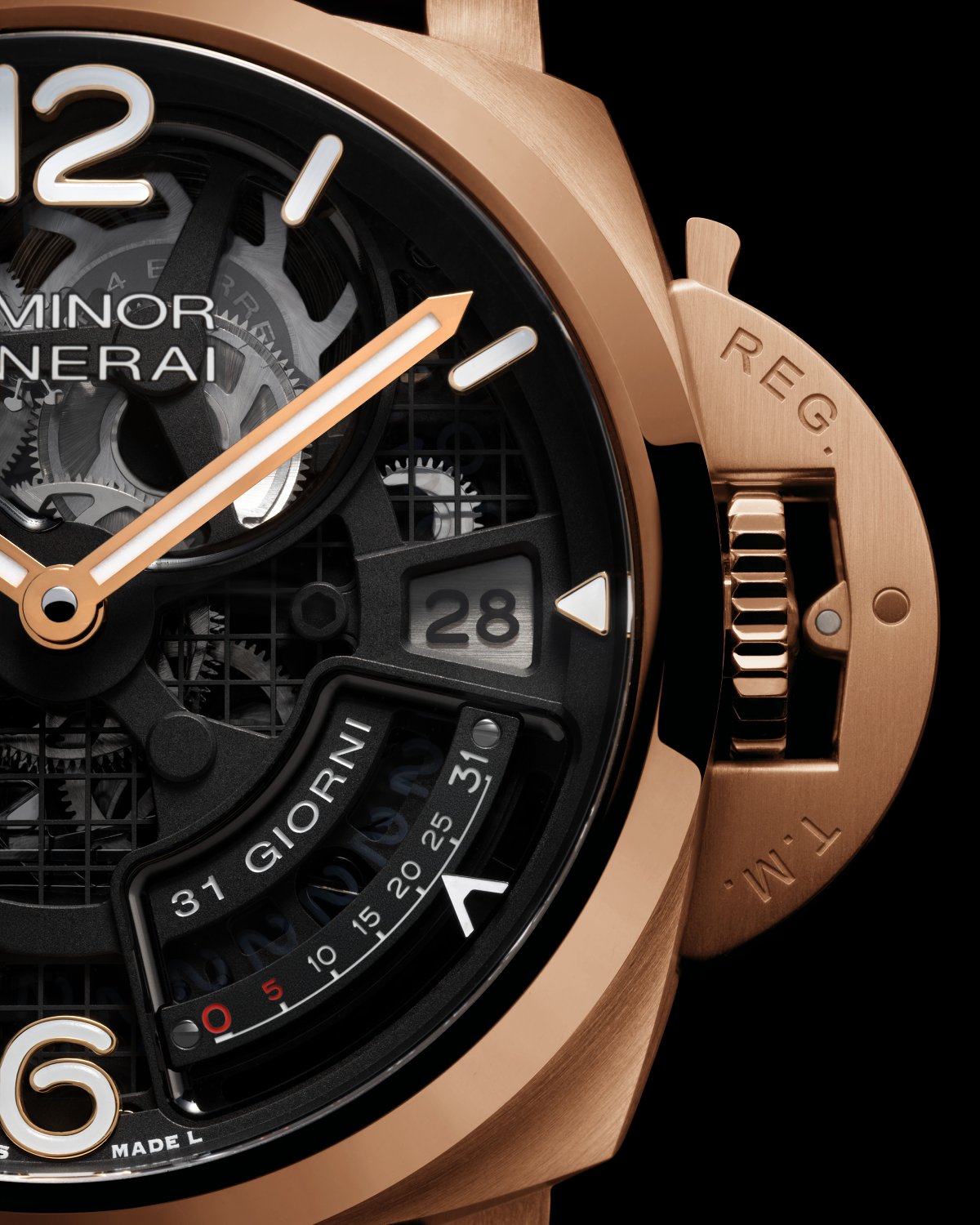
The calibre contains 276 components. It is visible through both sides of the watch because Panerai has skeletonised the dial. Four barrels, the great wheel, and the going train are all exposed, with the hour and minute hands reading over the top. A small seconds sits at nine o'clock. The date is at three. A power reserve indicator lives on the back.
The case
This is the first production watch in the Luminor line to use Goldtech, Panerai's copper-platinum-palladium alloy, in a 44mm cushion case with the house's distinctive crown guard. The crown itself is still the lever-locked design that has served Luminor since 1949. Inside that silhouette, the watch weighs considerably more than a steel or titanium Luminor, because Goldtech is a gold alloy and gold is dense. Panerai has not published a dry weight for PAM01631, but based on the 44mm Goldtech Luminors already in the line, a figure in the 180 to 220 gram range is likely. Panerai's supplied strap is a blue calfskin alligator with a Goldtech trapezoid buckle.
The dial, such as it is, shows the architecture directly. The barrels dominate the left side. The going train runs across the centre. The Luminor sandwich construction has been retained only for the numerals at twelve and six and the applied hour markers, which glow with Super-LumiNova. Gear Patrol, hands-on in Geneva, described the result as "a Luminor you read through," and noted that the skeletonisation is clean enough that the hour and minute hands remain the first things the eye finds.
The number that matters
95,000 euros. That is the figure published by Time and Watches in the introduction article, and consistent with the 107,000 US dollar figure in Gear Patrol's coverage from the same week. At that price, in Goldtech, in a 200-piece run, the 31 Giorni sits above almost every other production Luminor and competes directly with the long-autonomy watches from Hublot and A. Lange and Söhne's 31 Days Tourbillon. Panerai has not promised a tourbillon here. It has promised a stable rate over a month, which is a harder problem and one that has historically been solved by reducing running time, not extending it.
What it says about the brand
The PAM01631 is not a return to the military origin story that defines most of Panerai's recent releases. It is, explicitly, a technical statement. Revolution Watch framed it as Panerai "returning to its core territory" by going long on power reserve, referring to the brand's identity as a maker of overbuilt, low-intervention tool watches. A watch that runs for a month without attention is, in that reading, the logical extension of a watch originally made to survive military diving.
For collectors, the choice is a boutique appointment, a wait, and a decision about whether a skeletonised Luminor reads as progress or as a departure from what made the line work in the first place. The two hundred allocations will answer that question for Panerai quickly enough.
Sources: Time and Watches introduction piece for PAM01631 confirming the 95,000 euro price; WatchTime's brand coverage of the Luminor 31 Giorni; Gear Patrol hands-on report; Revolution Watch's "Panerai returns to its core territory" article; Stuff magazine launch coverage; Oracle of Time expansion piece on the Luminor manual collection; Panerai's US product page for PAM01631.