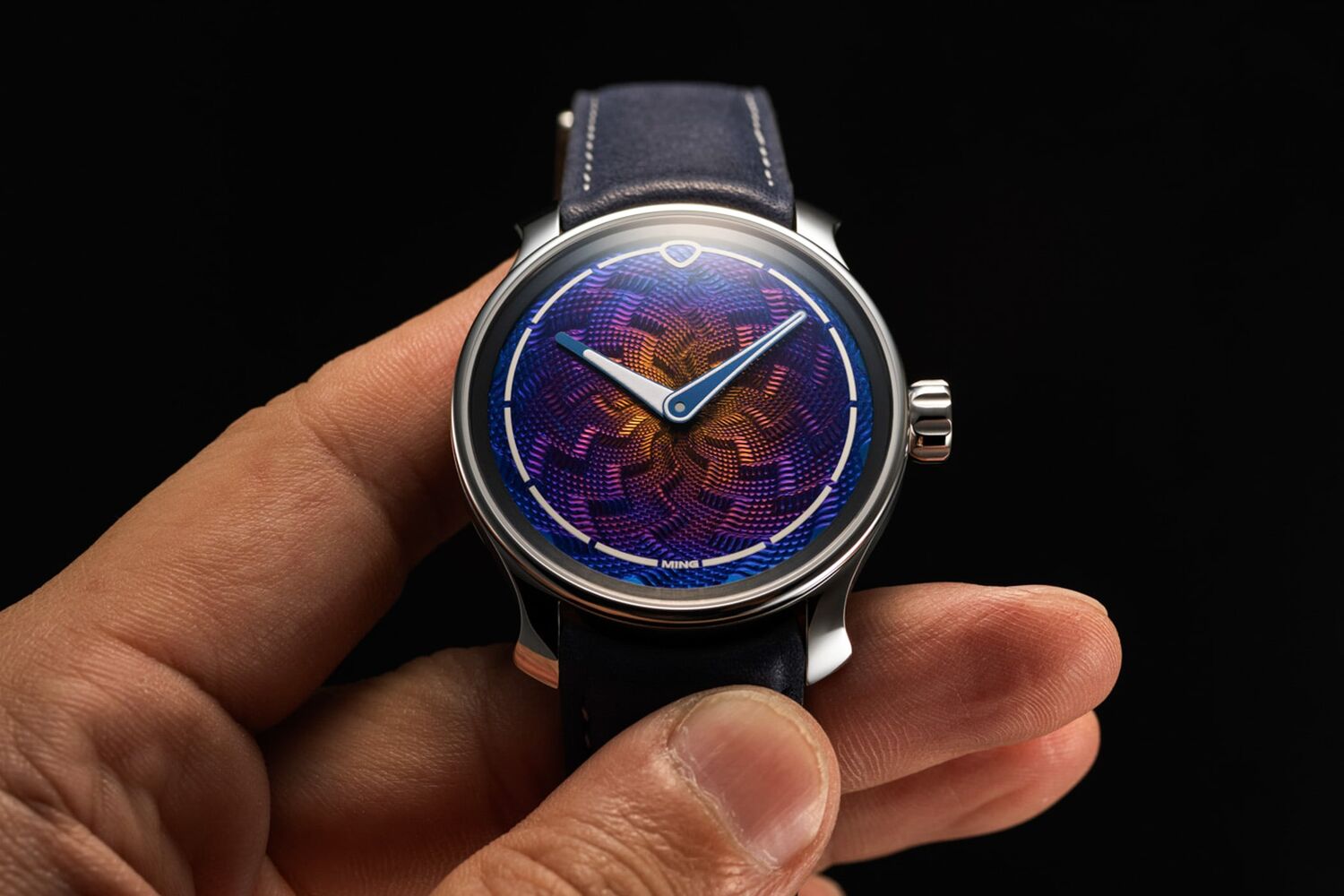
Two independent watchmakers put their hands on the same dial, and the result is the kind of object that only works because neither of them did the whole thing. The Ming x J.N. Shapiro 37.06 Lightning, introduced June 5, pairs the engine-turning of Los Angeles maker Josh Shapiro with the heat-coloured dial work that has become the signature of Ming, the design-led brand founded in 2017 by the Malaysian photographer and engineer Ming Thein.
The two are not strangers. Both sit among the founding members of the Alternative Horological Alliance, and they have built together before, on the Ming 21.01 Project 21. Shapiro began his career cutting guilloché dials for other watchmakers and has since grown into a vertically integrated American manufacture, the workshop behind the Resurgence, the first all-American mechanical watch built since 1969. The 37.06 takes the part of his craft he is best known for and hands the rest to someone else.
A pattern, then a fire
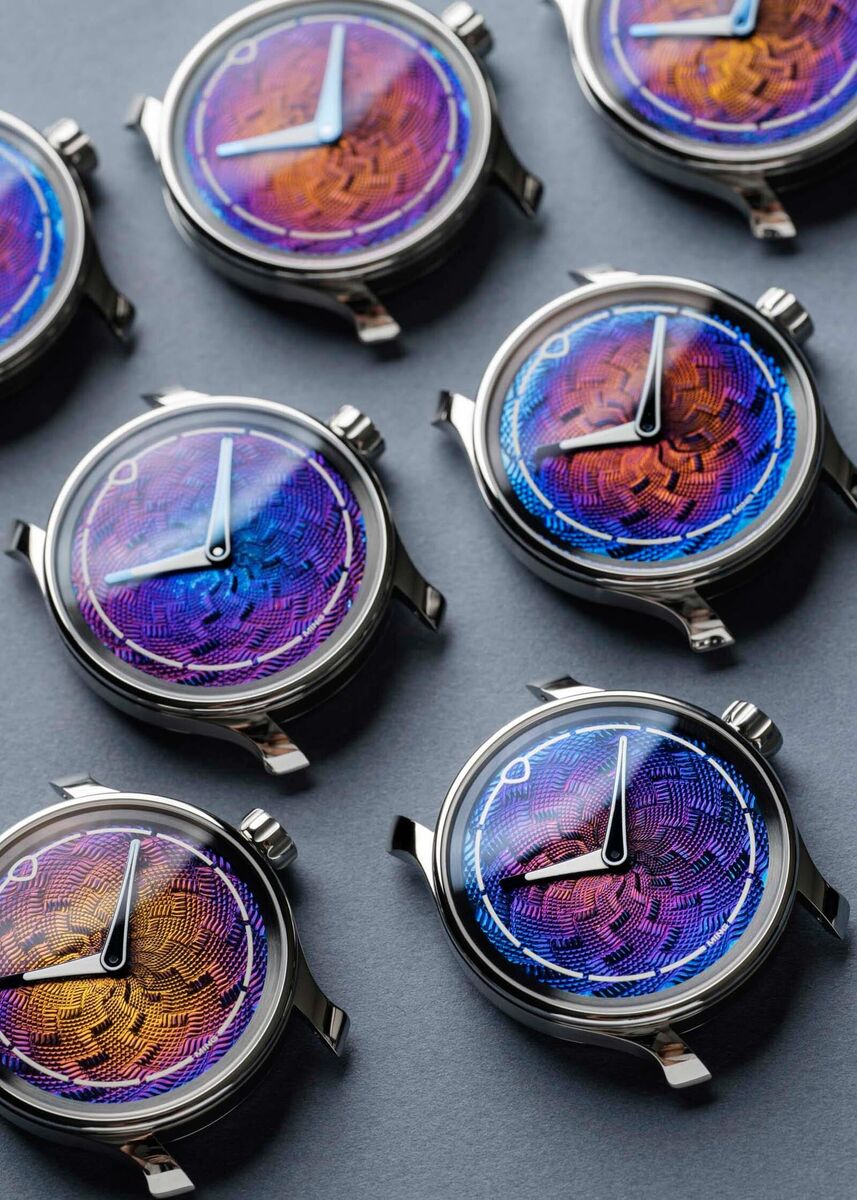
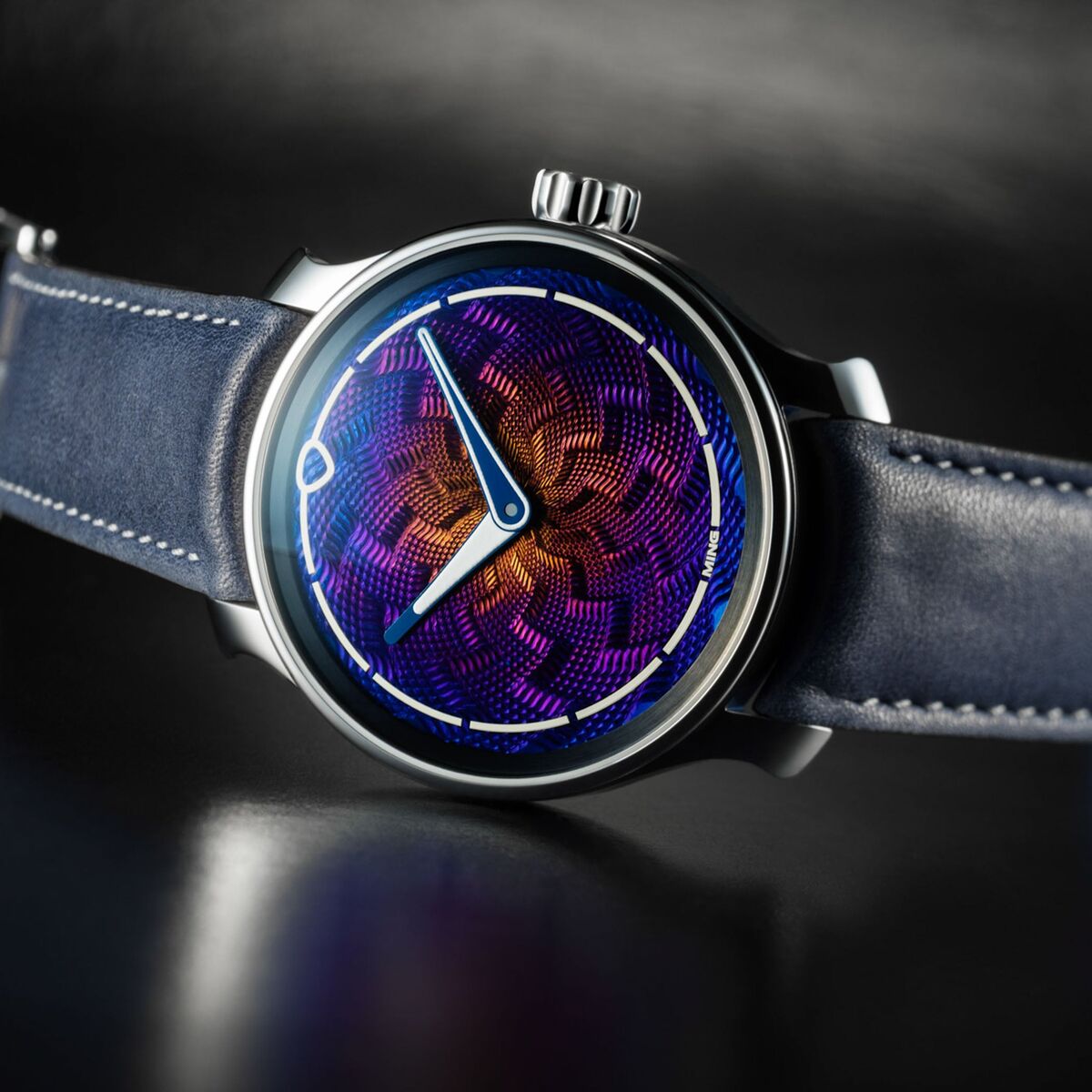
The dial starts as grade 2 titanium. Shapiro cuts the guilloché on traditional rose-engine lathes, in a pattern that is new to his repertoire: a set of jagged lines that radiate from the centre and break across the surface like lightning. The choice of titanium is not incidental. The metal takes heat colour in a way brass does not, and it is the heat that makes the watch what it is.
That second step happens in Ming's Kuala Lumpur atelier, where the colour is applied by hand with a butane torch. The gradient runs from oranges and yellows at the centre, through purple, out to deep blue at the rim. There is no chemical bath and no mask. The colour is temperature, read off the metal as it changes, and the maker has one pass to get it right.
It frequently goes wrong. Ming puts the failure rate at one dial in three. Hold the torch too long or not long enough and the colour distributes unevenly and the dial is finished. The guilloché compounds the risk, because engine-turning can expose variations in the crystalline structure of the titanium that only reveal themselves once the heat is on. Each surviving dial carries a slightly different gradient. None of them are identical, and none of them can be.

Where the light comes from
The luminescence is handled the way Ming has handled it for years, which is to say not on the dial at all. The hour indices are laser-hollowed cavities cut into the underside of the domed sapphire crystal and filled with luminous HyCeram, so they appear to float above the guilloché. The hour and minute hands are treated with Super-LumiNova X1.
The case is from the brand's 37-series: 38mm across, 10.9mm thick, with a compact 44.5mm lug-to-lug, a large notched crown and the sweeping pagoda lugs that give the line its profile. It is steel, brushed and polished, water-resistant to 100 metres, with domed sapphire crystals front and back.
The movement, and the maths
Under the caseback is a Sellita SW210.M1, a manual-winding calibre running at 4Hz with a 42-hour reserve, telling hours and minutes only. It has been reworked with skeletonised bridges and an anthracite-coated baseplate. This is the pragmatic half of the watch. The story here is the dial, and the movement is a reliable base chosen to carry it rather than compete with it. The watch ships on a blue Barenia calfskin strap by Jean Rousseau with a flying-blade buckle.
The price is CHF 6,250, before tax. Ming has not stated an edition size, because the edition size is whatever the process allows. Orders opened June 5 at 13:00 GMT for a first batch, and the two makers expect to produce roughly ten pieces a month going forward. At that rate the arithmetic is the interesting part: if a third of the dials are scrapped, the throughput is not a marketing constraint but a physical one. The watch costs what it costs because two people made it twice as often as it sold.
Sources
- Monochrome Watches — Introducing: The Electrifying Dial of the Ming x J.N. Shapiro 37.06 Lightning
- Ming — official site, orders and specifications
- Monochrome Watches — J.N. Shapiro Resurgence, the first all-American mechanical watch since 1969
- Monochrome Watches — Ming 21.01 Project 21, the makers' earlier collaboration