M.A.D.Editions is the part of MB&F that ordinary people can actually buy into. It started as a thank-you note in metal, a watch Maximilian Busser made for the friends, suppliers and collectors who had carried the brand, and it grew into a small line of its own. The M.A.D.1 came first, then the M.A.D.2 designed with Eric Giroud. For the third watch the label has done something different. It has handed the mechanics to Vincent Calabrese, an 82-year-old independent watchmaker, and built an accessible version of one of his signature displays. The result is the M.A.D.3, shown at Geneva Watch Days at CHF 2,900.
Vincent Calabrese and the Baladin
Calabrese was an independent watchmaker before the phrase meant anything. He co-founded the AHCI, the academy of independent watchmakers, with Svend Andersen in 1985, and across a long career he registered more than forty patents. His best-known work is not signed with his name at all: he designed the linear movement that became Corum's Golden Bridge, one of the most recognisable movement architectures in watchmaking. Among his own creations was the Baladin, a watch built to answer a complaint he had with jumping hours. He found the instant jump too abrupt, too disconnected from the sense of time passing, so he made the hour travel instead. On a Baladin the hour sits in a small window that moves slowly around the dial over sixty minutes, marking the minutes as it goes, and only then jumps back to begin the next hour.
What the M.A.D.3 does
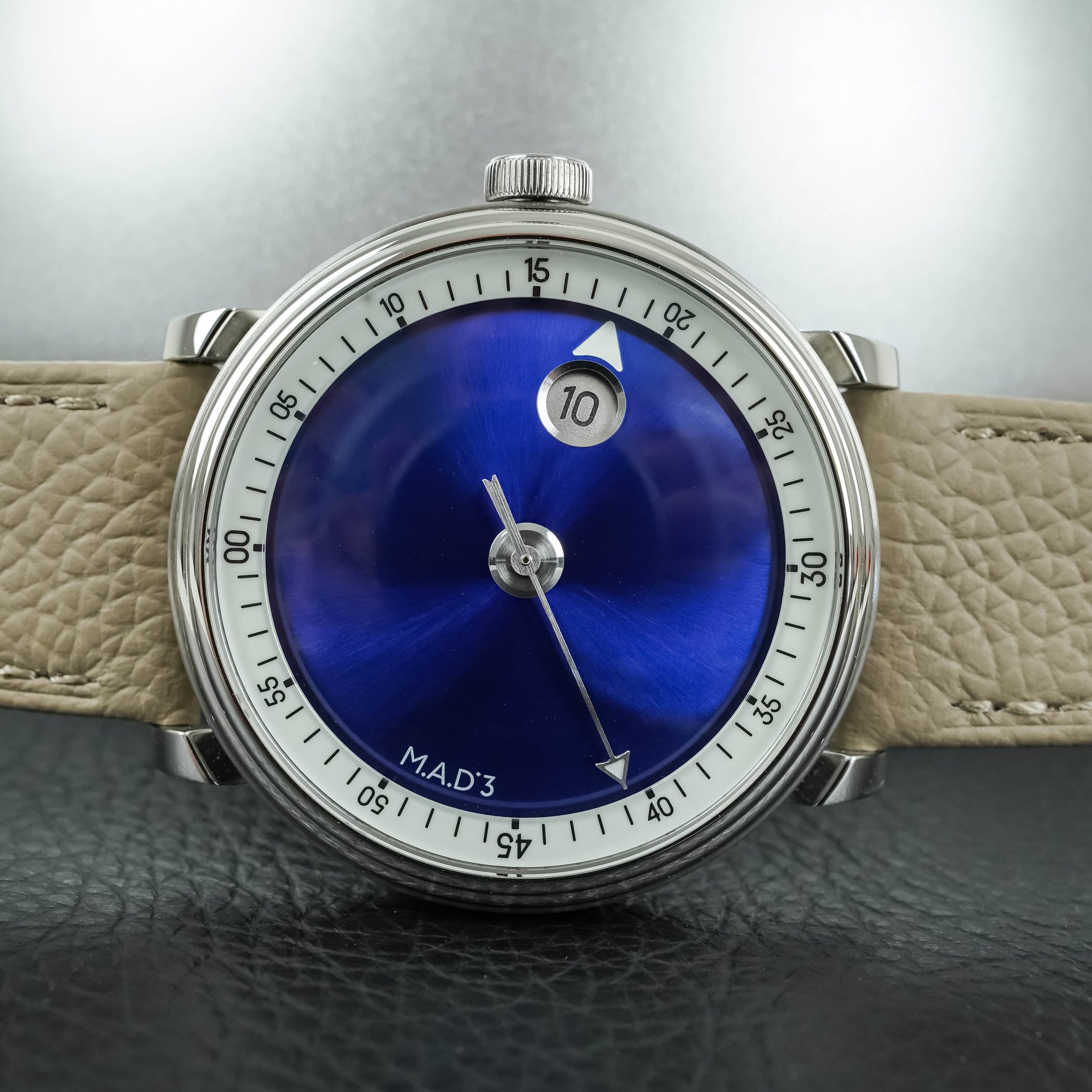
The M.A.D.3 takes that idea and rebuilds it for series production. The hour appears in a circular window fitted with an arrow, and over an hour the whole assembly sweeps around a luminous peripheral track, so the arrow points at the minutes while the window shows the hour. When the hour is up, the display returns to the top and starts again. There is also a central seconds hand, itself arrow-shaped, which is unusual on a jumping-hour watch but was a Calabrese habit. The dial is domed and sunray-brushed, in blue for the public edition and pink for the one kept for MB&F's collectors, and the flange, hour disc and pointer are coated in Super-LumiNova.
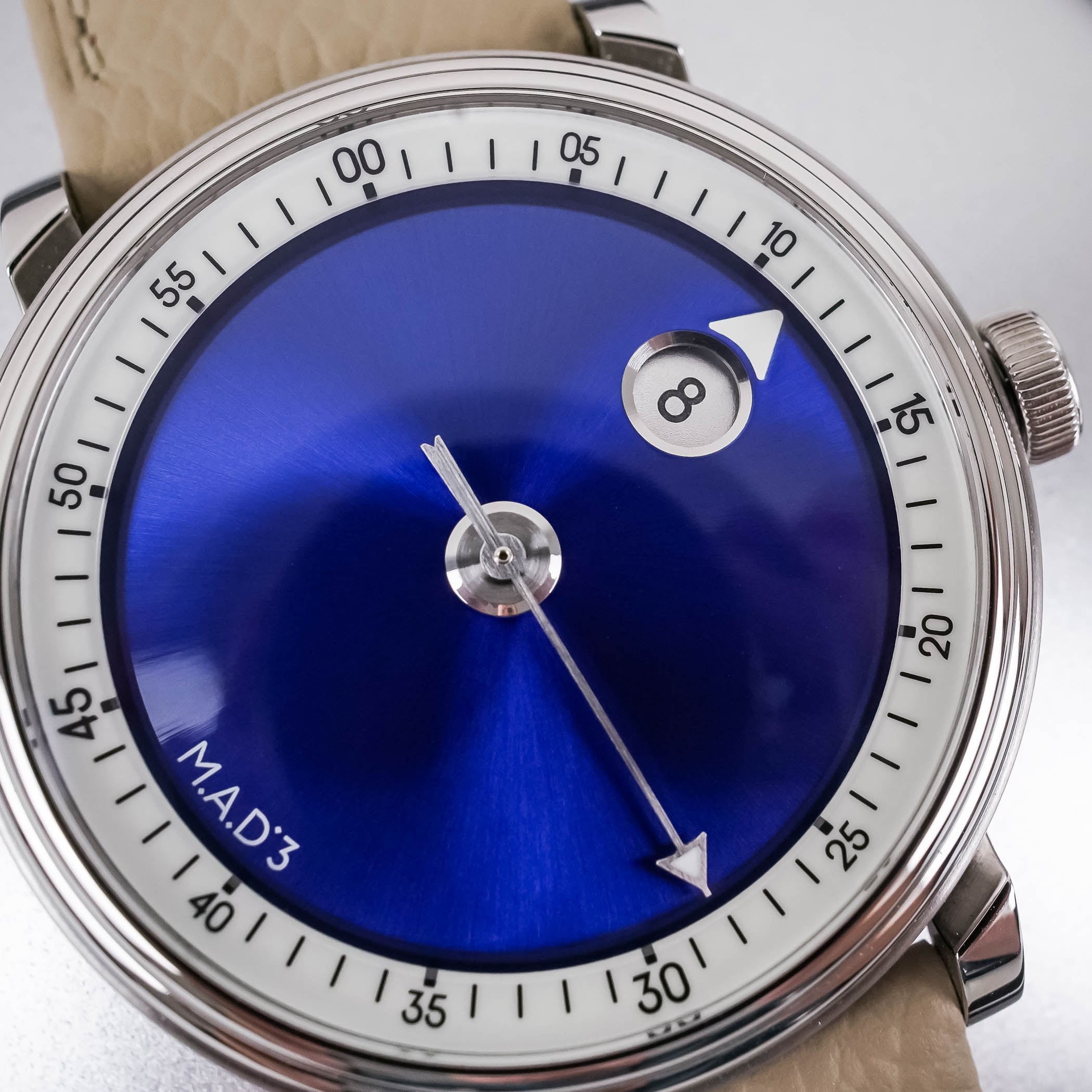
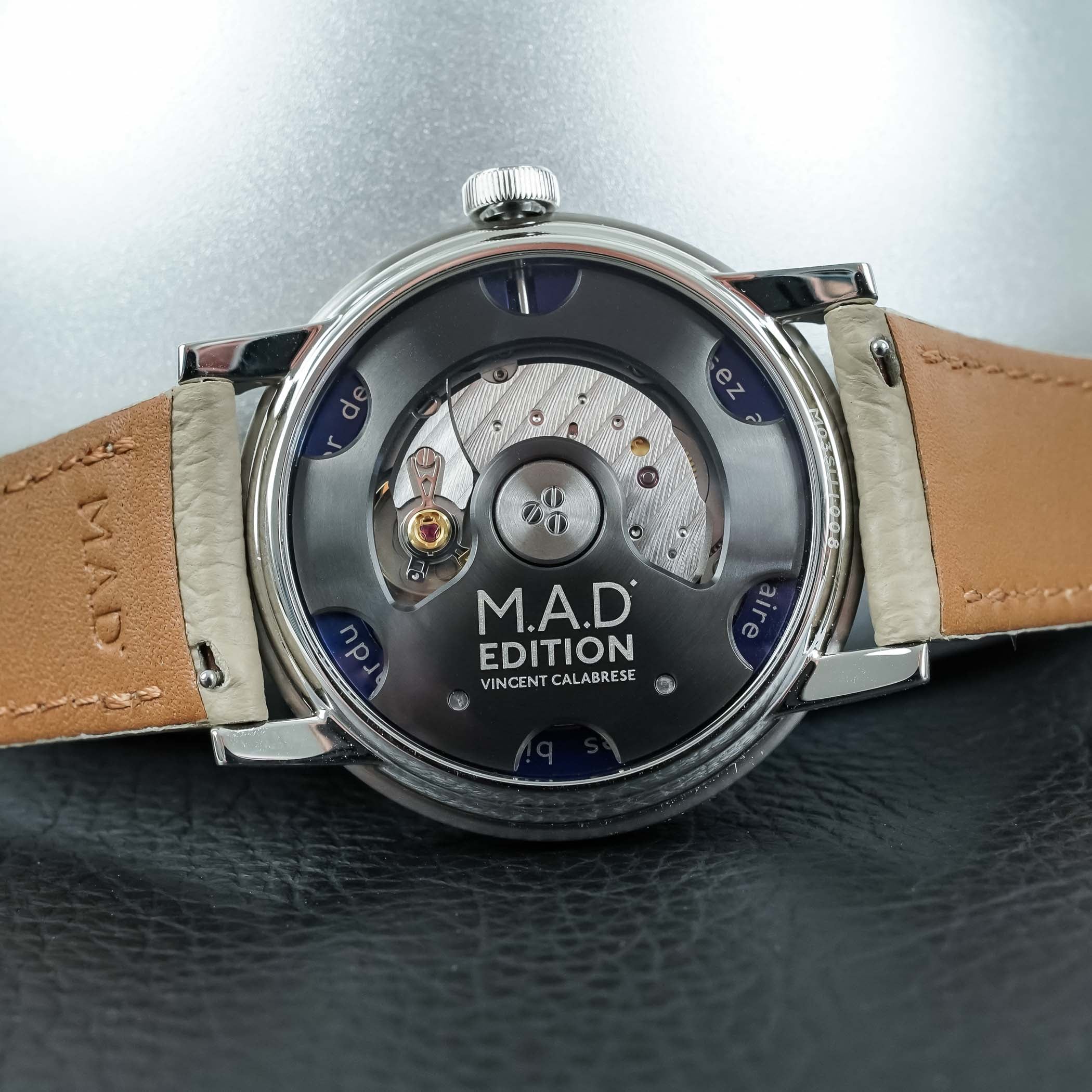
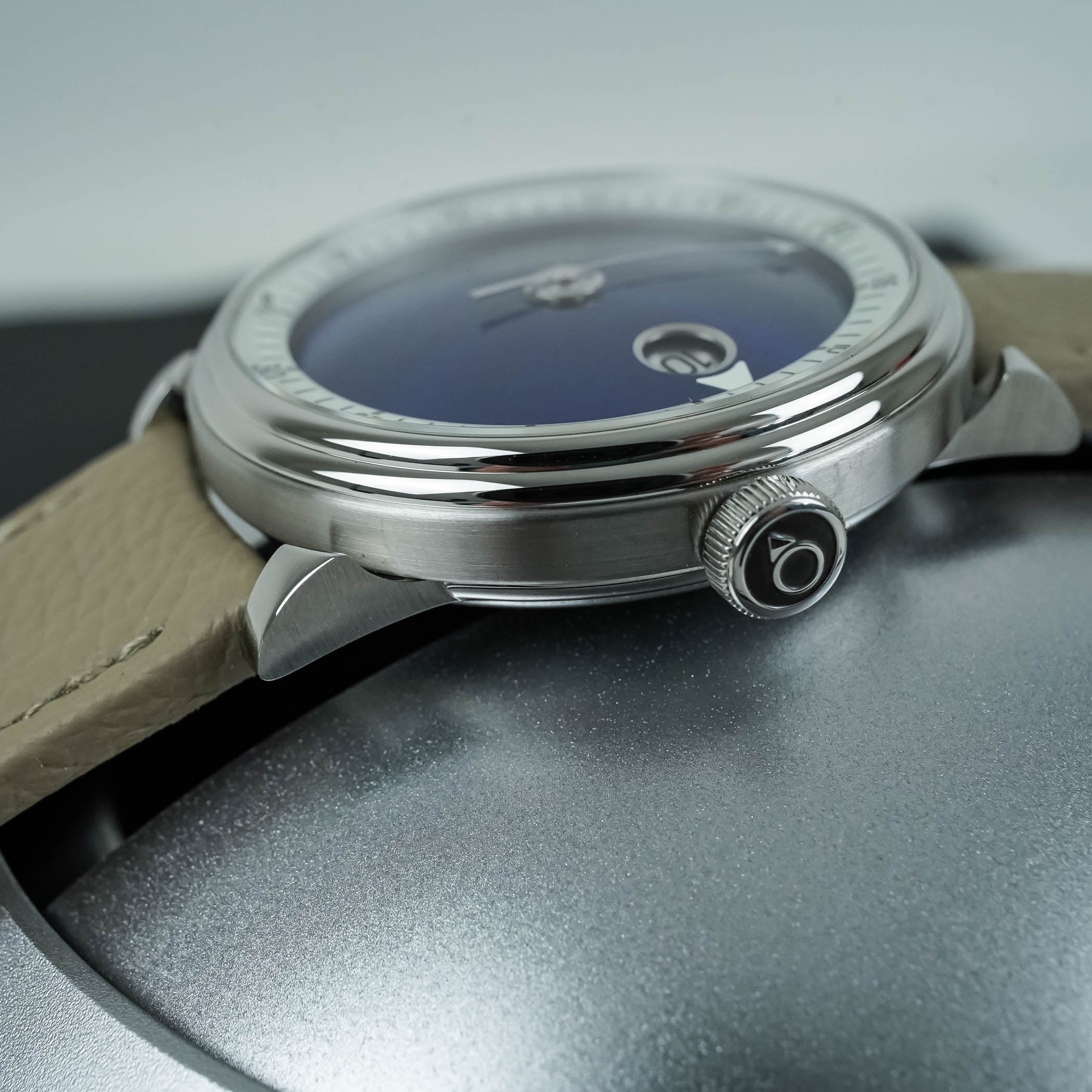
The case and the movement
The case is the M.A.D.Editions signature, designed by Eric Giroud, with floating lugs that stand away from the case band and a double-stepped bezel, but it is more restrained than the brand's earlier work. It measures 40mm across, 43.7mm from lug to lug and 12.7mm thick, in steel that is brushed and polished, with domed sapphire crystals front and back and 30m of water resistance. Inside is an automatic La Joux-Perret G111, the same base the label used in the M.A.D.1S and M.A.D.2, here carrying a bi-directional jumping-hour and trailing-minutes module developed by MB&F. It runs at 28,800 vibrations an hour, holds 24 jewels and keeps a 55-hour reserve. MB&F says it redeveloped the wandering module from the ground up, to make Calabrese's artisanal mechanism reliable and repeatable at this scale.
Price and availability
Two versions are made. The blue is offered to the public through a raffle, the standard M.A.D.Editions route, and the pink is kept for the brand's Tribe and Friends. Both come on a beige leather strap with a steel folding buckle, and both are CHF 2,900 excluding taxes. Registration details are at mbandf.com/madeditions, and Monochrome has the full first look. At that price the M.A.D.3 is one of the few ways to wear a Vincent Calabrese idea without paying for a piece of independent history, and it is the most traditional watch the label has made.