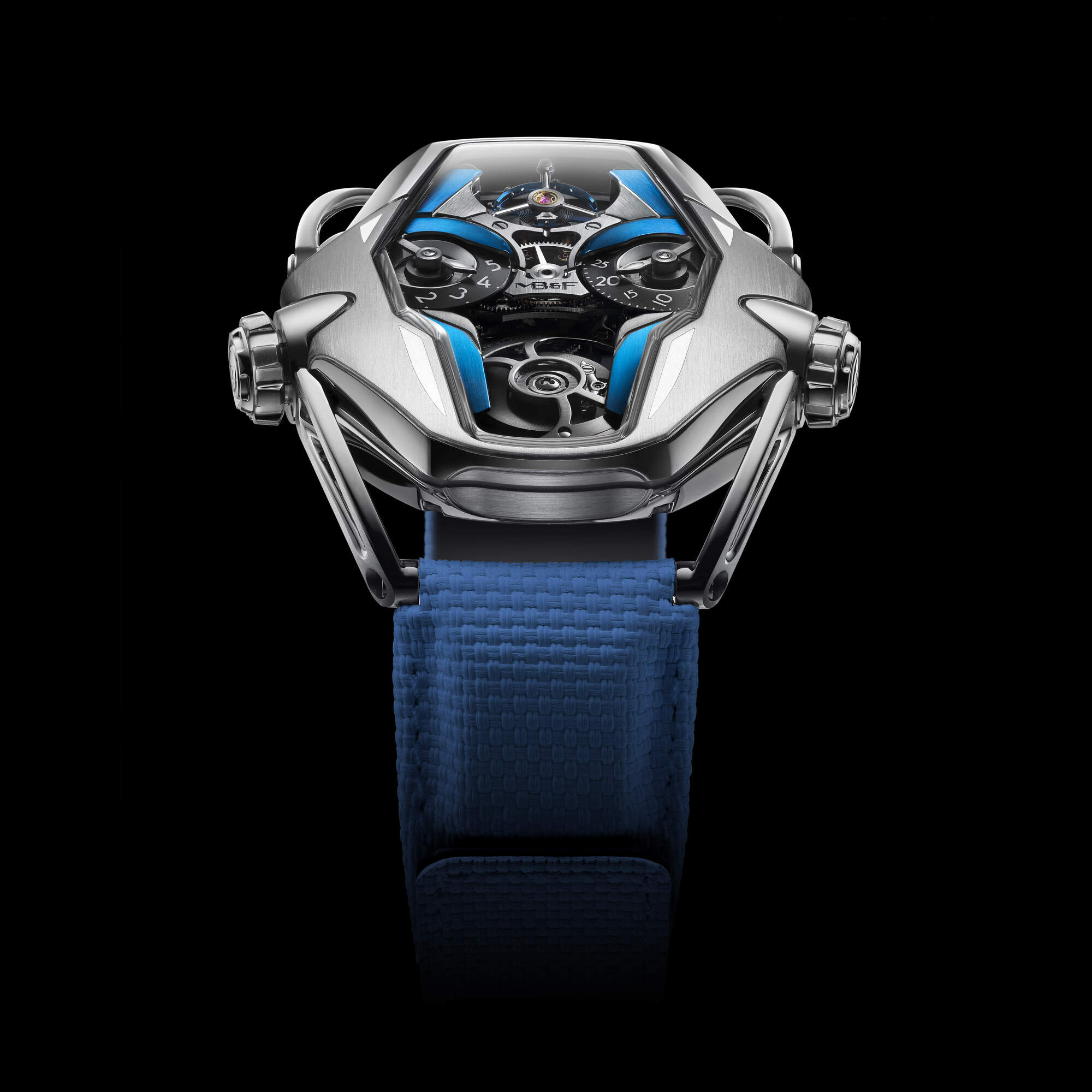
MB&F announced the Horological Machine N°12 on June 10, and the premise fits in one sentence: what if a robot's head were a watch? Maximilian Büsser asked the question, handed it to designer Maximilian Maertens, and stepped back. Four years later the HM12 The Guardian is the answer, a grade 5 titanium wristwatch that detaches from its strap and clips onto a 38.2cm mechanical robot built by L'Épée 1839. Between the two halves there are close to 1,500 components.
The release matters beyond the spectacle. It is the first Horological Machine in twenty years conceived without Eric Giroud, the designer whose hand shaped nearly every MB&F case since HM1 in 2007. Giroud remains a partner on other projects; HM12 belongs entirely to the two Maximilians. For a brand whose identity has always been collaborative, that is a quiet structural shift announced through a 15-kilogram robot.
The head
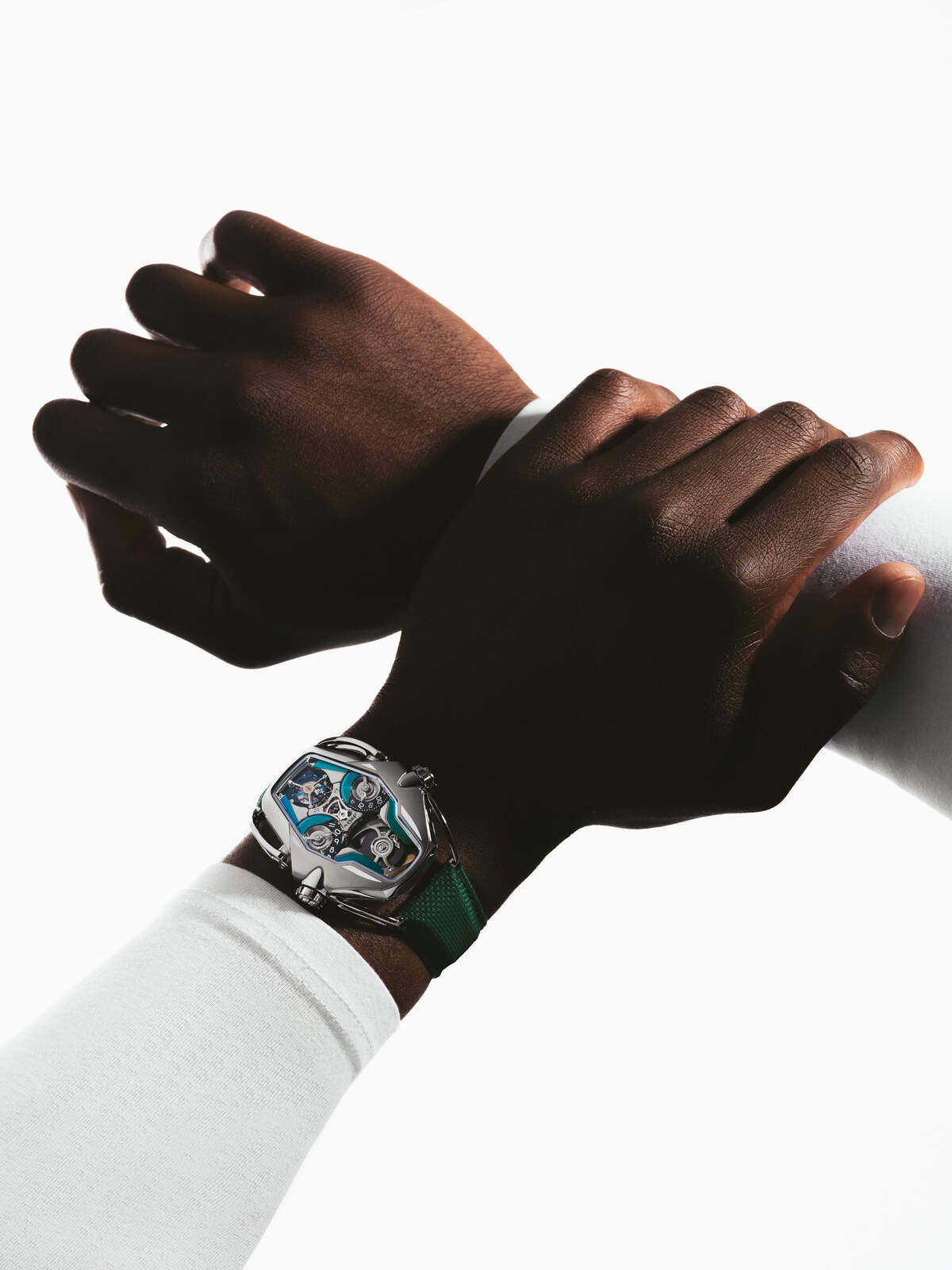
The watch reads as a face. Instantaneous jumping hours sit in the left eye, trailing minutes in the right, both on rotating discs read against fixed points. One side of the micro-rotor, cut in MB&F's battle-axe shape, turns where the mouth would be. The flying tourbillon occupies the position of the brain at 12 o'clock, visible from above and from the side through one of three sapphire crystals. The case measures 49.3mm long, 43.6mm wide and 13.8mm thick, with 84 components, mobile lugs at the top and fixed lugs at the bottom.
The signature complication is mechanical eyelids. A pair of shields, driven by the left crown through a system of more than 200 dedicated parts, slides across the dial to cover or reveal the face. The mechanism runs independently of the movement, stops at any position, and the crown declutches when the shields reach their end stops. MB&F treats it as a complication; functionally it is a privacy setting for a robot.
The engine
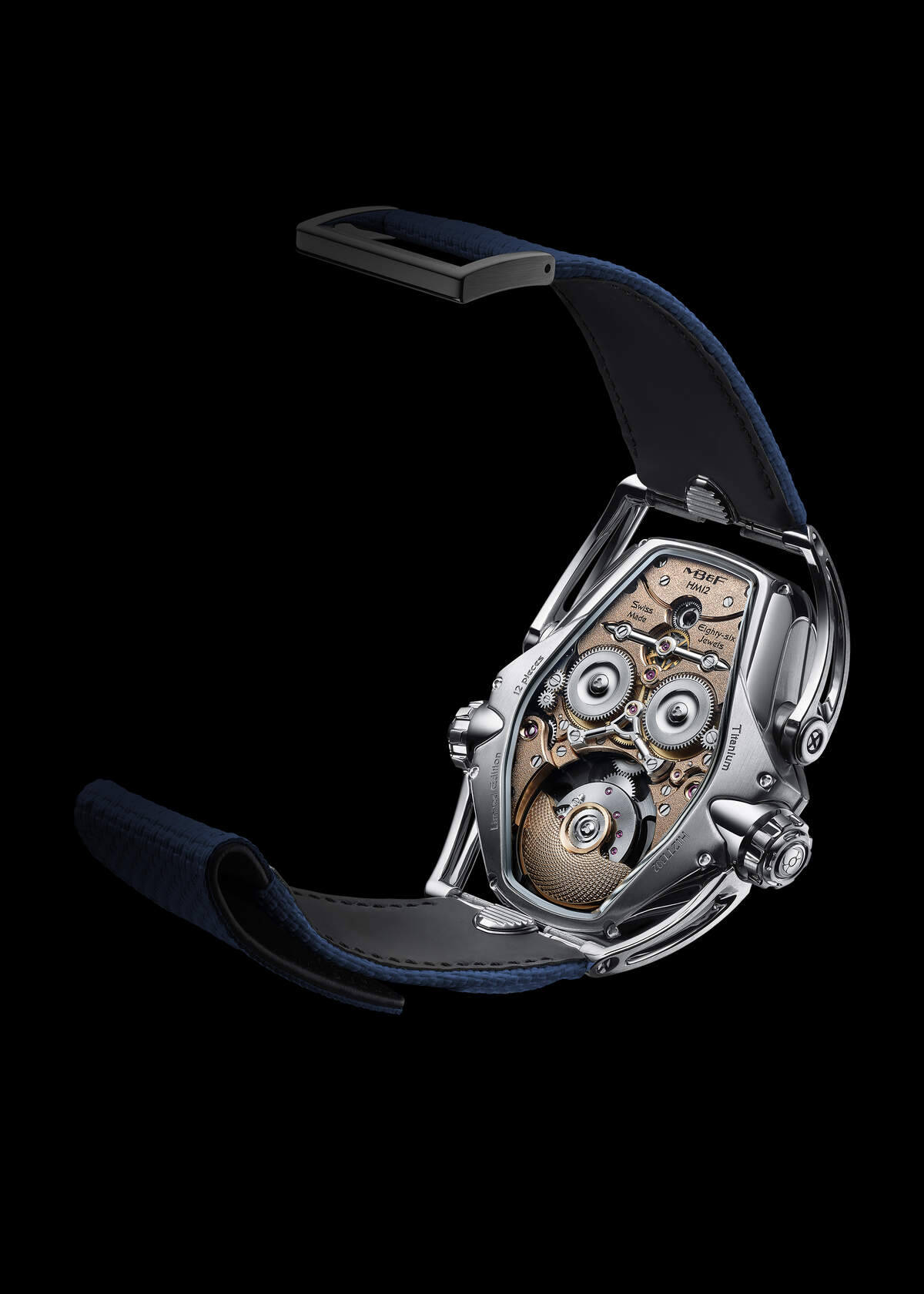
The in-house automatic calibre runs to 646 components and 86 jewels, with an 84-hour power reserve and a double-sided winding rotor. The back of the watch drops the science fiction entirely: symmetrical hand-finished bridges follow the case shape, and the domed rear rotor carries guilloché executed with the involvement of Kari Voutilainen and his team. The pattern is cut on a curved spherical surface rather than a flat plane, which Monochrome notes is considerably harder than conventional engine turning.
The body
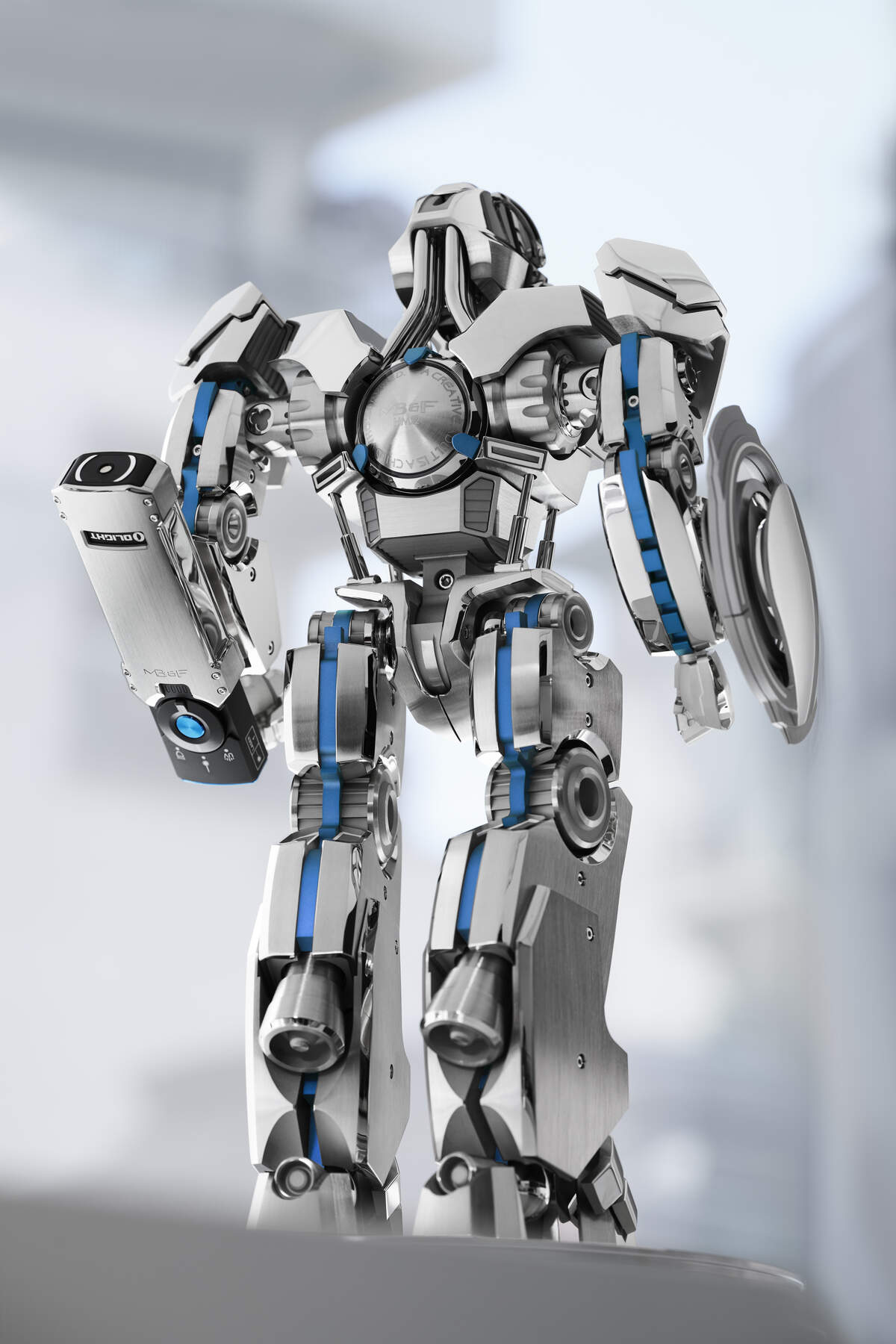
The Guardian itself is a L'Épée 1839 build of 755 components, 22cm across the base and roughly 15kg on the scale. It is not a stand with ambitions. The chest houses a working mechanical thermometer. One arm conceals a magnifying loupe for examining the movement, the other holds a detachable UV torch for charging the Super-LumiNova on both robot and watch. The strap, removed via quick-release when the watch is mounted, stores in a drawer hidden in the base. MB&F has built robot clocks with L'Épée before, Melchior in 2015, Balthazar in 2016, Grant in 2018, but those were clocks shaped like robots. This is the first time the wristwatch is the robot's head, and the first time the two are sold as one object.
Price and production
Three editions, green, blue and purple, at 12 pieces each, and MB&F states no further variants will follow. Thirty-six examples, at CHF 280,000 before VAT. That is Legacy Machine Thunderdome territory, and the buyers will not be cross-shopping anything. The HM12 is a twentieth-anniversary statement that the brand's third decade starts where the first one did, with childhood drawings taken unreasonably seriously.