Most debut watches come from people at the start of a career. The Marcu Initial comes from the other end of one. Jérôme Marcu began in watchmaking in the 1980s and has spent the decades since inside established workshops, among them Vacheron Constantin, Patek Philippe, Roth & Genta and Bovet. Since 2016 he has run his own atelier, prototyping and servicing watches for prestigious maisons that do not put his name on anything. The Initial is the first watch that does, and it arrives as one of two independent debuts Monochrome covered in a single week, a sign of how crowded the top of the independent scene has become.
An unusual case
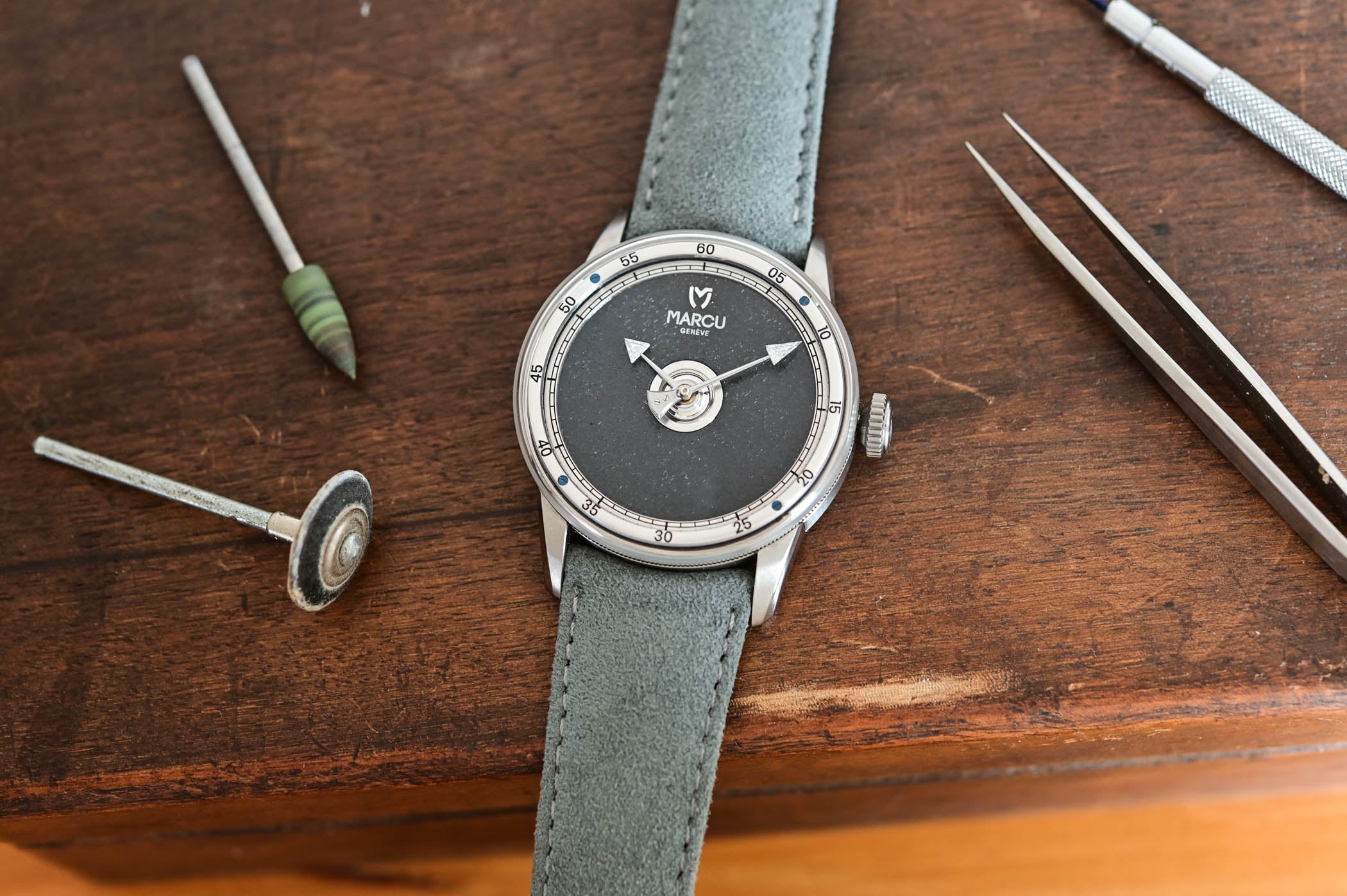
The round case is 40mm in diameter and made of grade 5 titanium, and it does not look like anything off a shelf. A domed sapphire crystal sits on top like a glass cap, extending out over the bezel and meeting the case band flush, so the front of the watch reads as one continuous curve. The bezel itself is mounted on pillars and graduated every five minutes, and the lugs are screwed on rather than integral. It is water-resistant to 30 metres. At 13.10mm thick it is not a slim watch, and the height has a specific cause that becomes clear once you look at the hands.
The dial and those hands
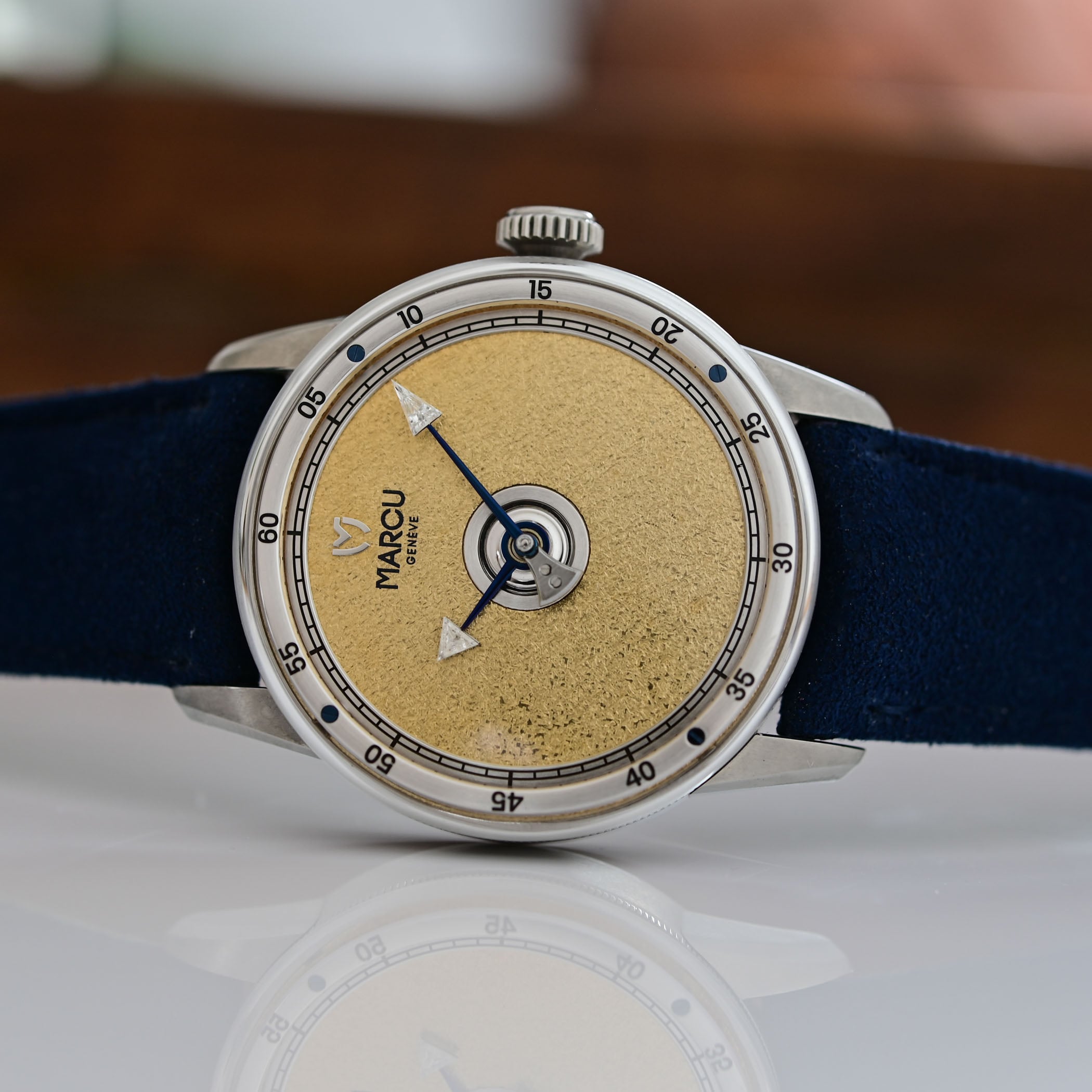
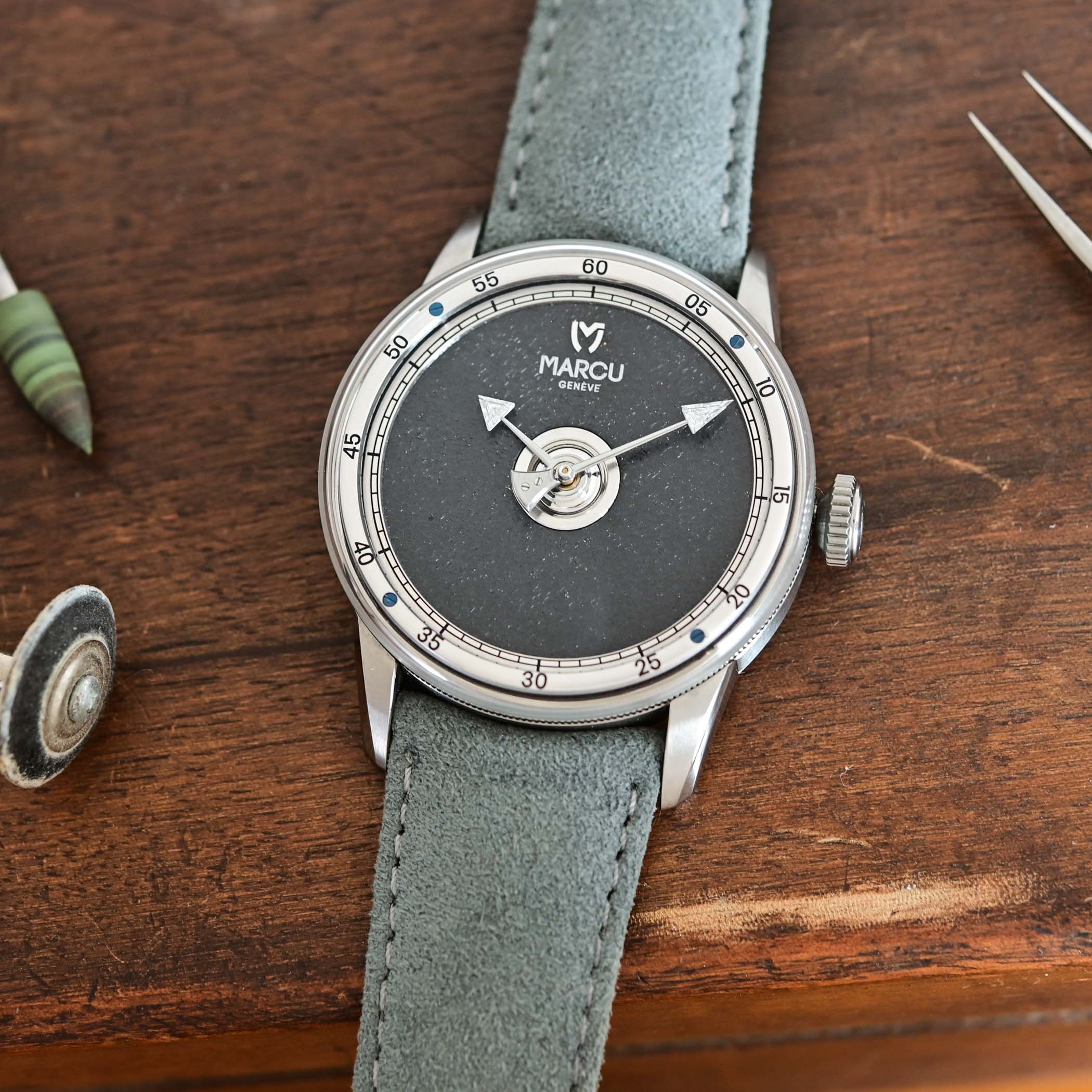
The dial carries a pine-needle motif with two concentric rings at its centre, an idea drawn from clockmaking. The reason for the height is the hands: rather than paint or lume them, Marcu tipped his steel hands with triangle-cut diamonds, each stone graded D IF VVS1 at 0.09 carats. A conventional hand is around 0.2mm thick; these stand 1.4mm proud of the dial. Setting a diamond onto a steel hand is difficult work, requiring a groove cut directly into the stone for an invisible setting, and the weight it adds is not trivial. To compensate, Marcu fitted a black polished steel counterweight in exact opposition to each diamond, cancelling the gravitational pull that would otherwise disturb the rate. It is the sort of problem an experienced watchmaker notices before it becomes one.
The JM01 calibre
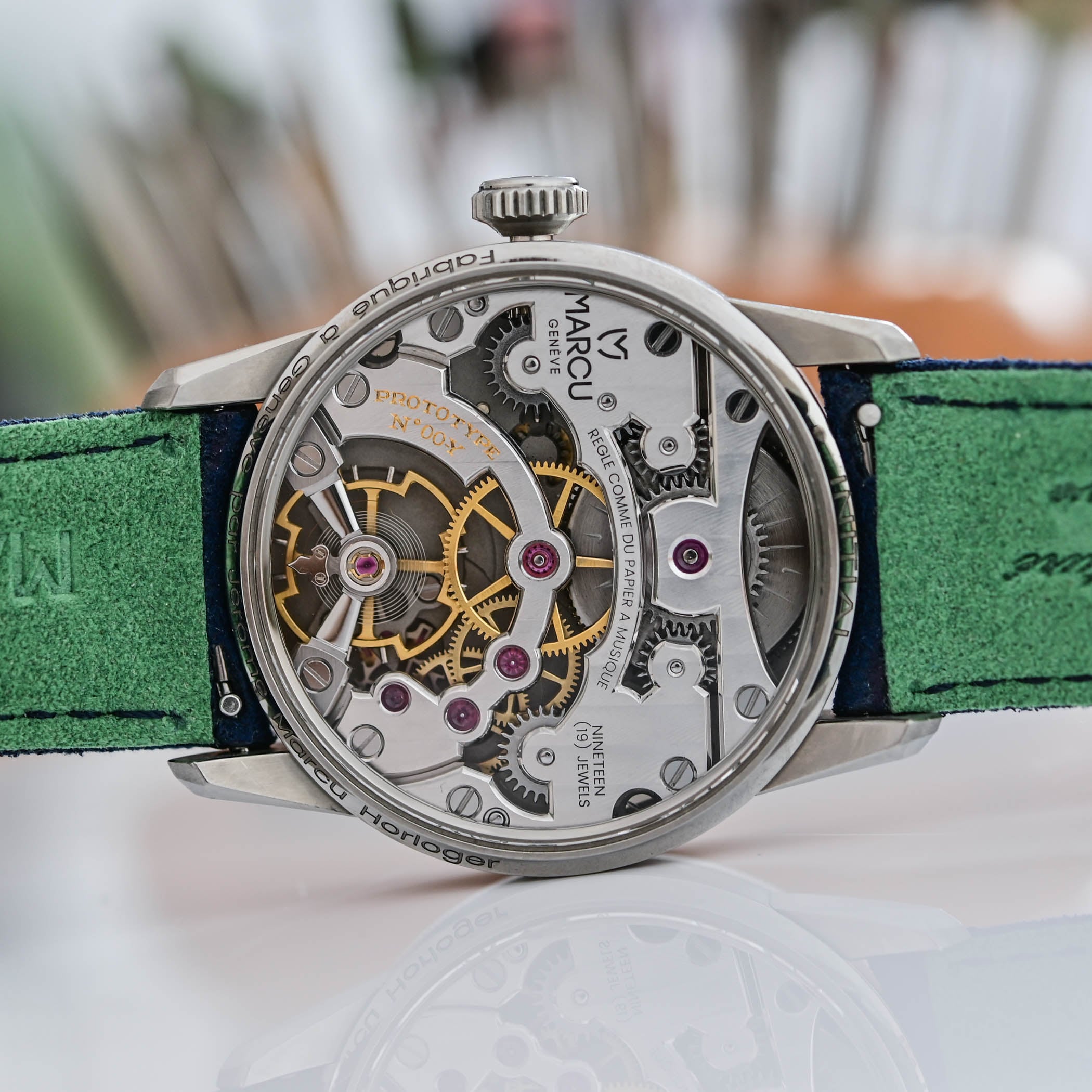
Turn the watch over and the case-back frames a large movement, 37mm across, built for symmetry. The barrel, central wheel and balance wheel are aligned on a single vertical axis, and the components are held by four separate bridges: one for the barrel, one for the winding mechanism with a click adapted to mirror the crown wheel, a semicircular wheel-train bridge, and a steel bridge over the balance. The hand-wound JM01 beats at 18,000 vibrations per hour for a 50-hour power reserve, running on 19 jewels with a variable-inertia balance regulated by gold screws, and it is built on a German silver mainplate and bridges decorated with Geneva stripes and no fewer than 75 hand-finished angles, 15 of them inward. In place of the usual réglé sur 5 positions, the movement is inscribed réglé comme du papier à musique, regulated with the precision of a musical score, a French idiom that also points back to a family who built automata and musical instruments. Each movement is individually numbered on the gear-train bridge.
Price and place
The Initial is presented on an Alcantara strap with a pin buckle and released in grade 5 titanium as a series of 33 pieces, 11 each with an anthracite, golden or deep blue dial. The price is CHF 59,000 before tax, which is a great deal of money for a time-only watch, and Marcu is not alone in asking it; the steady climb in prices among new independents has not gone without comment. What separates this launch from a bare-dial debut at similar money is that the movement is Marcu's own, finished by hand and solving a real problem of its own making. For a first watch that carries forty years of work under other names in its construction, that is a defensible place to start.
Sources: Monochrome Watches and Marcu Genève.