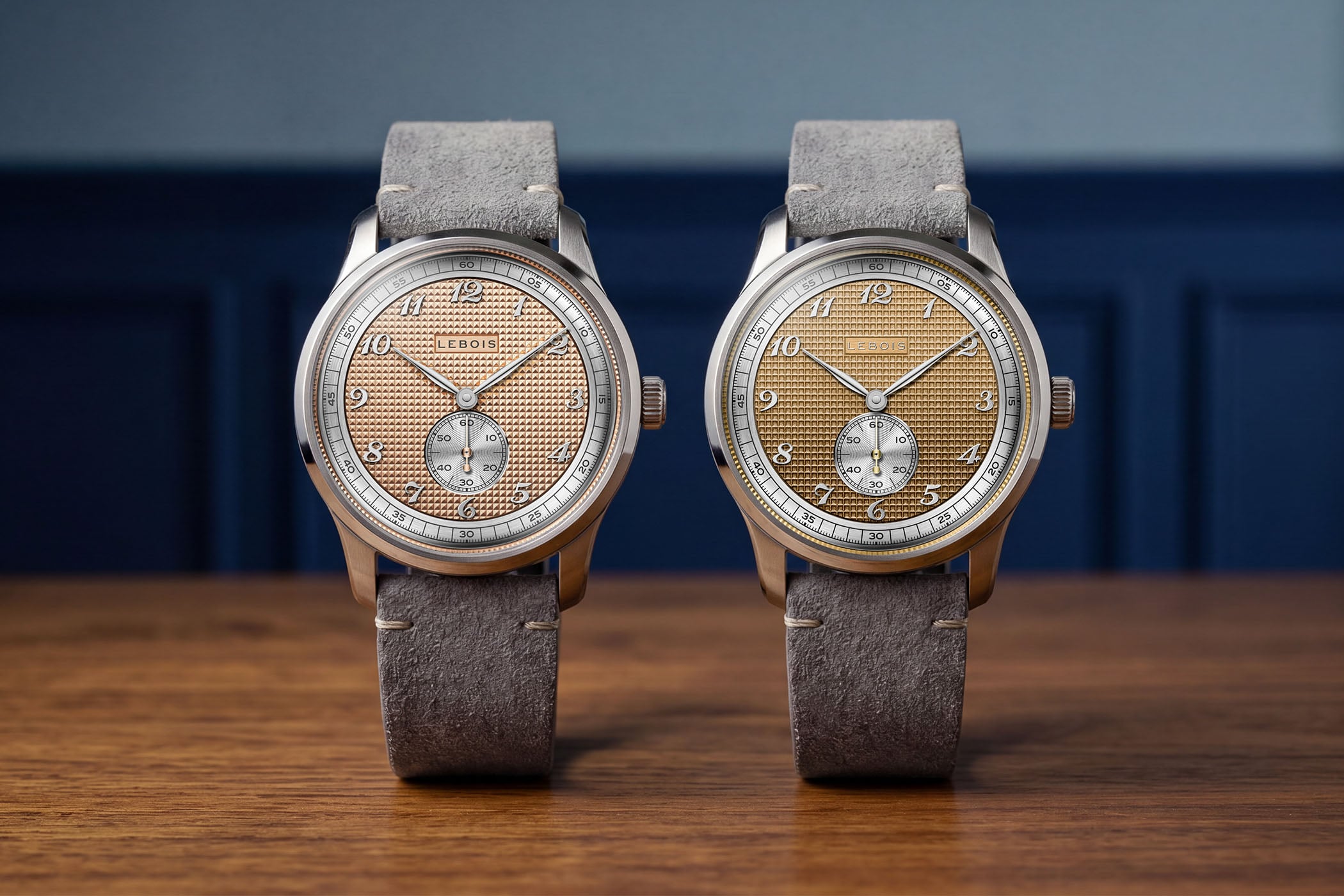
Lebois & Co has spent the years since its revival by Tom van Wijlick building classically styled watches with vintage character, most recently the compact Heritage Small Seconds. Now it has given its more elaborate work a name. The Heritage Atelier is a formal sub-collection for collaborations with outside specialists, and it launches with two dials made alongside Swiss dial house GT Cadrans: the Small Seconds Clous de Paris and the Small Seconds Stroopwafel. Both were introduced by Monochrome and covered in a hands-on by Oracle of Time.
Two dials from the same workshop
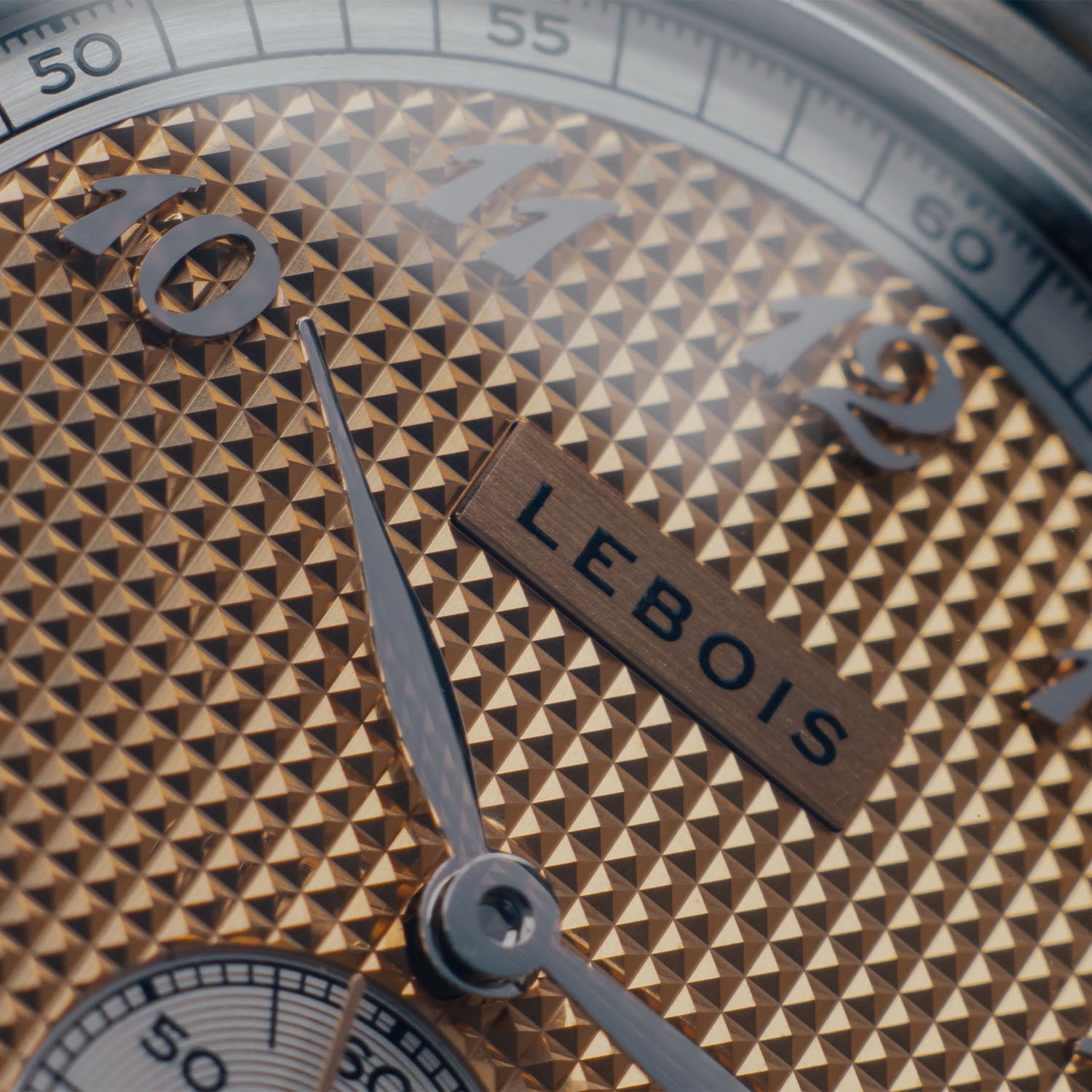
The Clous de Paris is the traditional one. Clous de Paris, or hobnail, is one of watchmaking's oldest decorative motifs, a repeating field of tiny pyramids that catch and scatter light. GT Cadrans produces the pattern with a precision CNC diamond-cutting process rather than a rose engine, then applies a galvanic finish using a 24-carat gold solution, which gives the dial its warm rose-gold tone. Against it sit a silver small seconds sub-dial and applied Breguet-style numerals.
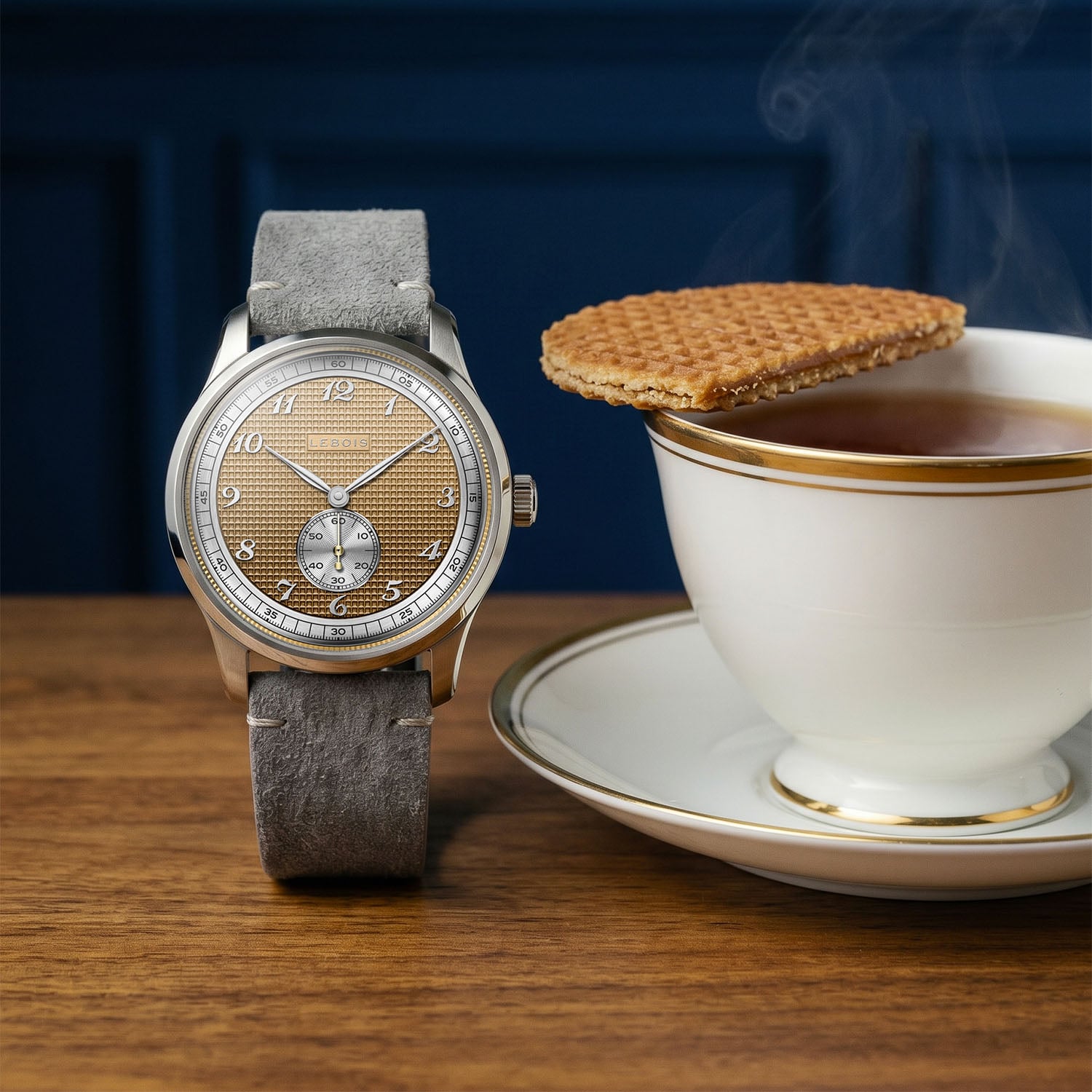
The Stroopwafel is the playful one, and it has a real origin story. During the 2024 New York watch fairs, the Lebois team brought a tin of stroopwafels to share, and the woven texture of the Dutch caramel waffle became a question: could it be a dial? Working again with GT Cadrans, the brand developed a finely laser-engraved pattern that recreates the waffle, finished in a caramel-toned galvanic treatment. Under magnification the engraving holds a surprising amount of detail, and it is executed with the same seriousness as any traditional decorative dial rather than as a novelty.
Both dials share the rest of the layout: applied Breguet-style numerals, leaf-shaped hands, a recessed small seconds at six and a railroad minutes track in contrasting silver.
The watch under the dial
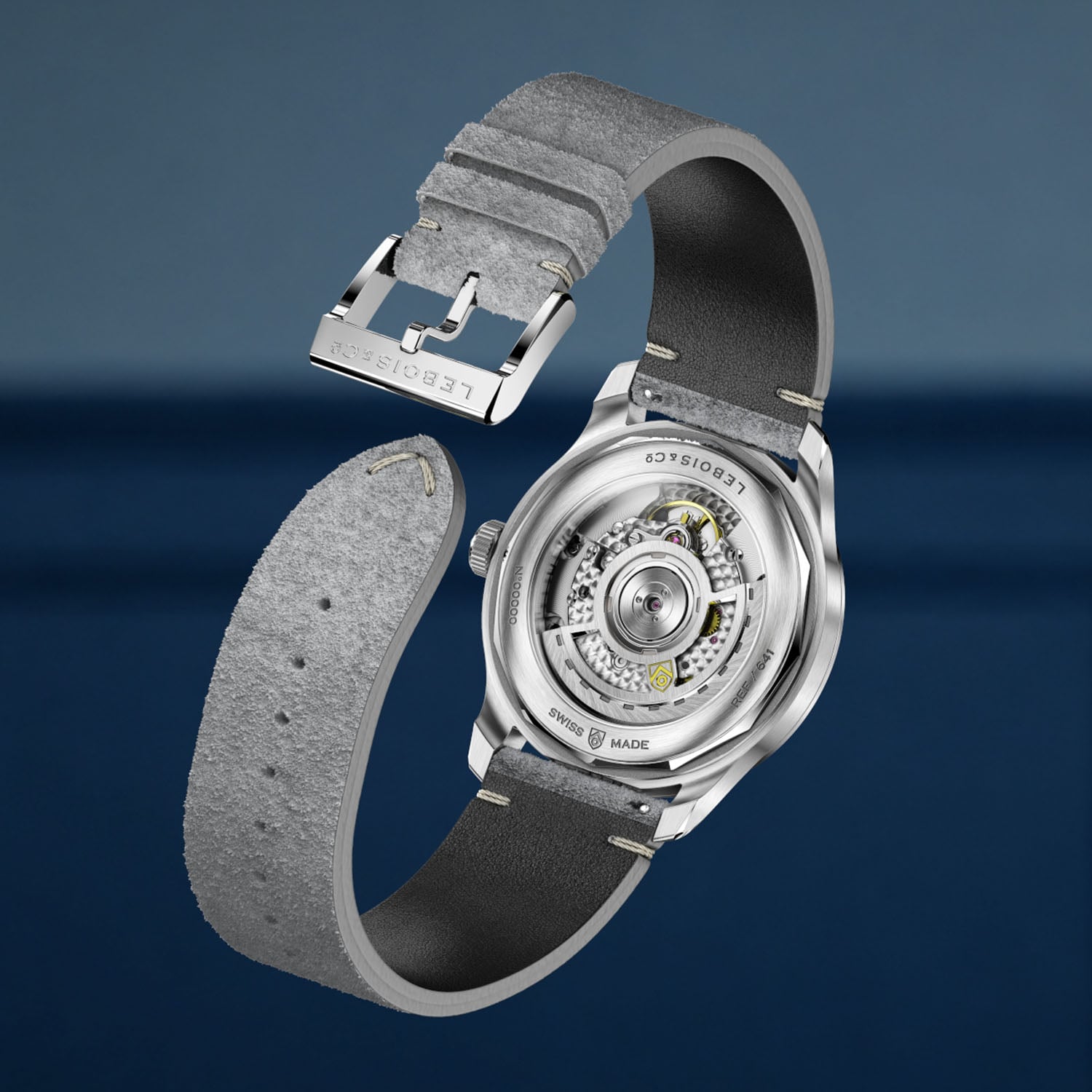
The new series keeps the proportions of the Heritage Small Seconds. The polished and brushed 316L stainless steel case measures 37.8mm across, 10.5mm thick with the crystal and 45.5mm lug to lug. A double-domed sapphire crystal with anti-reflective coating sits over the dial, a screwed exhibition caseback shows the movement, and water resistance is 50 metres.
Inside is the calibre LC-350, an automatic based on the Sellita SW360-1, itself the small seconds version of the SW300 and a long-standing alternative to the ETA 2892. It is COSC-certified as a chronometer, runs at 28,800 vibrations per hour with 31 jewels, and holds a 56-hour reserve. The Clous de Paris carries reference 641.548 and the Stroopwafel 641.550.
Price and how to buy one
Both are priced at EUR 5,500 including VAT, on a choice of leather straps with a pin buckle. They are not limited editions, but production is controlled through a single ordering window: orders open on 27 July 2026 and run for fourteen days, with deliveries expected in early 2027. Buyers receive an Atelier Discovery Set marking the collection, and anyone who pre-registered before the 27th gets an additional inauguration gift. More detail is at lebois.com.
The comments under the launch coverage were not uniformly kind about the price for a Sellita-based watch, which is a fair debate. The counterpoint is the dial work, and dials at this level of hand-guided finishing rarely arrive at EUR 5,500.