Perpetual calendars have a well-known flaw. You cannot run them backwards. If you forget to wind one and the calendar is sitting three months behind real time, you have to step through every day, one at a time, pushing the calendar forwards until the watch catches up. On a Kurt Klaus era IWC perpetual calendar, that means spinning the crown until your wrist gives out.
IWC just announced a new perpetual calendar movement, called ProSet, that fixes this. It is the most significant calendar mechanism the brand has shipped since Klaus designed its first modular perpetual in 1985, and it is the headline mechanical news from IWC's Watches and Wonders 2026 stand.
Gears instead of levers
Traditional perpetual calendars are built around a network of springs, cams, and levers that all take their cue from a central switch disc. The switch disc advances once per day. The levers read the disc, decide whether the month has 28, 29, 30, or 31 days, and push the date wheel accordingly. It works, but the system is unidirectional and fragile. Adjusting backwards can snap the levers off their springs.
The ProSet movement, covered in detail by Time and Watches and Monochrome, replaces the entire lever arrangement with a gear train. All of the calendar indications, the day, the date, the month, the year in its four-year cycle, and the moon phase, are locked onto the same synchronised geartrain. Setting the calendar is mechanically identical to setting the time. Turn the crown and the whole display moves together, in either direction.
This is a bigger deal than it might sound. Perpetual calendars are often only worn a few times a year, so the question of how to catch up after long rests is a practical one. Owners of Patek Philippe and Vacheron Constantin perpetuals know the ritual of sending the watch back to a boutique to have the calendar set. IWC is effectively saying you do not need to anymore.
The new Big Pilot editions
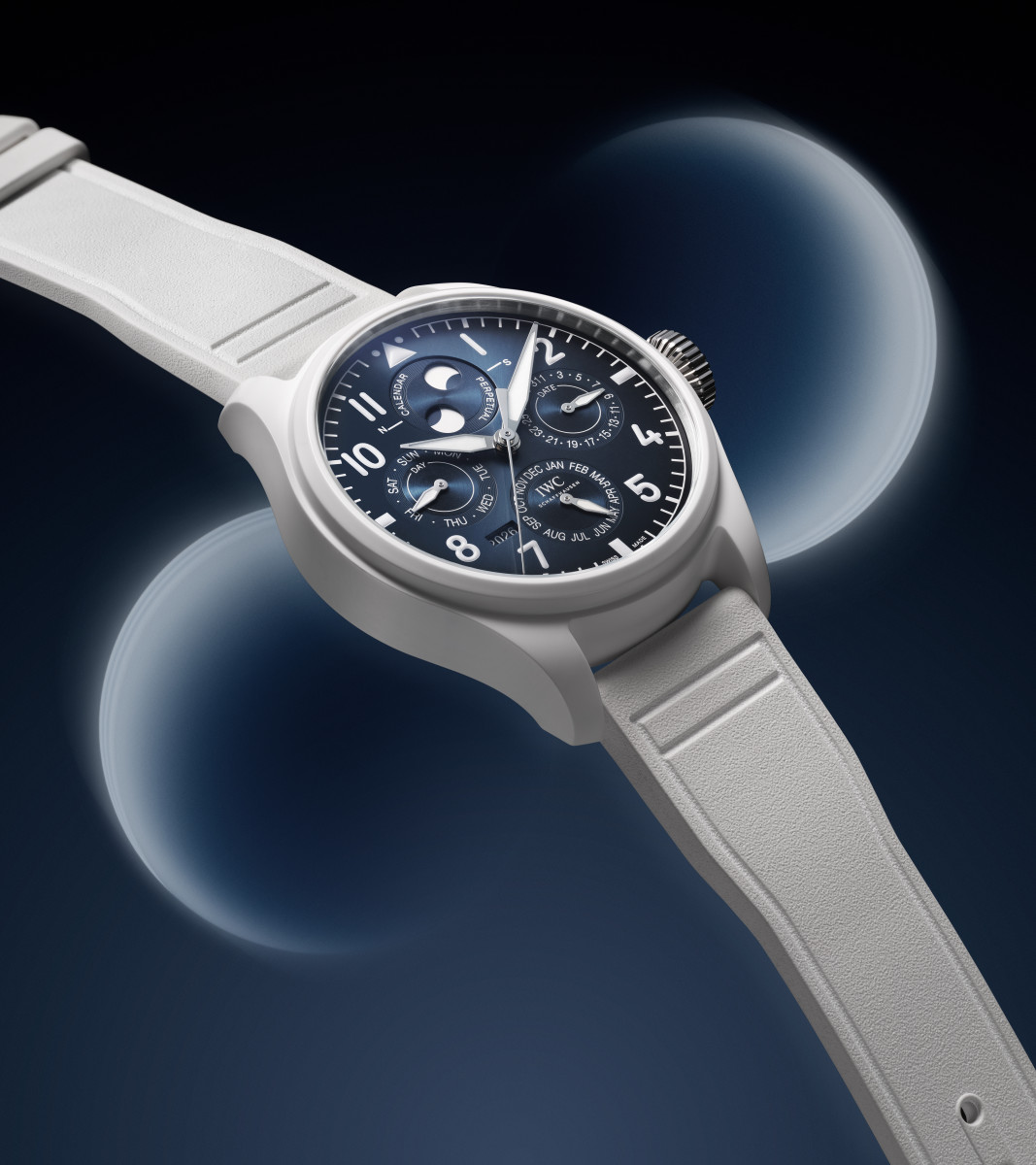
ProSet debuts in three Big Pilot's Watch references. All three run the calibre 82665, a variant of IWC's Pellaton-winding automatic architecture with silicon hairspring, nickel-phosphorus escapement, and a power reserve described by Monochrome as meaningfully above the industry norm.
The steel edition is priced at around CHF 38,700. The white ceramic version, at 42.9mm and 14.3mm thick, sits a little larger than the steel. The top of the range is an 18-carat 5N gold reference. Two of the three, the steel and the ceramic, wear Le Petit Prince livery, with the character engraved on the rotor and the signature blue dial that IWC has built a sub-collection around.
The moon phase
The ProSet's moon phase deserves a separate mention. It drifts one day in 1,040 years, which puts it in the same accuracy class as A. Lange and Soehne's Terraluna and Ochs und Junior's Luna Mondphase. For scale, a standard perpetual calendar moon phase drifts a day every 122 years.
Almost no one will ever notice. IWC knows that. The point is that the mechanism is now good enough that the watch will outlive the accuracy question.
The one mild disappointment from the release is that ProSet is launching first in the Big Pilot, a case that has become polarising on wrists under 7.5 inches. A thinner Portofino or Portugieser variant would be the logical next step, and IWC has said only that other collections will follow.
Sources: IWC Press Room, Time and Watches, Monochrome, Worldtempus.