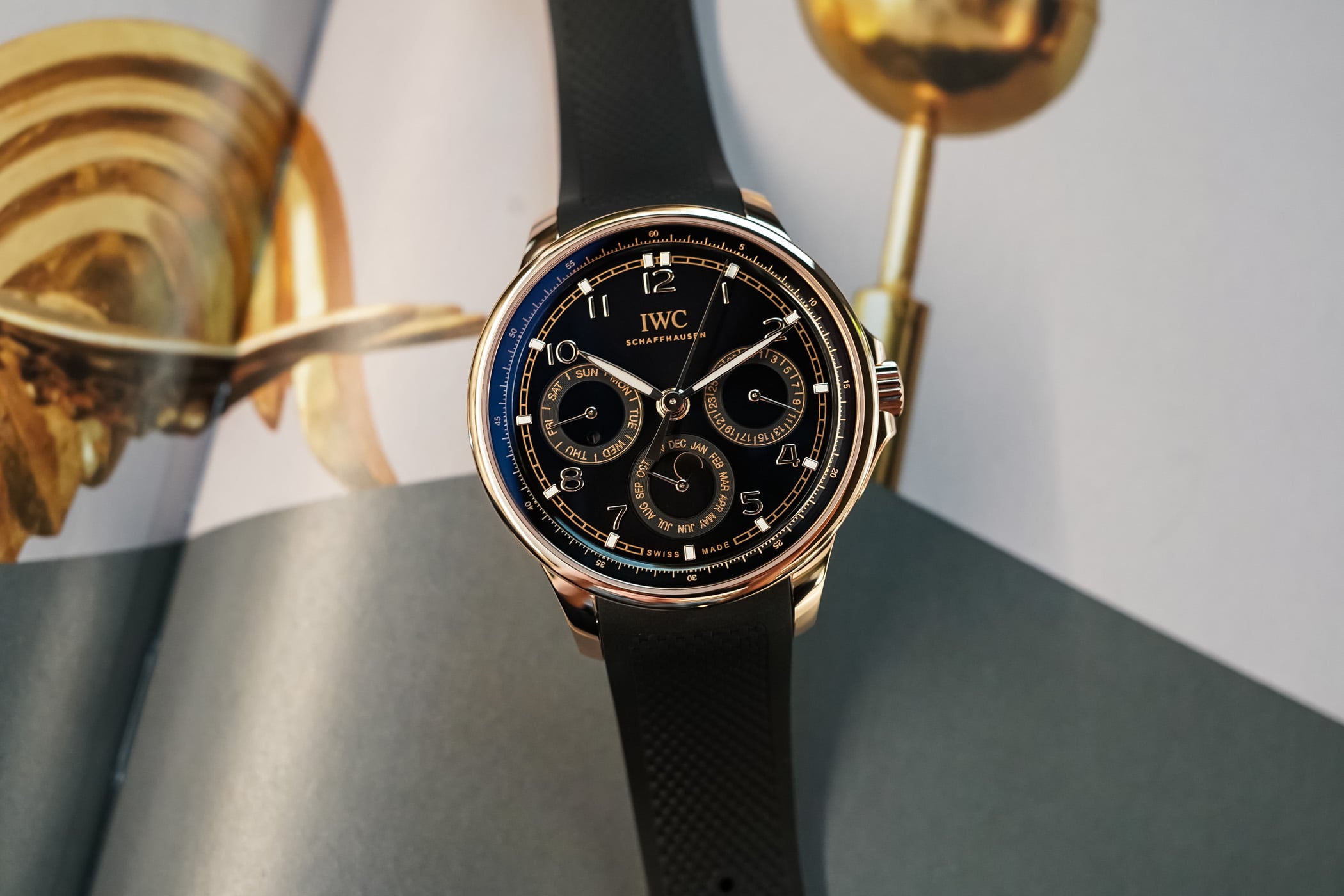
Since the early 1980s, when Kurt Klaus designed a perpetual calendar whose every indication could be set through the crown alone, the complication has been IWC's calling card. It has appeared across generations of the Portugieser line, but never in the Yacht Club, the collection's sporty branch with crown guards and rubber straps. That changes with the Portugieser Yacht Club Perpetual Calendar 42, reference IW344101, announced this week as a permanent-collection model.
A name older than the Portugieser connection
The Yacht Club name predates its current home. IWC introduced it in the 1970s as part of the SL collection designed by Gerald Genta, alongside the Ingenieur SL and the less remembered Golf Club and Polo Club. Early examples ran the brand's automatic calibre 8541 before quartz arrived, and the line became one of IWC's more successful sports watches of that decade. When the name returned in 2010, it did so under the Portugieser umbrella: the Arabic numerals, leaf hands and railway minute track stayed, while the case gained crown guards, more water resistance and a rubber strap. Until now the modern series consisted of chronographs and the Moon and Tide models, the 2024 version of which was the first IWC to carry a silicon hairspring.
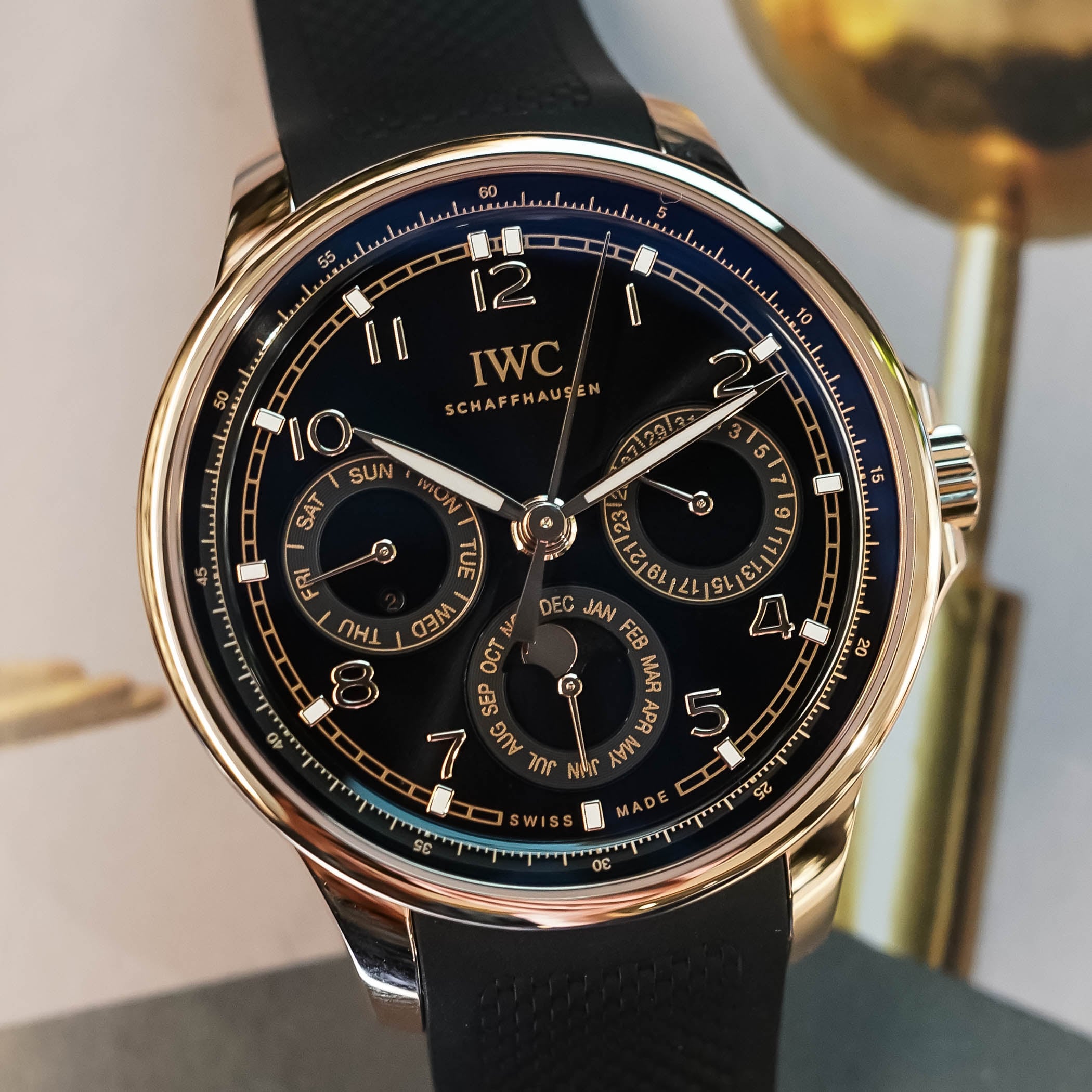
Armor Gold and lacquer
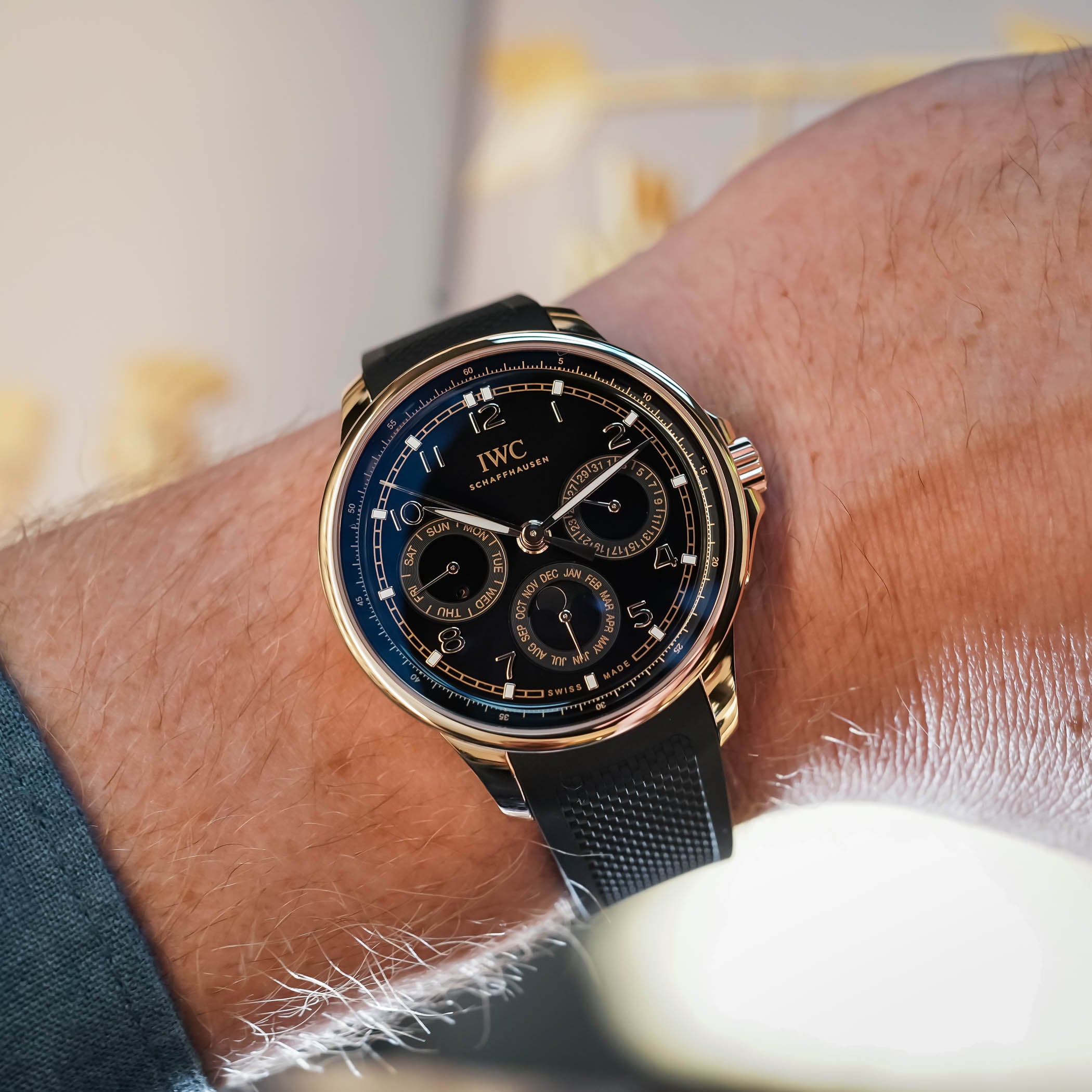
The case measures 42.4mm across and 14.1mm thick, in what IWC calls Armor Gold, an 18k alloy with a modified microstructure that the brand says is considerably harder and more scratch-resistant than conventional gold. A convex sapphire sits on top, an exhibition back underneath, and the screw-in crown is flanked by guards. Water resistance is 100m, which is not a number perpetual calendars usually carry.
The dial is built from multiple translucent layers of black lacquer, a treatment IWC calls Obsidian black and has used in the classic Portugieser line. Applied numerals and indices are solid gold, the leaf hands gold-plated. The calendar reads the way Klaus arranged it four decades ago: date at 3 o'clock, day at 9 with the leap-year countdown integrated, month and moon phase sharing the counter at 6. Every display advances together through the crown, and the moon phase deviates by one day only after 577.5 years of continuous running.
Calibre 82651
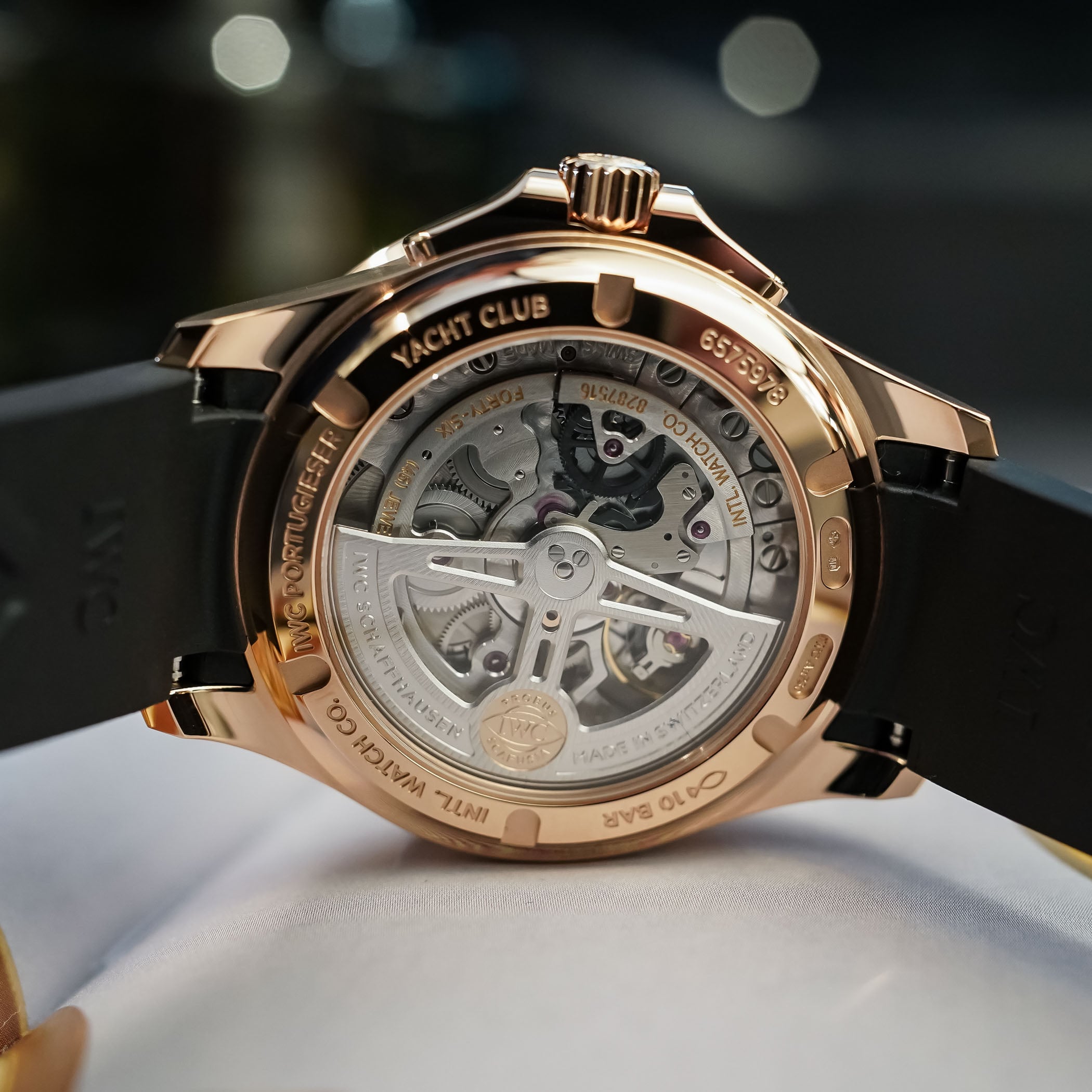
The movement is the manufacture calibre 82651, a new member of the 82000 family. Winding is by Albert Pellaton's bidirectional pawl system, first developed in the late 1940s, with the modern ceramic components at the wear points. It runs at 28,800 vibrations per hour, delivers 60 hours of reserve from a single barrel, and counts 307 components against 303 for the calibre 82650 that powers the classic Portugieser Perpetual Calendar 42; IWC has not yet detailed where those four extra parts went. Finishing is industrial but tidy, with circular graining and a skeletonised rotor carrying the Probus Scafusia medallion.
Price and positioning
On its black textured rubber strap with a gold pin buckle, the Yacht Club Perpetual Calendar 42 is priced at EUR 52,300, CHF 44,000 or USD 51,700. That undercuts nothing and surprises no one at this level; what is notable is the positioning. This is a perpetual calendar built to be worn without ceremony, rated to a depth most owners will never test, in a case alloy designed to shrug off the scratches that keep gold watches in drawers. The first requests in collector circles, predictably, are for the same watch in steel.