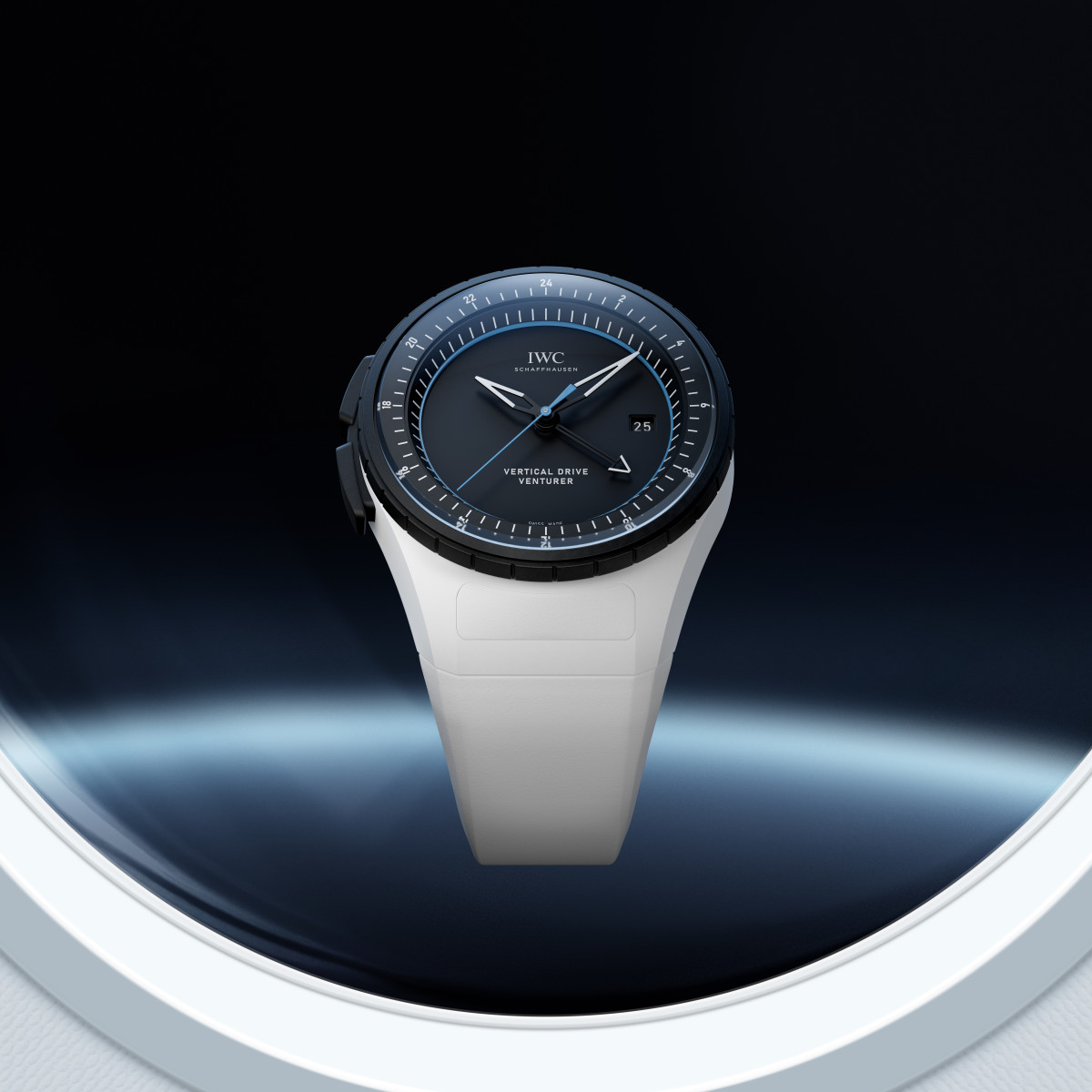
IWC Schaffhausen took the crown off a mechanical watch and built everything else around that decision. The Pilot's Venturer Vertical Drive, unveiled at Watches and Wonders 2026, is the brand's first piece designed from scratch for human spaceflight, and it has been certified for use aboard Haven-1, the commercial space station that Vast plans to launch in 2027.
The no-crown part is the headline. A crown is the worst possible control interface for someone wearing a pressurised spacesuit glove, which is part of why most commercial watches that end up in orbit are worn for sentiment, not function. IWC's solution is a patent-pending rotating bezel system paired with a rocker switch on the side of the case. The bezel cycles through functions, the rocker winds the movement and sets the time, and the whole thing can be operated with a thumb and one gloved finger.
The case material story
The 44mm case is built from white zirconium oxide ceramic and Ceratanium, a lightweight, hard, dark-finish alloy that IWC developed for tool watches a few years ago. The combination matters. In low Earth orbit, a watch on the outside of the spacecraft has to tolerate a temperature swing from about minus 150 degrees Celsius in shadow to over 100 degrees Celsius in direct sunlight, and ceramic is one of the only materials that does not flinch at either extreme. UV exposure is also brutal at that altitude, and ceramic does not yellow.
The ceramic comes in white, which is not a traditional choice for a tool watch. IWC's design director Christian Knoop told Worn and Wound the colour was picked to pair with the white interior of the Haven-1 cabin.
What Vast's certification means
Vast is a California company, founded in 2021 by Jed McCaleb, that is building what it hopes will be the first private space station. Haven-1 is a small four-person outpost scheduled to launch on a Falcon 9 in 2027, and IWC's partnership with Vast means the Venturer has passed the same certification tests the rest of the habitat hardware has: thermal cycling, vibration, radiation, vacuum, all of it. CNN's reporting, citing IWC's press room, confirmed the watch was tested and qualified for spaceflight by Vast.
This is closer to what happened with the Omega Speedmaster and NASA than to the more informal "worn in space" history of watches on shuttle missions. A space operator formally signed off on the piece for use on a crewed platform.
Pricing and availability
The Venturer Vertical Drive is priced at CHF 24,000. That is aggressive for a watch in this positioning. Monochrome, in its hands-on coverage, noted that IWC has not disclosed a production cap, but the specialised tooling suggests this will not be a high-volume reference.
For buyers who have no intention of ever boarding Haven-1, the watch still reads as a genuinely different kind of IWC. The Big Pilot silhouette that has defined the Schaffhausen look for two decades gives way to a rounder, softer case with a rotating bezel that is closer in spirit to a dive watch than a pilot's piece. The dial is clean to the point of austere, with large white baton hands, a three-line aviator-style marker at twelve, and subtle red accents on the rocker.
One footnote worth noting: Vast has not yet flown Haven-1, and the programme's schedule has slipped before. Whether an IWC actually reaches orbit on a crew member's wrist is a 2027 question. Whether IWC has built the first serious post-Speedmaster space watch is a 2026 one, and the answer appears to be yes.
Sources: CNN, IWC Press Room, Worn and Wound, Monochrome, HiConsumption.