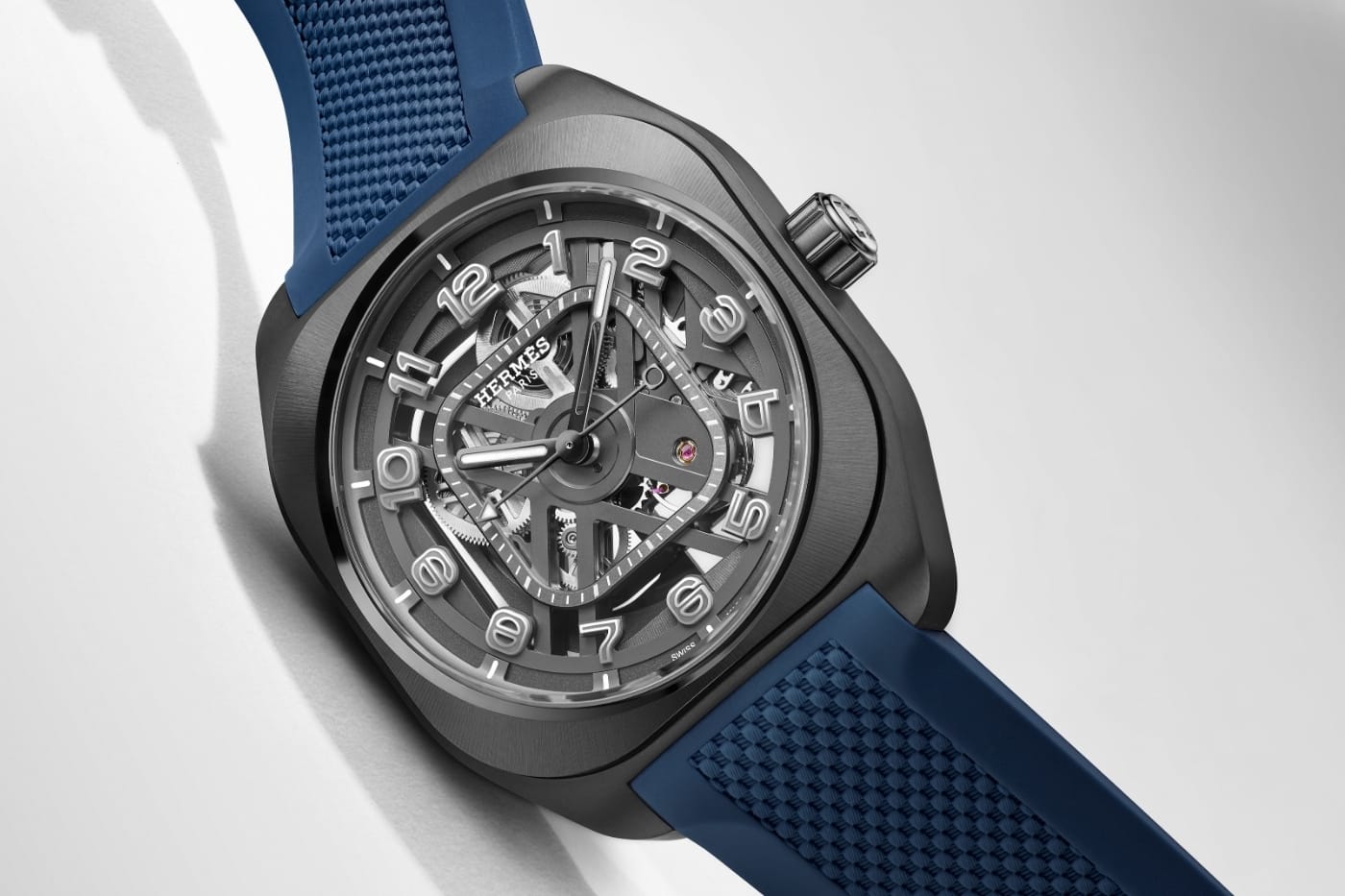
Hermès has added a skeleton to the H08 family. The H08 Squelette, launched at Watches and Wonders this week, is the first openworked piece in a collection that, until now, has leaned consistently into clean, closed dials. It is also, by a wide margin, the most expensive H08 the brand has made.
The price tag is the first thing to register. The blue and the grey versions both sit at roughly 20,000 euros, or 17,500 pounds in the UK. Worn and Wound, Oracle of Time, and Monochrome all flagged the leap in their first-look coverage. Prior H08 references have lived between 6,000 and 9,000 euros depending on case material. Doubling the floor on a single variant is an aggressive move for a brand that tends to price its watches carefully.
A new movement, finally in-house
The reason Hermès is willing to ask for that much is inside. The H08 Squelette runs the H1978S, a new mechanical movement that the Hermès manufacture has been working on for three years. It is the first skeleton movement the maison has built, and unlike most of the H08 line's prior calibres, it is fully designed and finished at the brand's La Chaux-de-Fonds site.
The specification sheet is solid without being ostentatious. 60 hours of power reserve. A free-sprung balance. A central rotor that has been skeletonised to match the rest of the architecture. Hermès says the movement has been endurance-tested to the equivalent of ten years of continuous wear, which is a claim that tends to show up on movements with long-term service intervals in mind.
The skeletonisation is not the aggressive, muscular treatment that brands like Richard Mille and Roger Dubuis have made their signature. The H1978S is spare and architectural, and the geometric pattern on the mainplate echoes the typographic lattice of Hermès's H08 logo. You can see the balance from the front, which is the point, but the watch still reads quickly as an H08.
Case and dial
The Squelette's 39mm case is sand-blasted black DLC titanium with a ceramic bezel. It is the same silhouette as the other modern H08 references, slightly cushioned at the corners, with integrated lugs. The rubber straps, in Bleu Zanzibar, Noir, and Bleu Abysse, all use the quick-change system that has been standard on H08 since the 2021 launch.
The two dial executions are "skeleton blue" and "skeleton grey". Both are tinted over the skeletonised plate, with a lacquer that deepens and warms under different light. T3's hands-on coverage described the blue version as especially strong in artificial light, the kind of colour that only fully resolves when it is on a wrist in motion.
Where this fits
Hermès has been building its watchmaking credibility patiently. It owns a stake in Vaucher, it has an in-house case workshop, and over the last five years it has steadily moved calibres from external suppliers to its own bench. The H1978S is the clearest statement yet that the manufacture is ready to compete on movement architecture, not just design and dial work.
The 20,000 euro price is a test. It sits squarely in territory occupied by Vacheron Overseas, Royal Oak Selfwinding, and Chopard Alpine Eagle, all watches with deeper movement pedigrees. If collectors accept it, Hermès has quietly repositioned itself. If they do not, the regular H08 is still a fine watch.
Sources: Worn and Wound, Oracle of Time, Monochrome, T3, Europa Star, Wallpaper.