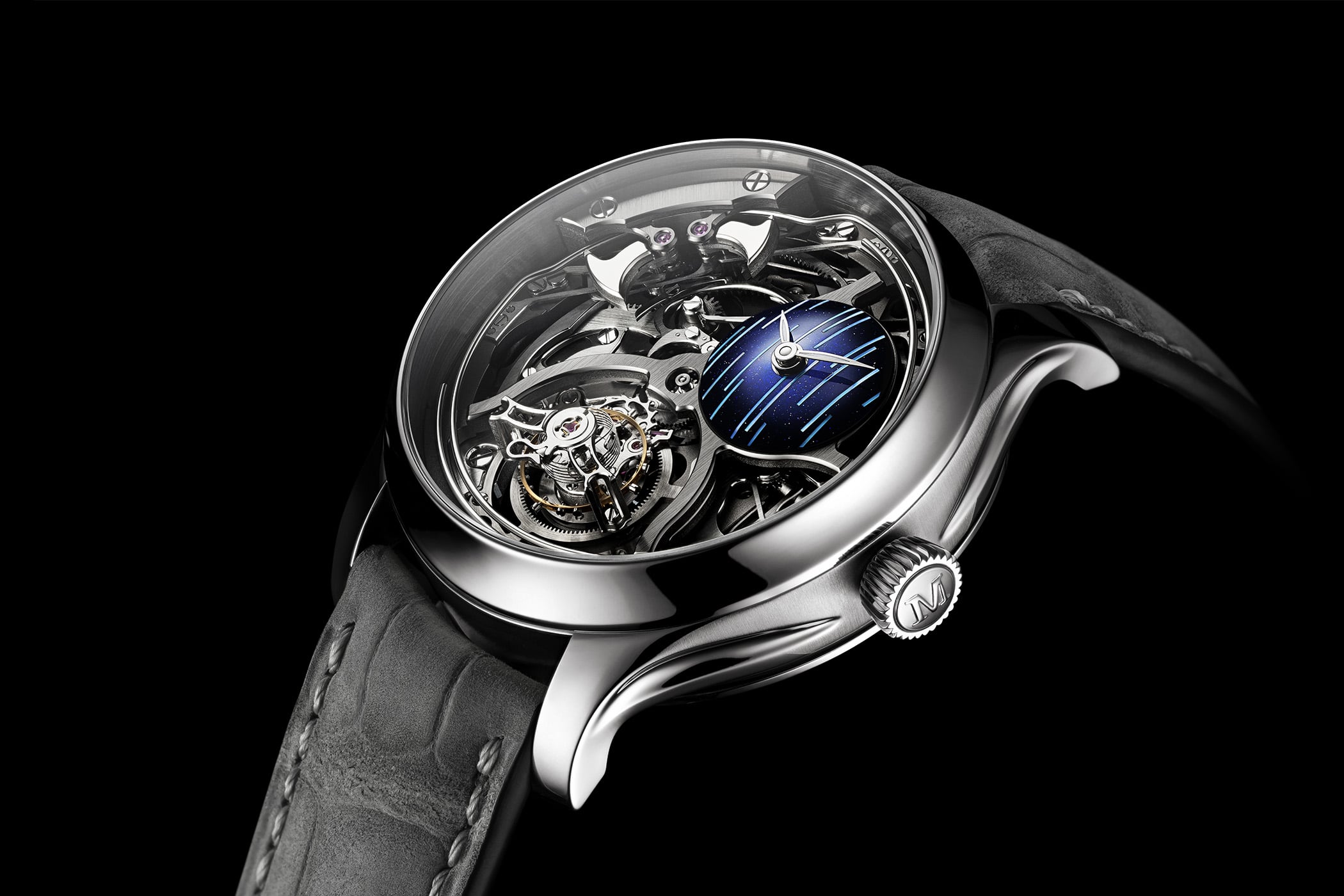
H. Moser & Cie. released its first minute repeater with a tourbillon in 2019, and did something unusual with it: both complications were placed on the dial side, in full view. A skeletonised version followed earlier this year. The Endeavour Minute Repeater Cylindrical Tourbillon Skeleton Cosmic Rain, unveiled on 22 July, keeps that architecture and adds an artistic dial, in a titanium edition of 20 pieces.
A repeater you can watch
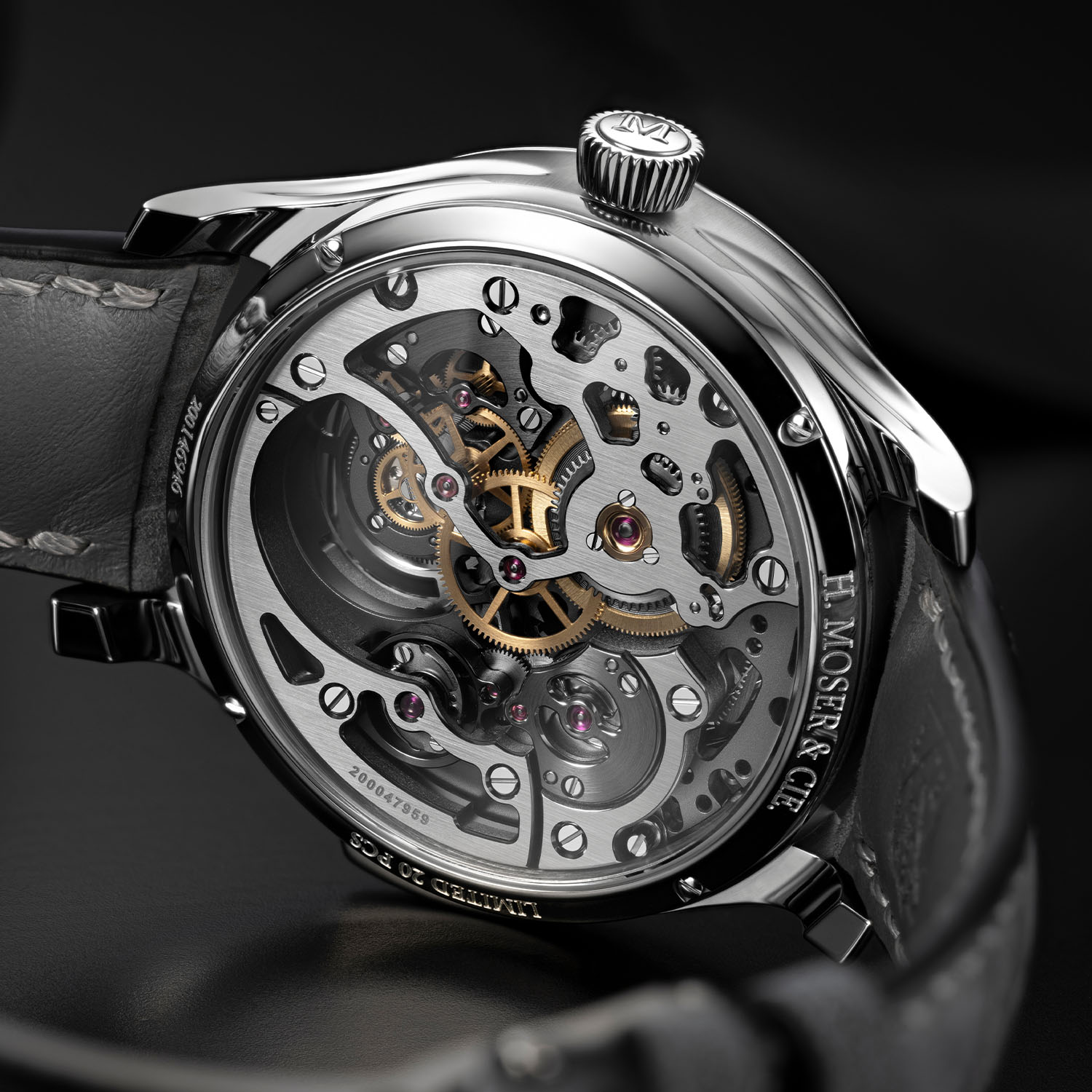
Traditional minute repeaters hide their hammers and gongs on the back of the movement, where the owner hears the chime but never sees it. Moser moves the mechanism to the front. The mirror-polished hammers and curved gongs sit between nine and eleven o'clock, so the striking of the hours, quarters and minutes can be watched as it happens. The skeletonisation forced a rethink of the whole movement: to clear the flying tourbillon and its cylindrical hairspring, the gongs had to be brought onto the same plane and filed by hand to reach the right pitch, which is harder with curved gongs than round ones.
The Cosmic Rain dial
The only solid element in the openworked panorama is a small domed sub-dial at two o'clock, and it is the point of this edition. Made of blue aventurine glass traversed with mother-of-pearl inlays, it is built up from two tones of aventurine applied by hand and fired several times to recreate Moser's signature fumé gradient, lighter at the centre and darker at the rim. Thin curved strips of iridescent mother-of-pearl are then set into the cut-outs, reading as shooting stars across a night sky. There are no indices; the hours and minutes are shown by leaf-shaped hands.
The tourbillon and the case
The one-minute flying tourbillon at six o'clock carries a cylindrical hairspring, a form borrowed from 18th-century marine chronometers and shaped by hand at Moser's sister company, Precision Engineering AG. Set in a deep well lit from both sides, the spring rises vertically around the balance staff. The case is 40mm by 14.4mm in titanium, chosen for sound: unlike gold or platinum, titanium does not absorb the vibrations, and its low density and high rigidity lift the volume, clarity and duration of the chime. The hollowed middle acts as a soundbox.


The movement, and the price
The hand-wound HMC 909 measures 33mm by 9.6mm and runs 415 components, 35 jewels and a 90-hour reserve at 21,600 vibrations an hour, its bridges and plates hand-finished with Moser's double stripes. Because skeletonisation is treated here as a complication in its own right, Moser counts this as a triple-complication watch. It is limited to 20 pieces and priced at CHF 378,350 including taxes. It is a great deal of watch for very few buyers, which is roughly the point: the Cosmic Rain is Moser showing, at length, what it can do when it stops hiding the mechanism.