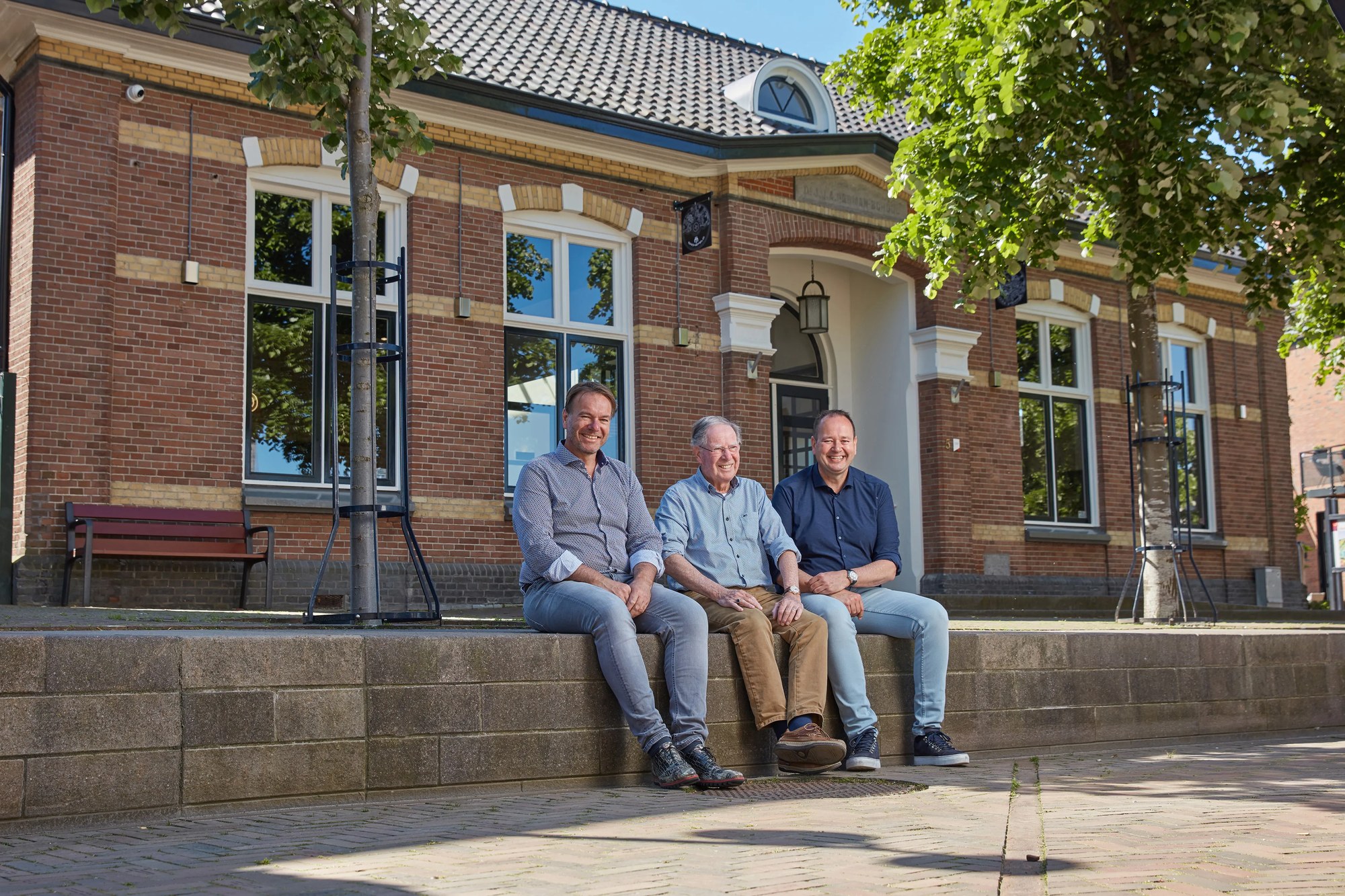
Meet Bart and Tim Grönefeld. They do not work in Geneva, or Le Locle, or any of the Swiss valleys where most serious watchmaking happens. They work in Oldenzaal, a town of 32,000 people in the east of the Netherlands, in the same building where their grandfather opened a watchmaking shop in 1912. They produce 70 to 80 watches a year. They have won three Grand Prix d'Horlogerie de Genève awards, in three different categories. And unless you follow independent watchmaking closely, you may never have heard of them.
That is about to change.
Three generations, one address
The story starts with Johan Grönefeld. In 1912, he established his workshop on the Sint Plechelmusplein in Oldenzaal, directly next to the Sint Plechelmus basilica, a church dating back to 1240. Johan maintained the basilica's clock mechanism. When he died in 1974, his son Johannes, known as Sjef, took over both the shop and the church clock. Sjef was born in 1941, a year that would later become central to the brand's identity.
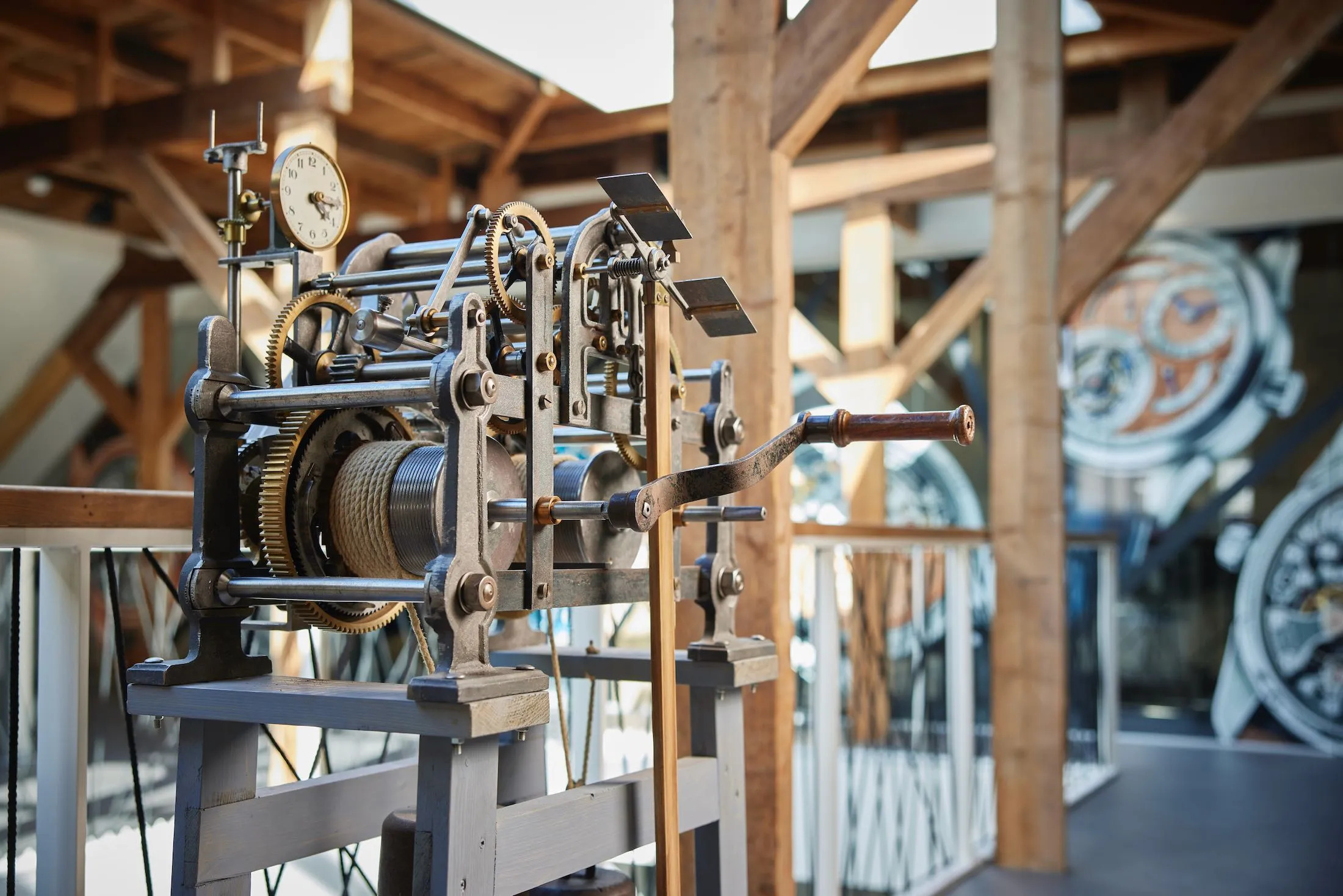
Bart and Tim grew up surrounded by watchmaking. Bart attended technical school in Oldenzaal, then watchmaking school in Rotterdam, and finally trained at WOSTEP in Neuchatel, the Swiss academy that has shaped many of the industry's best technicians. Both brothers eventually joined Renaud et Papi in Switzerland, the elite movement manufacturer that builds complex mechanisms for Audemars Piguet. There, they worked alongside watchmakers who would later become legends in their own right: Robert Greubel and Stephen Forsey among them.
In 1998, they returned home to Oldenzaal. For a decade, they ran a general repair service while quietly developing their own calibers. In 2008, they launched the Grönefeld brand with a clear mission: design and build their own movements, finish them entirely by hand, at a level that belongs among the best in the world.
The collection
1941 Remontoire
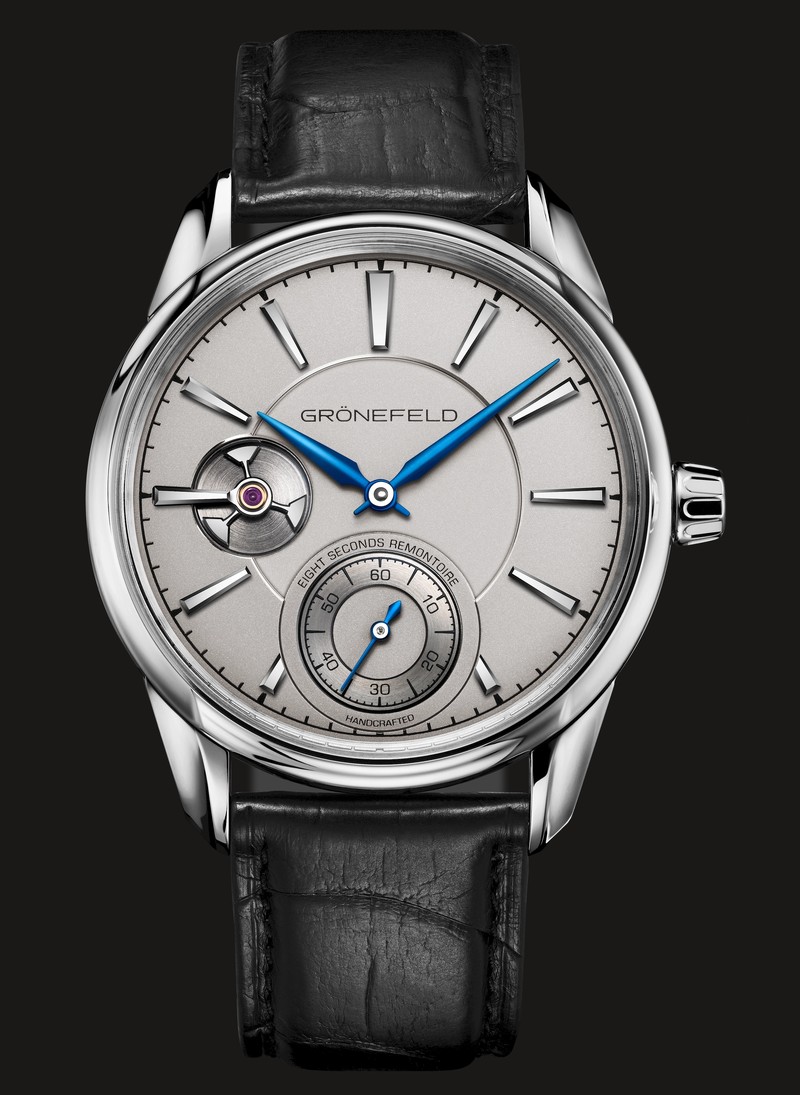
The watch that put them on the map. The "1941" in the name honors Sjef's birth year, a naming convention the brothers carry across their collection. Inside is the Caliber G-05 with an 8-second constant-force remontoire, visible through a small governor at 9 o'clock that completes one rotation every eight seconds. The mechanism ensures uniform energy delivery to the escapement regardless of mainspring tension. In practice, this means more consistent timekeeping throughout the entire power reserve.
The case measures 39.5mm by 10.5mm in stainless steel, red gold, or white gold. Power reserve is 36 hours at 21,600 vibrations per hour. Production is limited to 188 movements. It won the GPHG Best Men's Watch prize in 2016.
Parallax Tourbillon
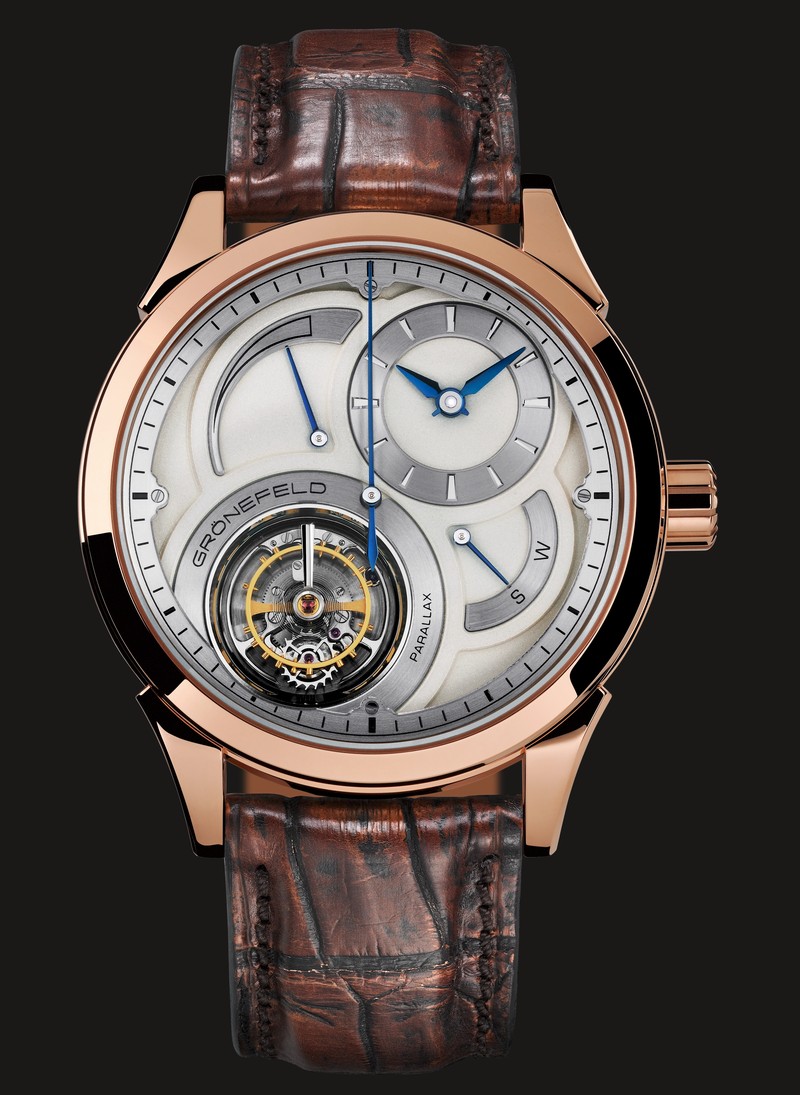
The name refers to a real optical problem: reading a seconds hand from an angle introduces an error. Grönefeld addressed this by positioning the central seconds hand exceptionally close to the track, minimizing the parallax effect. It sounds simple. Getting it right in a tourbillon is not.
The Caliber G-03 has 278 parts, a one-minute flying tourbillon, and a 72-hour power reserve. A crown-activated stop-seconds mechanism halts both the running seconds and the tourbillon cage, allowing precise time-setting. The case is 43mm, available in stainless steel (limited to just 12 pieces) or 18k red gold (limited to 28). Select dials feature tremblage, a hand-hammered texture created with hammer and chisel. It won the GPHG Best Tourbillon in 2014.
1941 Principia
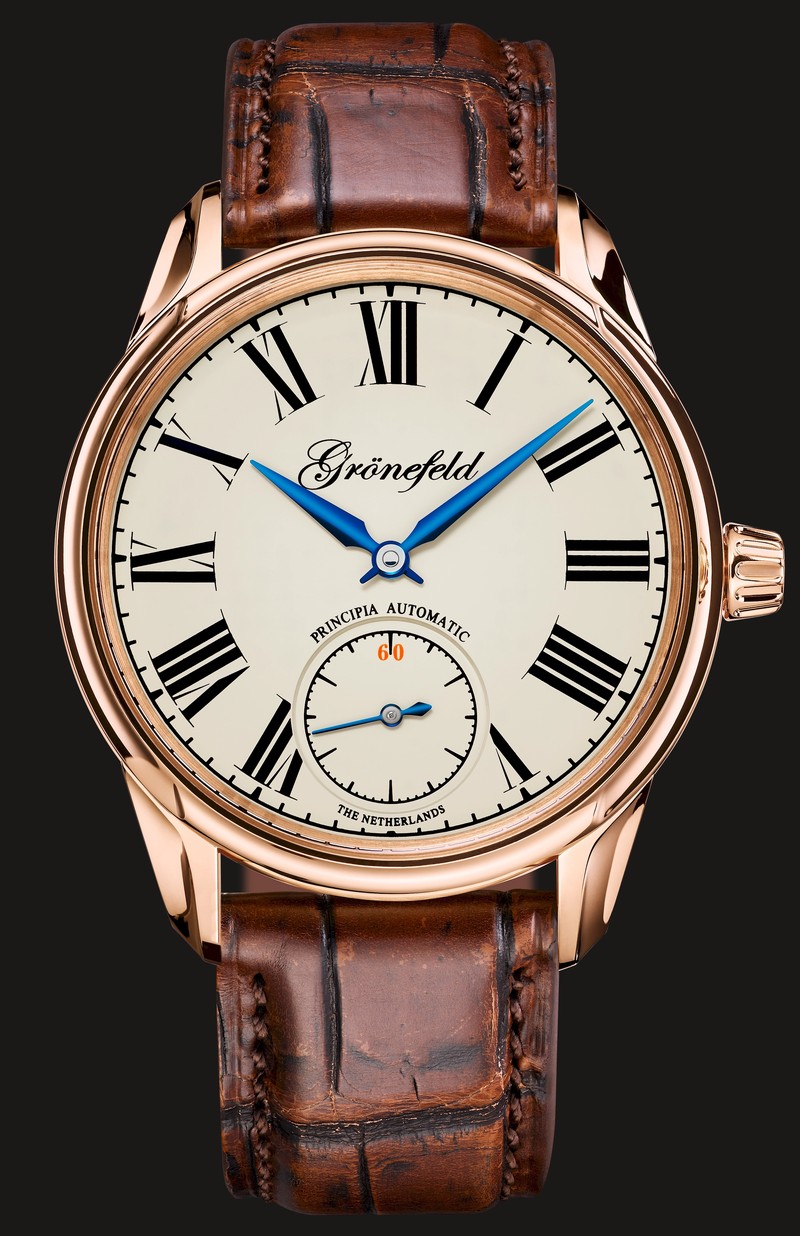
Perhaps the most revealing watch in the collection. Named after Newton's "Philosophiæ Naturalis Principia Mathematica," this is their first uncomplicated piece: a three-hand automatic, no date, no complications. The case shares the Remontoire's 39.5mm proportions.
What makes it exceptional is what you see through the caseback. The same four-plus weeks of hand finishing that go into their tourbillon go into this simple time-only caliber. That is the statement: every Grönefeld gets the same care, regardless of complexity. Dial options include cream lacquered with Roman numerals, salmon, matte turquoise, and light blue. Production runs at about four to five pieces per month. Retail starts around EUR 35,000.
1941 Grönograaf
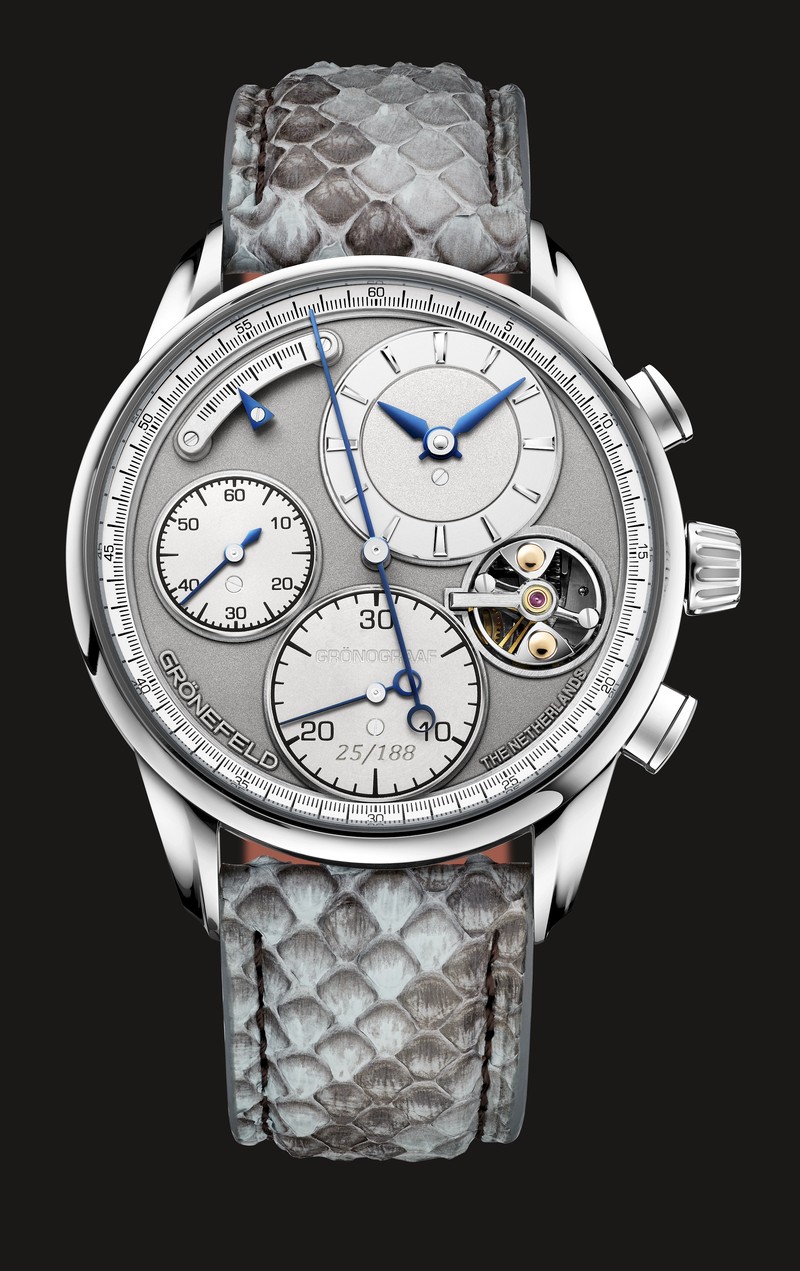
Their first chronograph, released in 2022. The Caliber G-04 uses a traditional column wheel and side-mounted clutch, with 408 hand-decorated parts. The premiere edition was limited to 25 pieces in tantalum, a dense, blue-gray metal that is notoriously difficult to machine and finish. Steel and other precious metal variants followed.
It won the GPHG Best Chronograph prize in 2022, making Grönefeld one of very few brands to win in three different categories at the Grand Prix.
The movements
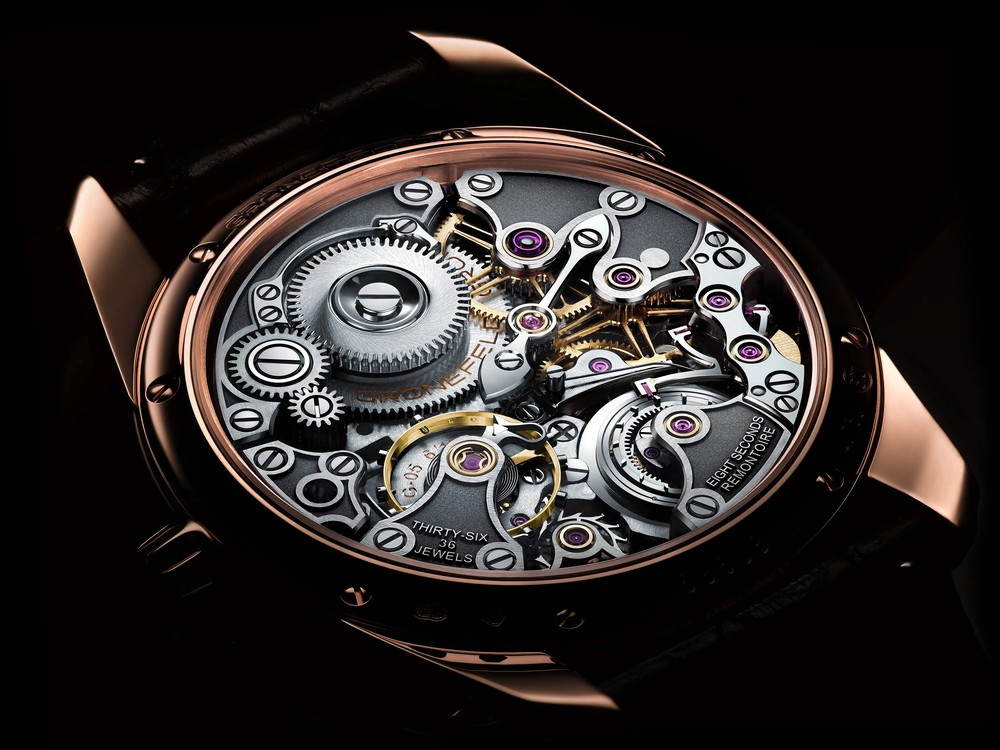
What separates Grönefeld from most independent brands is the consistency and depth of their hand-finishing. Every caliber they produce is designed, built, and decorated entirely in Oldenzaal. The movement bridges are shaped to echo Dutch "bell gable" architecture, with hand-beveled surfaces that catch light in defined, deliberate ways. Center sections are micro-blasted for contrast. Screws are black-polished to a mirror finish. Anglage is done with felt, creating rounded reflective edges that reveal themselves differently at every angle.
The Caliber G-05 (Remontoire) and G-03 (Parallax Tourbillon) share a design language but differ fundamentally in architecture. The G-05 uses a constant-force mechanism with a governor visible from the dial side, while the G-03 integrates a one-minute flying tourbillon with a stop-seconds function. The G-04 (Grönograaf) introduced a column-wheel chronograph with 408 parts, their most complex movement to date. The newest caliber powers the 1941 Principia, their simplest watch, yet it receives the same four-plus weeks of hand finishing as the tourbillon.
Each movement requires a minimum of four weeks of dedicated finishing work, plus another week for assembly. The brothers do not outsource any of this. When they expanded to a larger workshop in 2021, they grew the team to 15, but the pace stayed the same. The goal was not to produce more watches. It was to produce the same watches with a little more breathing room.
What is happening now
In 2025, they introduced the 1944 Tanfana, their first ladies' watch, named after Sjef's wife Netty's birth year. It won the TEMPORIS International Awards "Red Carpet Lady's Watch" prize and was shown at Watches and Wonders Geneva 2025. The brand returns to the fair in 2026.
The most interesting recent move is Grøne Oldenzaal, a separate sub-brand the brothers launched to make their work more accessible. The Grøne Manueel One is a classic time-only dress watch. The Grøne Moment Meter is a hand-wound chronograph, limited to 300 pieces at EUR 3,490. Orders opened in December 2025, with deliveries from January 2026. For collectors who have admired Grönefeld from a distance, this is a genuine entry point, designed and developed by the same hands.
What to know as a buyer
Primary market prices start around EUR 35,000 for the Principia and climb above EUR 150,000 for the Grönograaf. Secondary market ranges are wide: roughly EUR 30,000 to over EUR 200,000 depending on model, material, and rarity. The 12-piece steel Parallax Tourbillons, if they surface at all, command significant premiums.
Availability is the real challenge. With 70 to 80 watches produced annually and wait lists of up to two and a half years, buying a new Grönefeld typically requires either a direct relationship with the brand or patience. The secondary market exists but is thin.
For documentation purposes, every Grönefeld ships with full papers. But production numbers are small enough that individual watches are well known within the collector community. A complete service history and original documentation add genuine value at resale, as they do with any independent maker where provenance is part of what you are buying.
Why they matter
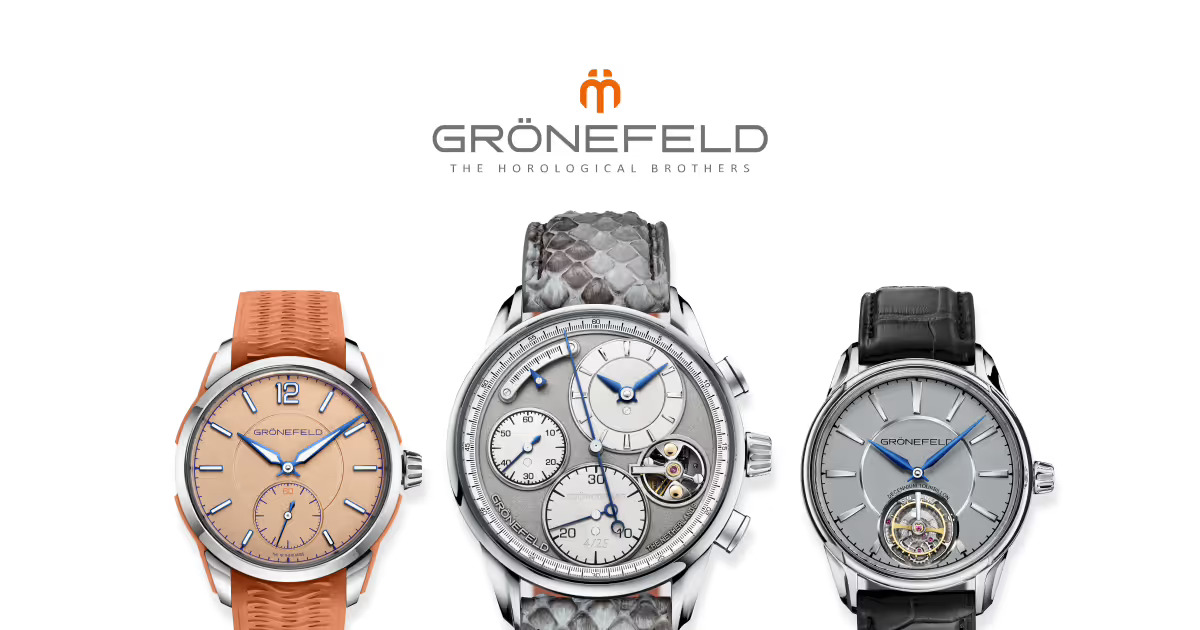
The watch industry has no shortage of brands calling themselves "independent" or "artisanal." Grönefeld is the real thing. Three generations, one building, movements designed and finished entirely in-house, and a production volume that ensures each watch gets actual human attention. They do not make aspirational claims about craftsmanship. They just do the work, in a small town in the Netherlands, the way their grandfather did.
That is a story worth documenting.
Sources: Grönefeld official, Fratello Watches, Monochrome Watches, GPHG, Watches and Wonders Geneva, Deployant