Glashütte Original has taken the Senator Chronograph, the integrated automatic chronograph it introduced in 2014, and revised it for 2026 in a smaller case with two very different dials. Monochrome published a first look on 20 August, and both watches sit in the permanent collection on glashuette-original.com.
A smaller case
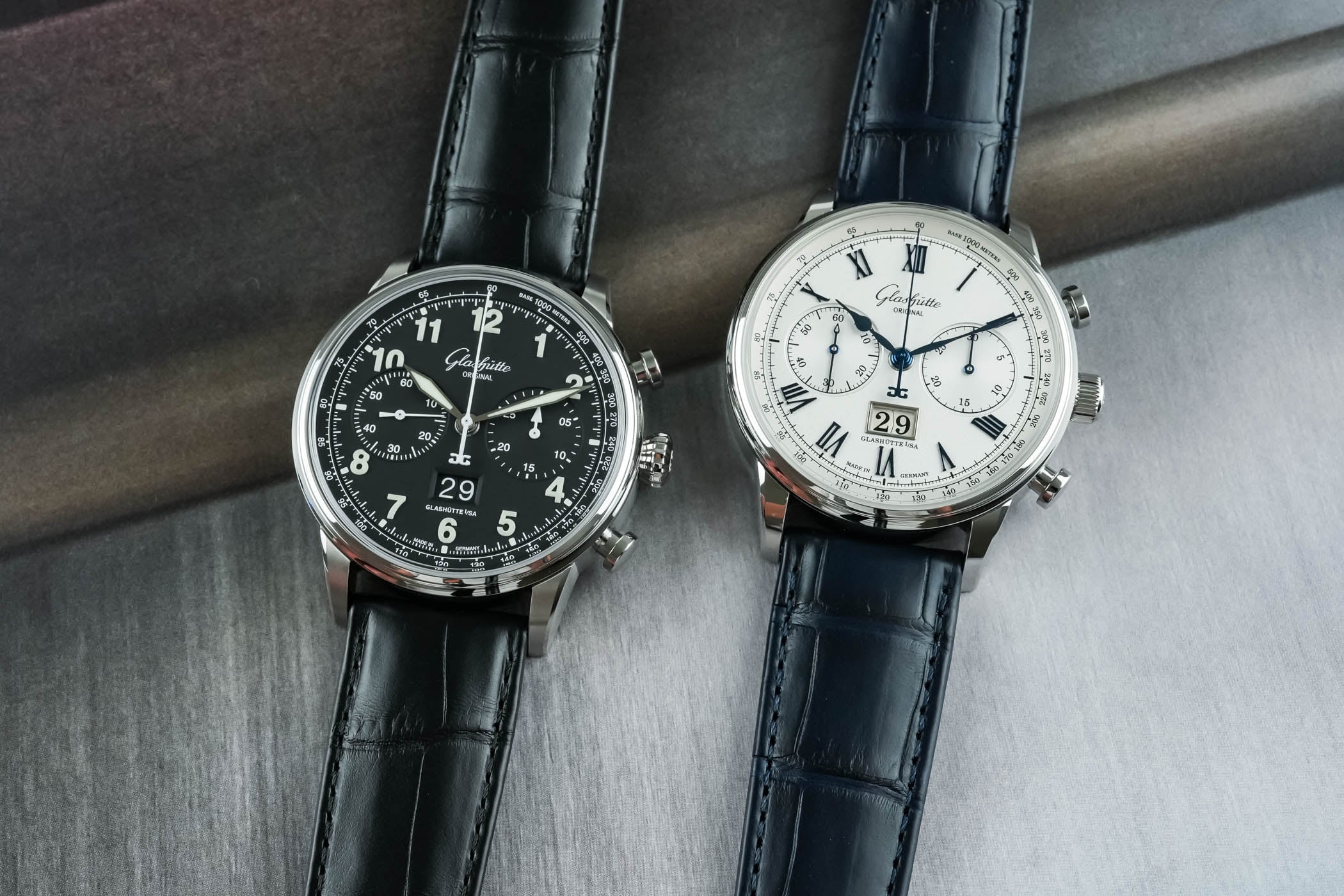
The previous Senator Chronograph was 42mm across and about 14.6mm thick. The 2026 case measures 41mm and 12.9mm, with short curved lugs that settle it more naturally on the wrist. It is steel, mixing polished and satin-brushed surfaces, under a sapphire crystal with anti-reflective coating on both sides, and it shows the movement through a sapphire back. Mushroom-shaped pushers at 2 and 4 o'clock replace the rounded rectangular pushers of the old model and give the case a more traditional chronograph look.
One change goes the wrong way. Water resistance drops from 100m to 50m, which is not critical on a dress chronograph but is worth noting. The millimetre off the diameter and the nearly two millimetres off the thickness matter more on the wrist than the numbers suggest, though the comments under Monochrome's coverage split cleanly between readers who wanted a 38mm case and readers glad to finally get one under 13mm.
Two dials, one platform
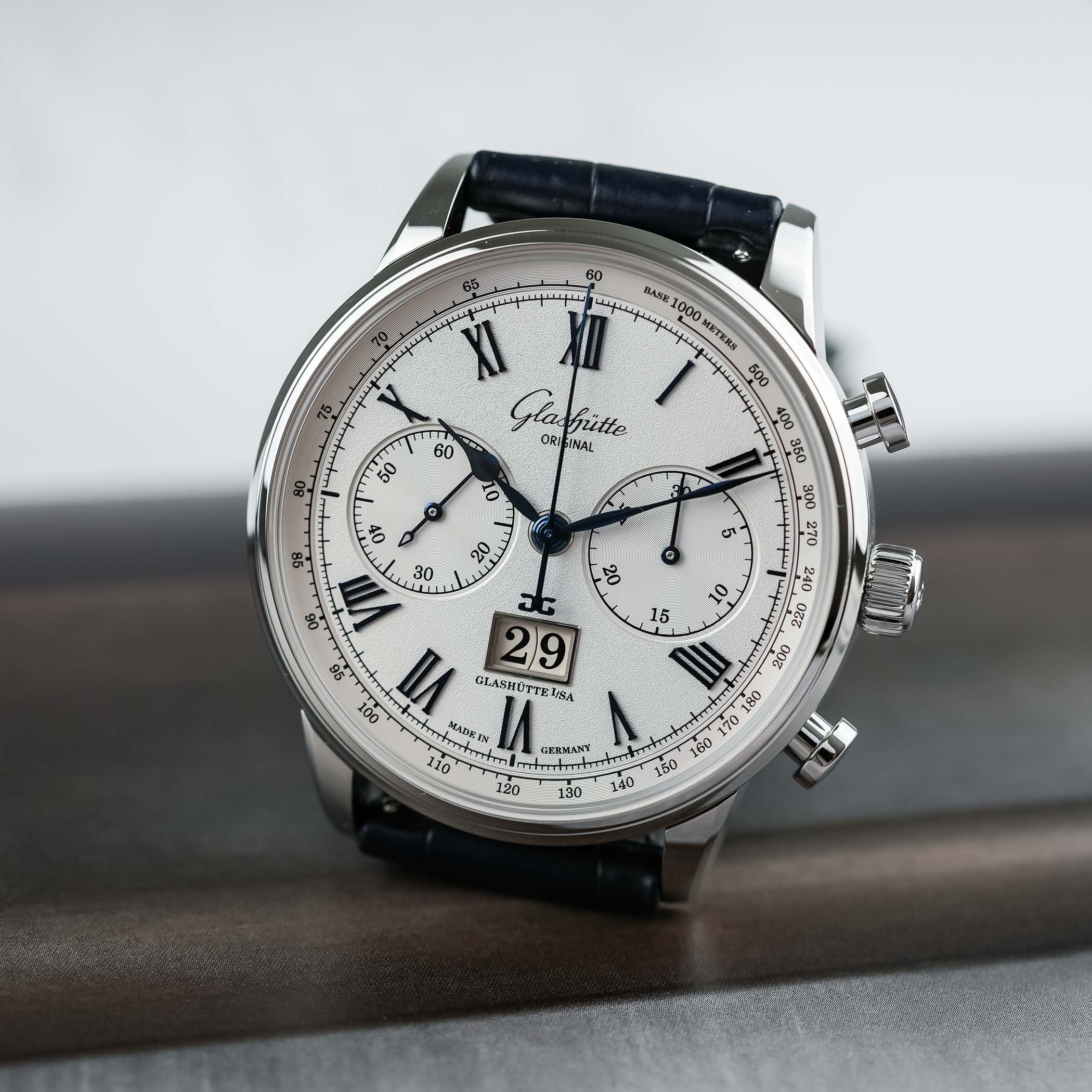
The Senator Chronograph is the formal one. Its silver-white galvanic dial has a fine grainé texture, applied solid-gold Roman numerals with a blue coating on every hour except 3 and 9, and blued-steel hands. Two recessed sub-dials with a vinyl-record finish sit symmetrically at 9 and 3, small seconds and a 30-minute counter, with the Panorama Date framed in white gold at 6 and a tachymeter printed on the flange. Compared with the outgoing model it loses the 12-hour counter at 12 and the power-reserve hand that used to crowd the small-seconds register, which is what makes the new dial read as quiet.
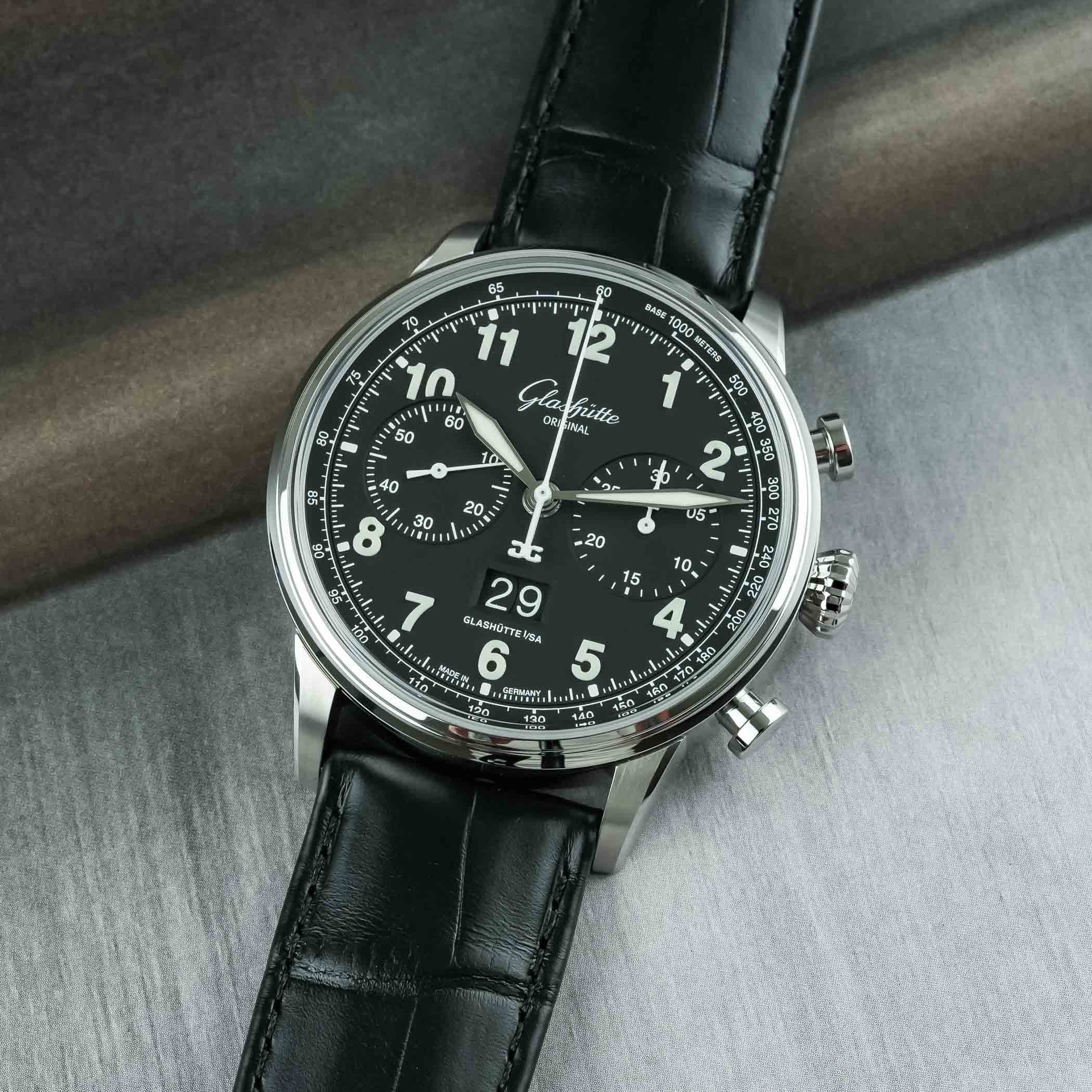
The Navigator takes the same case and movement and goes the other way. Matte deep-black lacquer, solid blocks of luminous material for the Arabic numerals, luminous hour and minute hands, and white lacquer for the chronograph seconds, the 30-minute counter and the small seconds. The layout is identical, down to the tachymeter flange and the date at 6. Glashütte Original's point is that these are not a light-and-dark pair of one watch but two personalities built on one platform, and that reads as true.
The Calibre 37-24
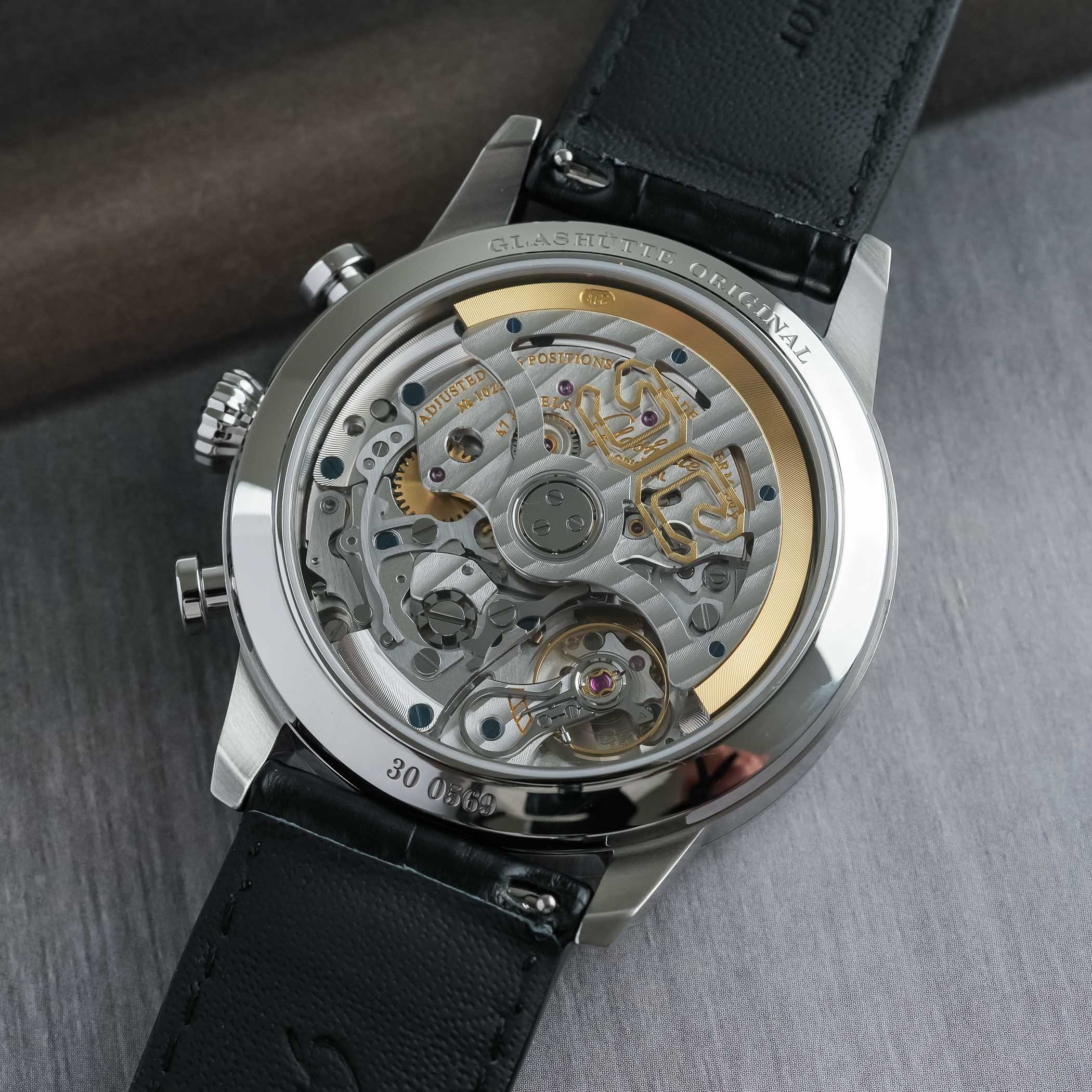
Both run the new Calibre 37-24, an evolution of the 2014 Calibre 37 reworked for the slimmer case. It is 34.20mm wide and 8mm thick, an integrated automatic chronograph with a column wheel and a flyback function, so a running chronograph can be stopped, zeroed and restarted with a single press. There are 47 jewels, it beats at 28,800 vibrations per hour, and the power reserve is 70 hours. A silicon balance spring handles magnetism and temperature swings, regulation is by solid-gold screws on the rim of the balance with the brand's swan-neck fine adjustment, and the skeletonised rotor carries a 21-carat gold weight. Through the back you get the three-quarter plate with Glashütte striping, bevelled edges, polished steel parts and blued screws.
Price and references
Both models cost the same. EUR 15,900 or USD 16,100 on a Louisiana alligator strap, blue on the classic and black on the Navigator, or on a sand-coloured synthetic strap, and EUR 16,800 or USD 17,100 on the steel bracelet. Every strap uses a quick-change system, and for the first time the folding clasp does too, so it moves between straps without tools. References run 1-37-24-01-02-61, 1-37-24-01-02-64 and 1-37-24-01-02-71 for the Senator Chronograph and 1-37-24-20-12-61, 1-37-24-20-12-64 and 1-37-24-20-12-71 for the Navigator. Both are permanent-collection pieces, available now. This is a quieter, better-proportioned version of a watch that had grown busy, and the split into two clear characters is the more interesting decision.