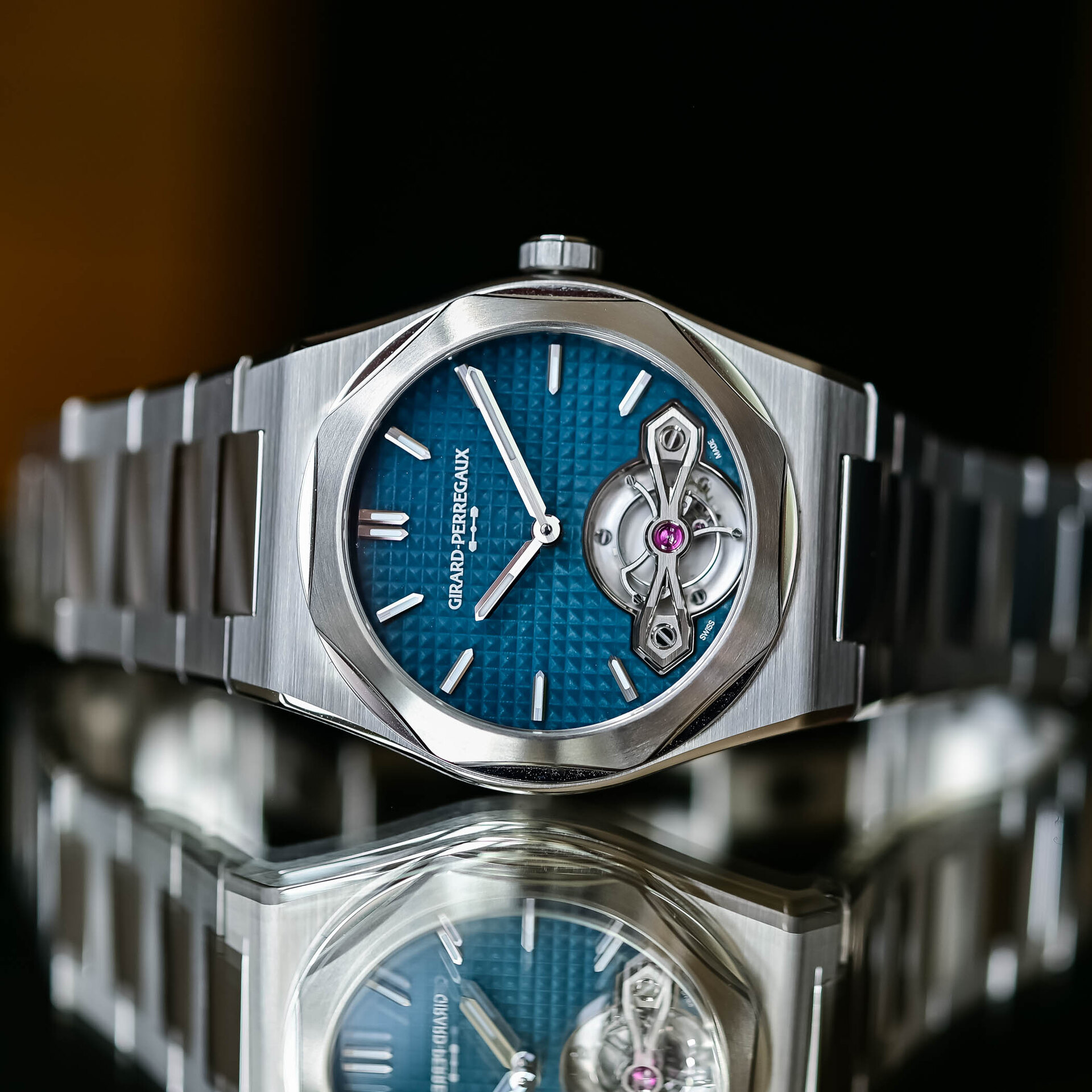
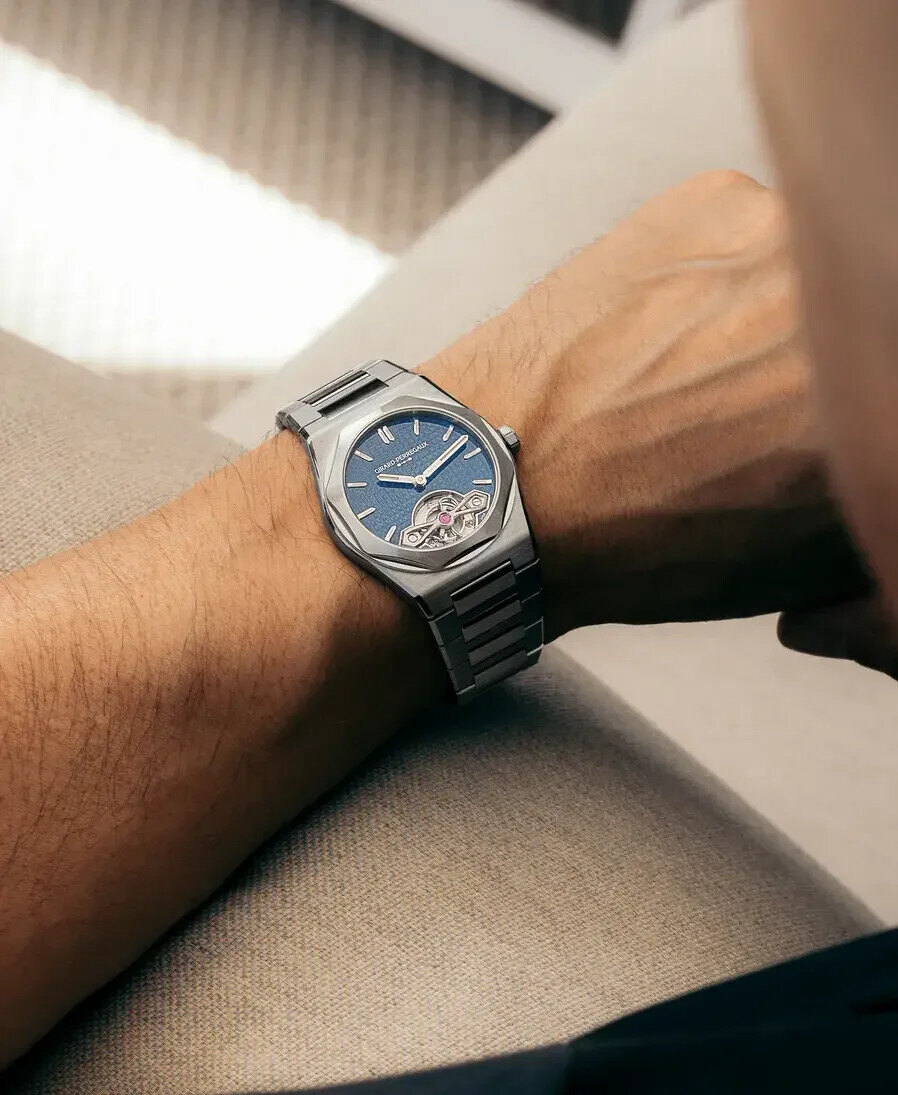
The Laureato is one of the 1970s integrated-bracelet sports watches, launched in 1975, three years after the Royal Oak and a year before the Nautilus. For most of its life it has been a time-and-date watch, occasionally a chronograph. What Girard-Perregaux showed at Geneva Watch Days 2026 is different in kind: a tourbillon, driven by an entirely new movement, in a steel case that has barely grown to accommodate it. The Laureato Fifty Tourbillon Micro-Rotor is 39mm across and 10mm thick, which for a self-winding tourbillon on a bracelet is the headline before any of the finishing is discussed.
Restraint is the point
Tourbillons usually force a case to grow, both wider and much thicker, to fit the regulator and its bridge. Here the watch stays within the proportions of the standard Laureato Fifty, the slimmer sub-collection Girard-Perregaux introduced in 2025 for the design's 50th anniversary. The case is steel, with the tonneau-shaped middle, circular plinth and octagonal bezel that define the Laureato, and the 2025 revisions carry over: broader polished chamfers on the bezel edges against satin-brushed tops, and an integrated bracelet with slimmer H-links and a triple-folding clasp holding 4mm of micro-adjustment. Sapphire sits front and back. The one concession is water resistance, rated at 50m rather than the 100m of the time-only models.
Two dials, both textured
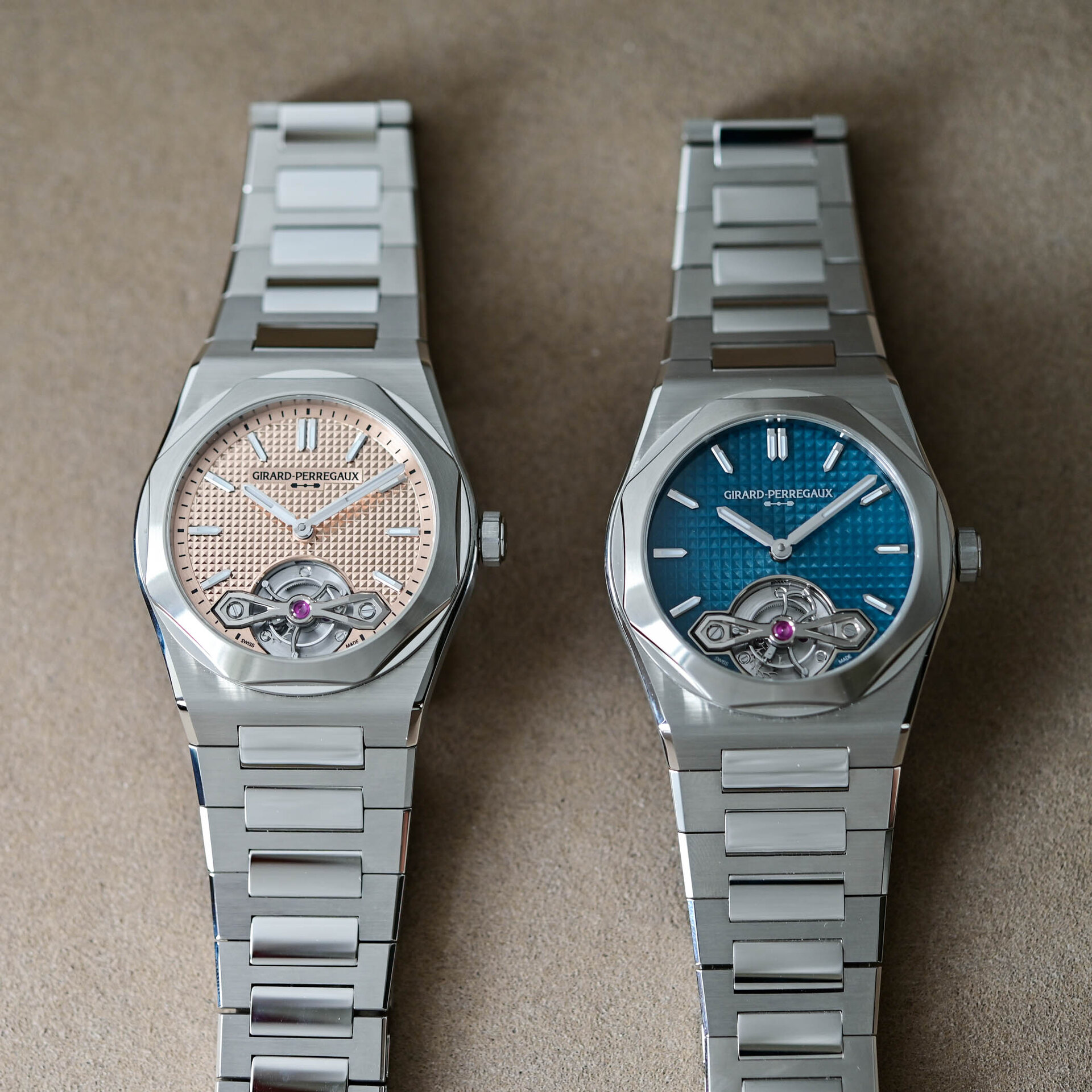
Both versions keep the Laureato's Clous de Paris, the small pyramidal hobnail pattern, as the base of the dial. The first, reference 99116-11-3528-1CM, takes a white-gold dial stamped with that pattern and covers it in translucent blue Grand Feu enamel, so the texture shows through the enamel and the colour shifts as light crosses it. The second, reference 99116-11-3615-1CM, uses a solid gold dial in a rose-gold tone with the same hobnail. On both, the applied indices and hands are white gold with luminescent inserts, and the tourbillon sits open in an aperture at six, held by a white-gold bridge over a lyre-shaped cage.
The GP8410 and the Three Bridges
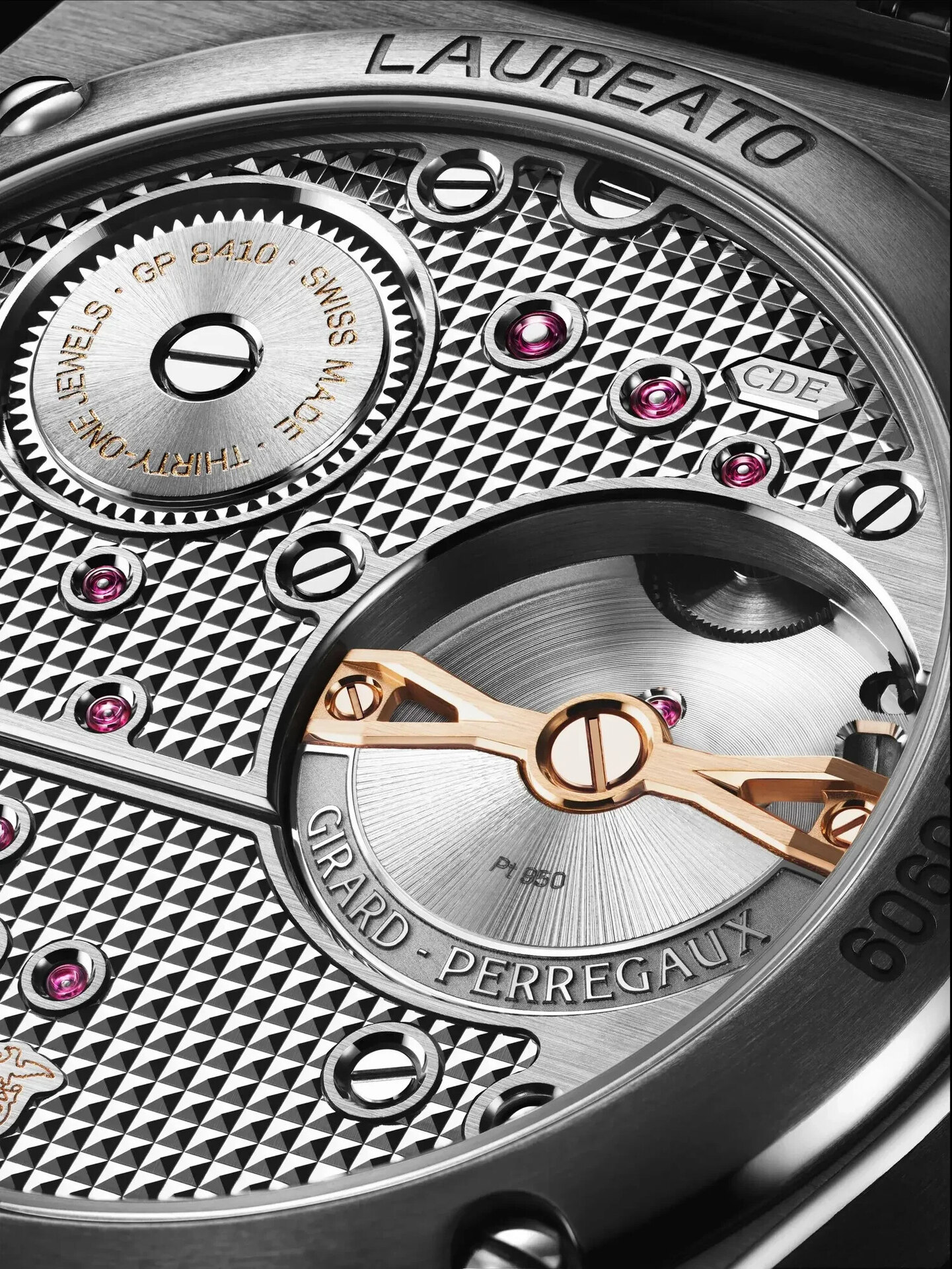
The movement is new and specific to this watch. The Calibre GP8410 is a manufacture automatic tourbillon measuring 30.4mm across and 6.1mm thick, with 207 components and 31 jewels, running at 21,600 vibrations an hour for a 72-hour power reserve. It winds through an off-centred micro-rotor made of platinum and pink gold, a design choice that matters: a micro-rotor sits within the movement rather than across the back of it, which leaves the architecture and finishing visible under the sapphire. That rotor rides on a golden arrow-shaped bridge, and the two white-gold bridges over the going train carry the same Clous de Paris decoration as the dial.
The arrow shape is not decoration for its own sake. It points back to Girard-Perregaux's Three Bridges, the three parallel, symmetrical bars conceived by Constantin Girard in 1867 and made famous by the La Esmeralda pocket watch at the 1889 World's Fair, one of the oldest recognisable signatures in watchmaking. Girard-Perregaux frames the Laureato Fifty Tourbillon as bringing together five of its enduring signatures: the Laureato architecture itself, the Clous de Paris motif, Grand Feu enamel, the micro-rotor and the Three Bridges-derived construction.
Where it sits
The Laureato Fifty was a commemorative sub-collection when it appeared in 2025. From 2026 it becomes a permanent part of the range, and the tourbillon is the piece that shows what that range is now meant to hold. Girard-Perregaux launched it at Geneva Watch Days, available through its boutiques and retailers, with early reporting putting the blue enamel version at about 95,600 US dollars and the solid-gold dial at about 100,000. That is firmly haute horlogerie money, but the watch spends it on a genuinely new movement and a difficult set of finishes rather than on size, which is the harder and more interesting thing to have done.
Sources: Monochrome Watches, The Manual and Girard-Perregaux.