Gallet is one of the older names in Swiss watchmaking, founded in La Chaux-de-Fonds in 1826, and for most collectors it has meant vintage: the Flying Officer that Harry Truman wore, the waterproof MultiChron Clamshell, the stopwatch that timed the Wright brothers. The name went quiet for decades. On 3 September 2026, exactly two hundred years after Julien Gallet started the business, it came back, relaunched with four collections at once. The catch, and the interesting part, is who is behind it.
Manufactured by Breitling
Gallet is not returning as an independent. Breitling acquired the name in 2025 and now positions it inside its House of Brands, alongside Breitling itself and the recently revived Universal Genève. Every Gallet is made on Breitling's lines, serviced through its after-sales network, and sold through its distribution, with dedicated Gallet corners going into select Breitling boutiques. Within that group, Gallet sits as the entry-luxury sibling, below Breitling on price.
"Gallet has a remarkable history and a distinct identity. By manufacturing every watch within Breitling's infrastructure, we're able to honor that heritage while ensuring the quality, reliability, and service expected from a modern Swiss watch brand," says Erwan Rossignol, Managing Director of Gallet. Georges Kern, who runs the House of Brands and led the Universal Genève revival, frames it more plainly: Gallet "was born in an age of exploration and has followed that path ever since."
That is the honest read of this launch. It is a portfolio move as much as a revival, the same play Kern has been running with Universal Genève, taking a dormant name with real history and rebuilding it as a positioned sibling rather than a standalone workshop. What that buys the buyer is Breitling engineering and servicing at a lower entry price than Breitling.
Three families, four collections
The core range is built around interchangeable quick-release straps and a shared lug width, so a leather, rubber, fabric, or field strap swaps in seconds without tools.
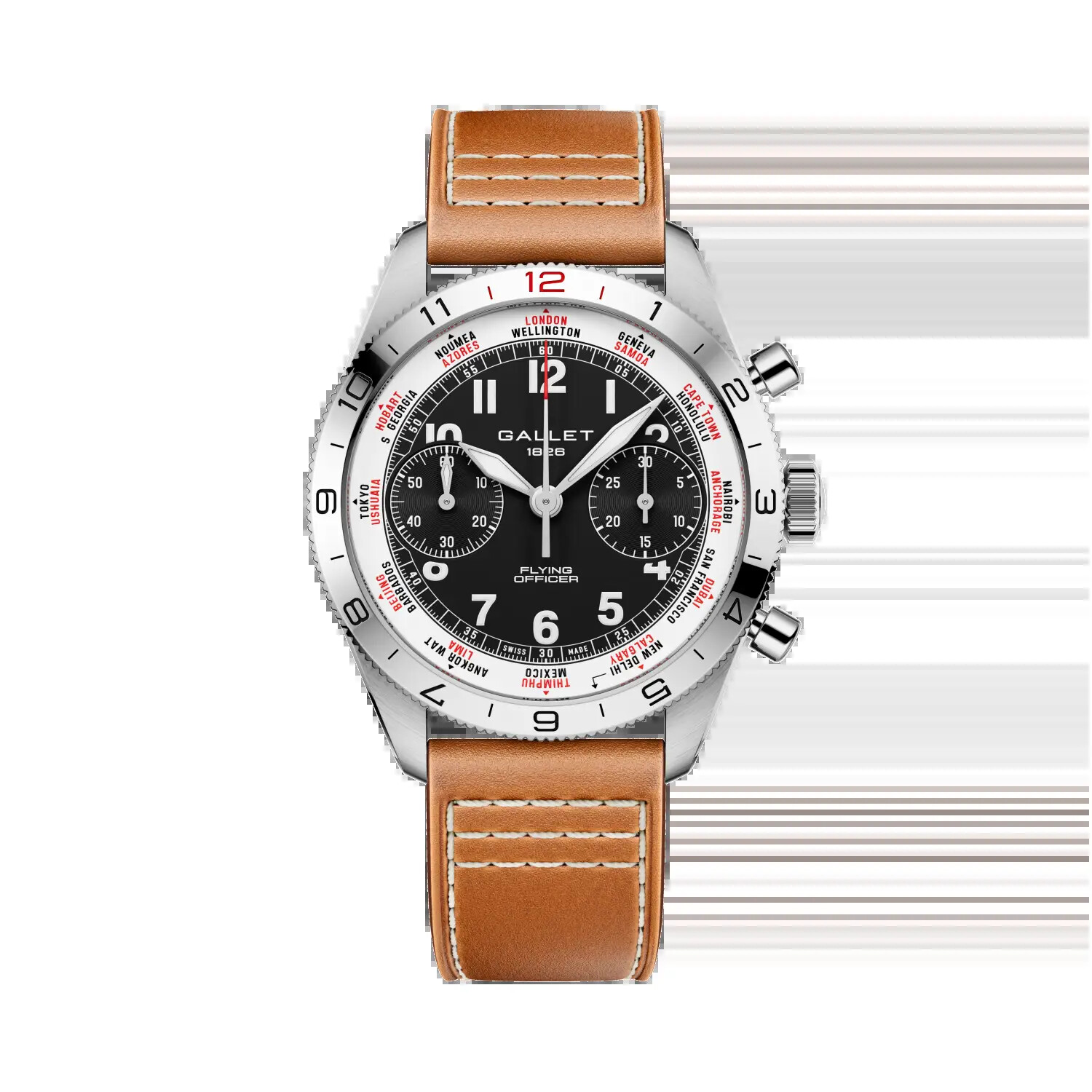
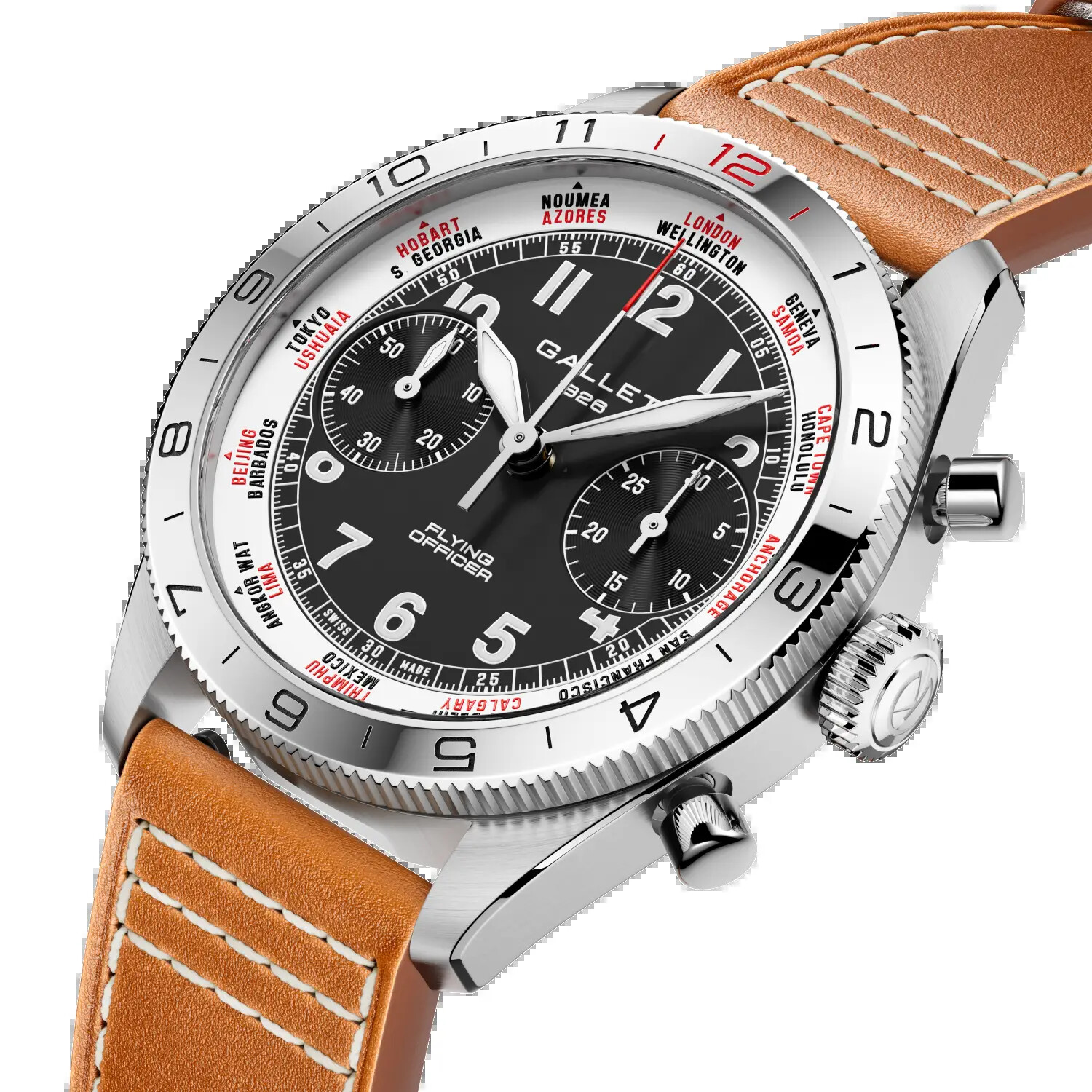
The Flying Officer is the flagship and, by Gallet's own account, the blueprint for the modern brand. First made in 1939 for the earliest intercontinental flights, it tracked the time at upcoming refueling stops through a city ring on the bezel. The 2026 version keeps that idea, sized at 40mm, with the ring redesigned around 24 contemporary destinations. It comes as a chronograph on the Gallet 23 caliber, a Sellita SW510 base with roughly 65 hours of reserve, and as a cleaner three-hand automatic on the Gallet 17, a Sellita SW200 base with about 41 hours. The three-hand version starts at USD 2,900 and the chronograph at USD 4,400.
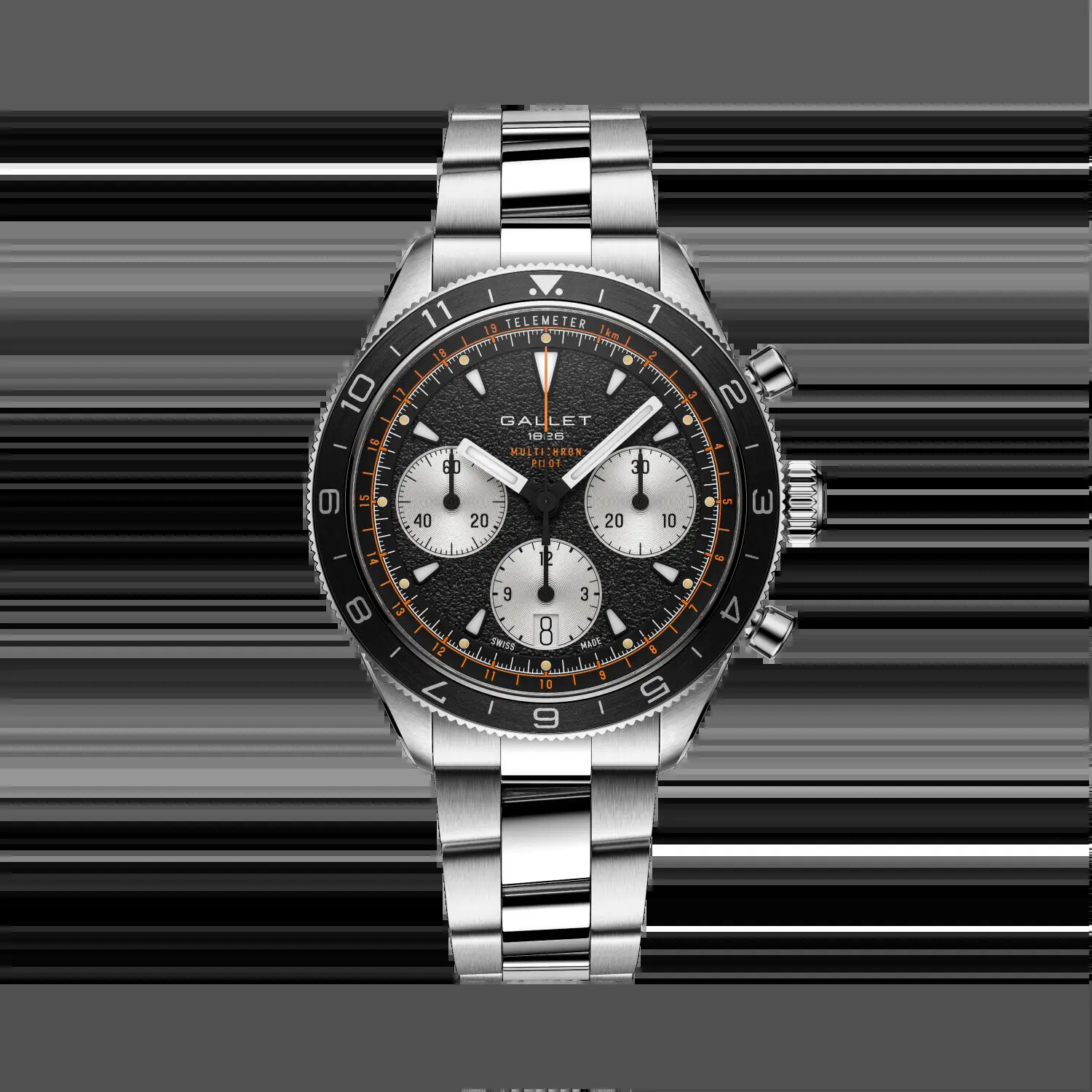
The two Multichron collections carry the tool-watch line. The Multichron Pilot is a 42mm chronograph with a bi-directional bezel, a telemeter scale, a date at six and the same Gallet 23 movement, priced from USD 4,400. The Multichron Sport is a 41mm chronograph built around a tachymeter and motorsport timing, with vivid orange chronograph hands. Neither reinvents the tool chronograph, but both are legible, honest instruments at a price that undercuts most of the Swiss competition.
The Gallet Classics, and the B09
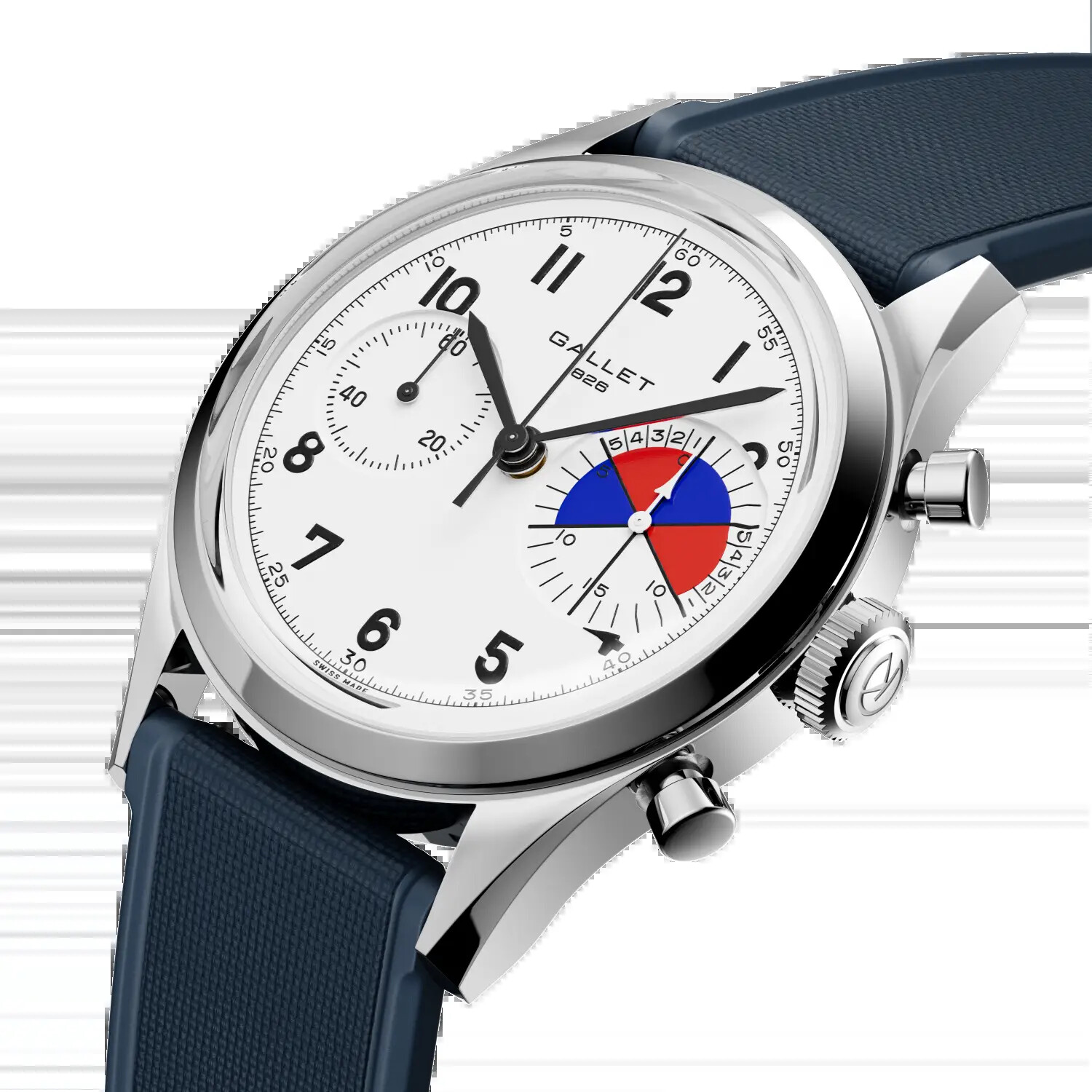
The piece that will interest collectors most is the bicentennial trio, the Gallet Classics. These are the only watches in the relaunch that skip the Sellita-based calibres and run the Caliber B09 instead, Breitling's hand-wound manufacture chronograph movement, the same engine that just appeared in Breitling's own Miles Davis Navitimer. In compact 38mm cases with roughly 70 hours of reserve, they are the more traditional, hand-wound expression of the brand, offered on straps only at USD 6,700.
Each of the three is a tribute to a specific archival Gallet. The Tribute to Yachting Big Eye revives the 1960s regatta chronograph, its outsized blue-and-red countdown register still the defining graphic on the dial. The Tribute to Multichron 45 is the dark-dial, low-light interval timer. The Tribute to Silverlight, with a silvered dial and stylised numerals, draws on the old Multichron Navigator.
Why it matters
The revival leans hard on real history, and the history is genuine: the stopwatch called The Sun timed the Wright brothers' first powered flight of 59 seconds in 1903, the Clamshell was among the first waterproof chronographs in 1938, and Rex Mays took a MultiChron Regulator when he won the Springfield Mile in 1940. Anniversary launches usually reach for a signature or a colour and call it a tribute. Gallet has reached for four working collections and a movement with substance in the Classics, and priced the range where a Breitling buyer's younger sibling might actually shop. Whether the market wants a heritage name that is, in practice, a Breitling sub-brand is the open question. The watches themselves are more convincing than that framing suggests.
Sources: Gallet press lounge, gallet.com, and Gear Patrol.