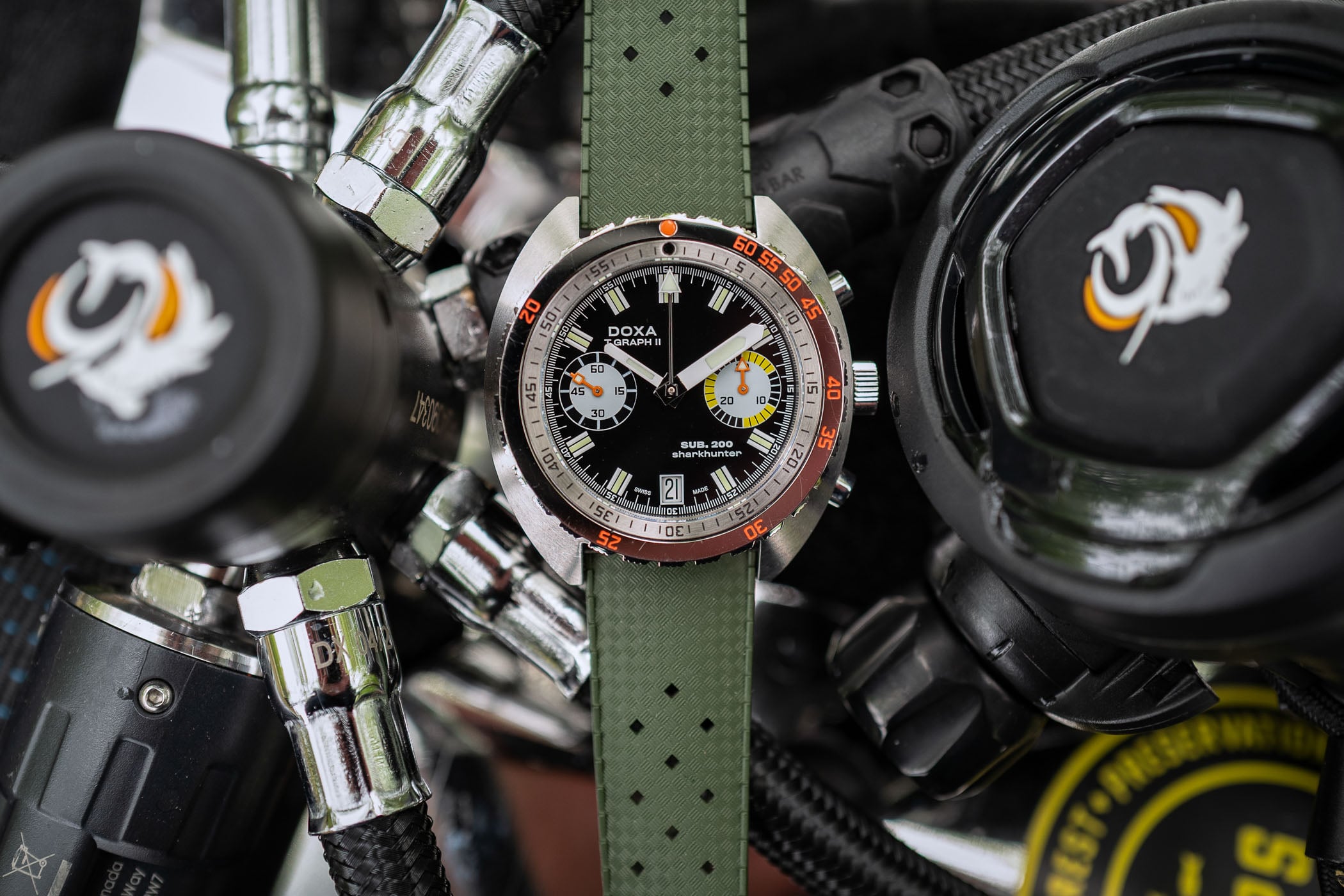
In 1969, the same year the SUB 300 was finding its feet, Doxa did something most dive-watch makers were not doing: it put a chronograph on a diver and called it the SUB 200 T.Graph. The logic was practical. The rotating bezel still tracked your dive, and the stopwatch handled everything that happened at the surface, from intervals to a safety stop. It was a niche idea that never quite caught on at the time, and that is precisely why surviving examples became collectible. When Doxa issued a 50th-anniversary reissue in stainless steel in 2019, those models became as sought after as the vintage originals. A broader return was only a question of when.
It has now arrived as the SUB 200 T.Graph II, and the most important decision Doxa made was to keep the changes small.
A slightly smaller cushion
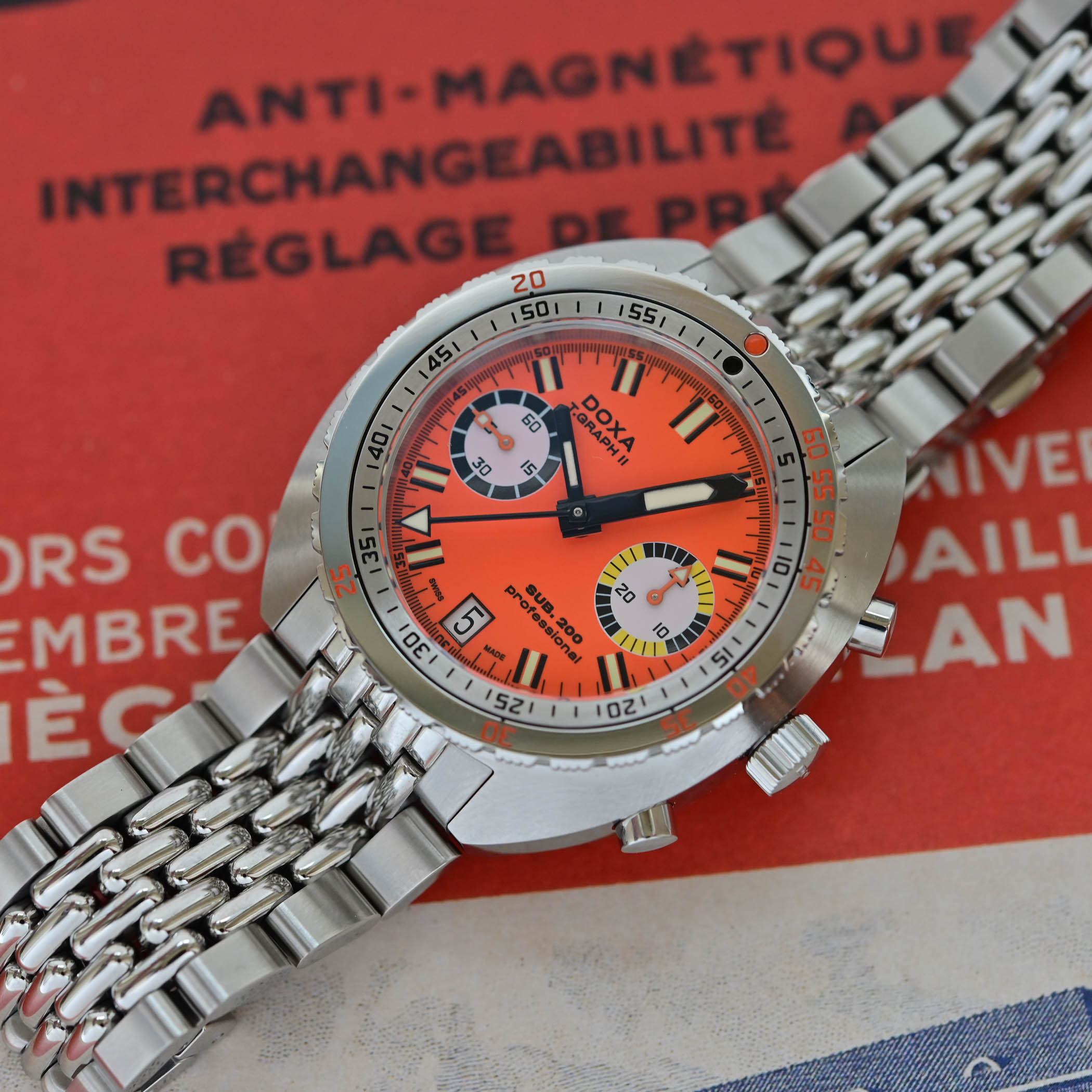
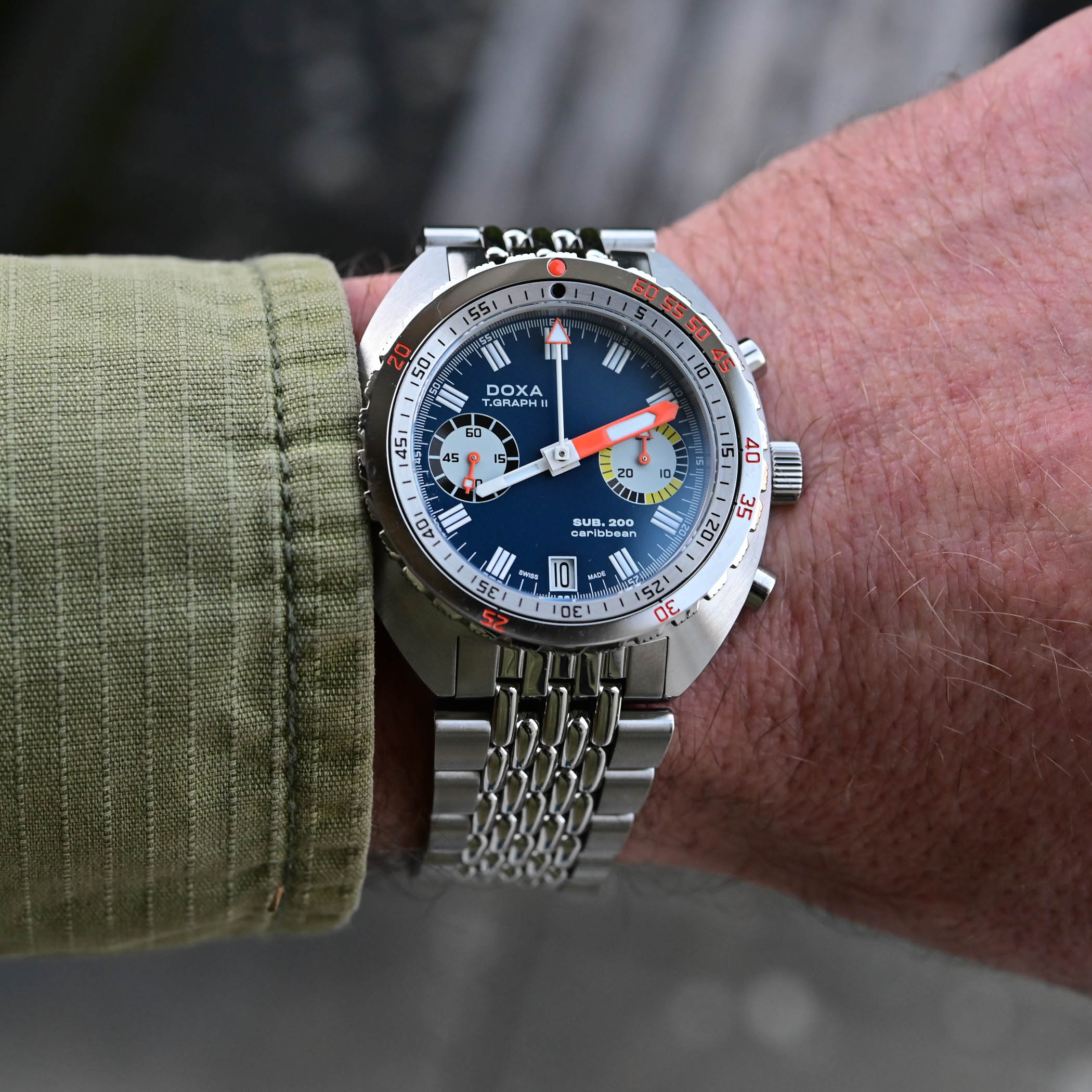
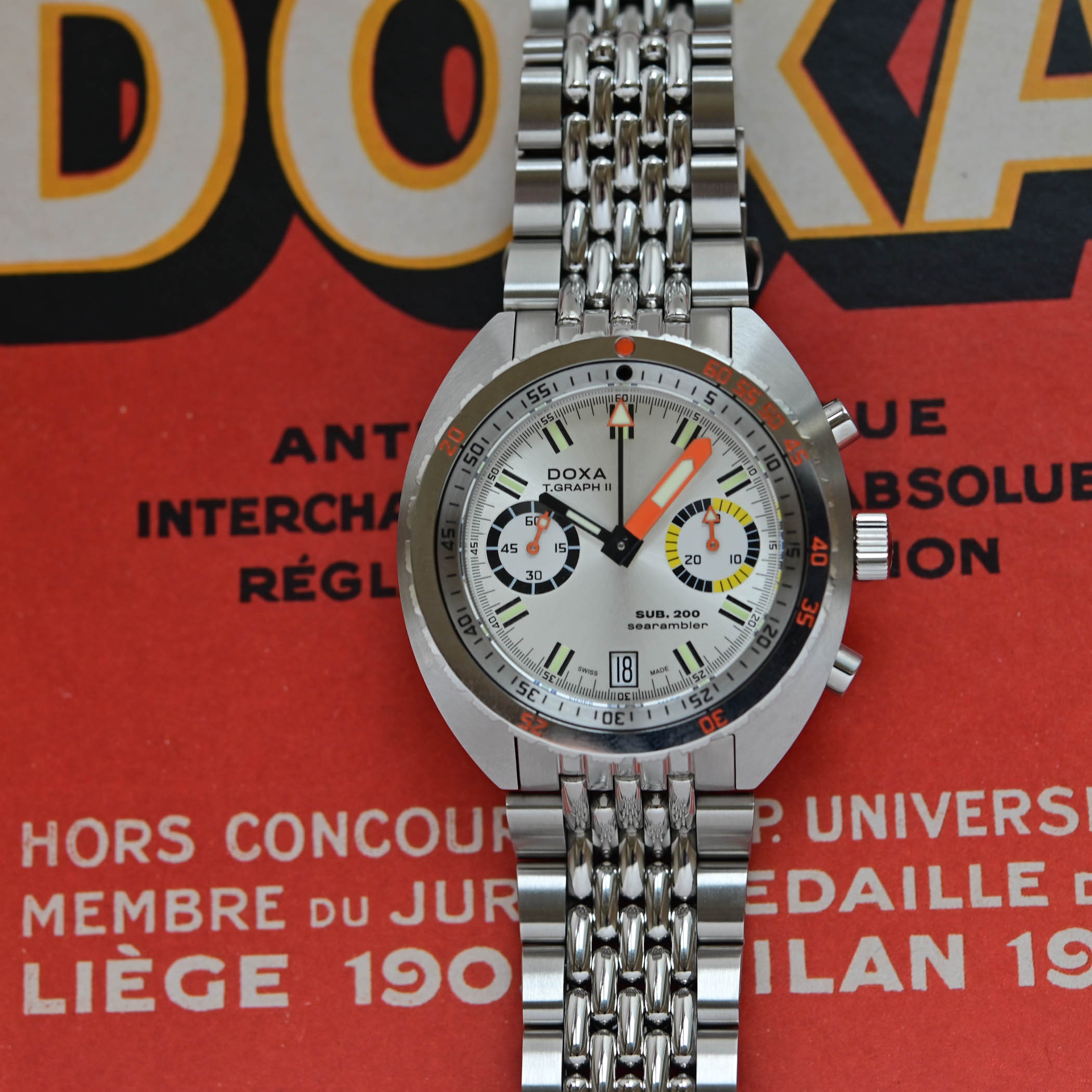
The signature cushion case is intact, still broad and legible, but the proportions have been trimmed. The T.Graph II measures 42mm wide, 14.6mm thick and 44.5mm lug to lug, down from the 43mm by 15.15mm of its predecessor. None of that sounds dramatic on paper. On the wrist it is the difference between a watch that perches and one that settles, which matters more on a tool watch than on almost anything else. Water resistance is 200m, with a screw-down crown, a screwed solid caseback, a sapphire crystal with anti-reflective coating, and a unidirectional steel bezel carrying the no-deco and 60-minute scales.
Four colours, one of them new
The dial layout is exactly what a Doxa should be: painted indices loaded with Super-LumiNova, a 30-minute chronograph counter at 3 o'clock, a running seconds register at 9, a central chronograph seconds hand and a date at 6. No clutter. What is new is the colour spread. Three dials revive the brand's own language: Professional orange, Searambler sunburst silver and Sharkhunter black. The fourth brings Caribbean blue to a T.Graph for the first time. Caribbean has been part of the SUB line for decades, so its arrival here reads less as novelty than as a gap finally closed.
The movement is honest, not in-house
Under the caseback sits the Sellita SW510, an automatic chronograph beating at 28,800vph with roughly 56 hours of power reserve, built on the architecture of the Valjoux 7750. It is not a manufacture calibre, and Doxa is not pretending otherwise. This is a company that sources a reliable, serviceable movement, engraves its own name on it and spends its attention on the parts of the watch a diver actually touches. For a watch in this category, that is the correct order of priorities.
Bracelet, strap and price
Buyers choose between the steel beads-of-rice bracelet, a Doxa hallmark, and a rubber strap, supplied in black or, on the Professional and Caribbean, colour-matched to the dial. Both fit a signed folding clasp with a wetsuit extension, and the lug width is 20mm. Pricing runs to EUR 3,990 (USD 4,290, CHF 3,690) on the bracelet and EUR 3,950 (USD 4,250, CHF 3,650) on rubber, a sensible gap of about forty euros. The T.Graph II is a permanent-collection model rather than a limited edition, available now through Doxa retailers and doxawatches.com.
The read
Doxa frames the watch with a useful distinction: this is not a chronograph that happens to dive, it is a dive watch that happens to carry a chronograph. The timing bezel stays the primary instrument underwater, and the stopwatch is there for the surface. That framing keeps the T.Graph II honest to what made the 1969 original worth reviving. At this price it has plenty of capable rivals, but few of them arrive with more than fifty years of dive-watch lineage and four dials drawn straight from it.