Christiaan van der Klaauw has spent five decades doing one thing. The atelier, founded in the Netherlands in 1974, builds only astronomical complications, which makes it less a watch brand than an observatory with a strap department. Its newest piece, the Venus Zodiac, was introduced alongside the Venus Annual Calendar at Watches and Wonders in April; this week the first live photographs of the rose gold version began circulating, and they explain the watch better than the press release did.
Four discs, three orbits
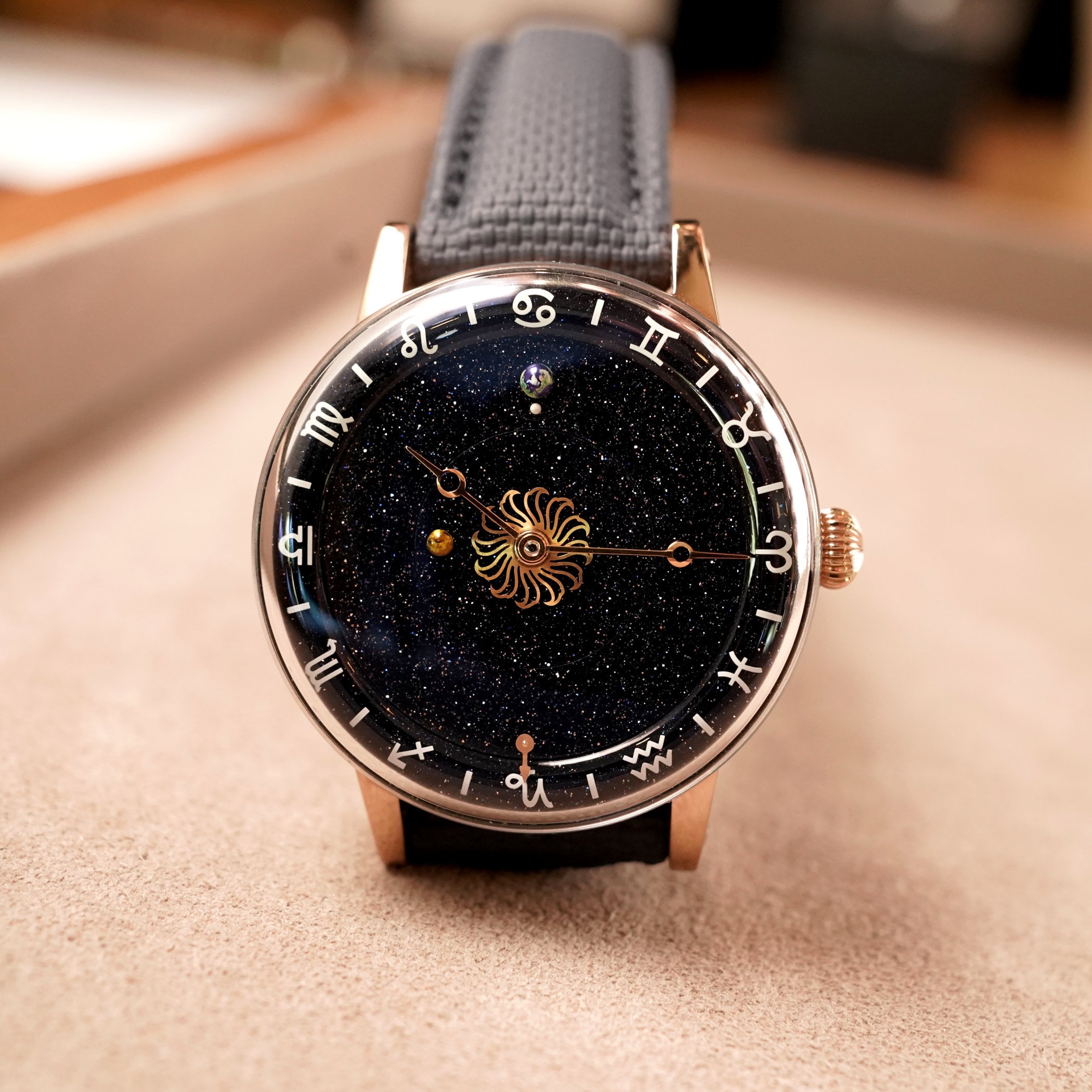
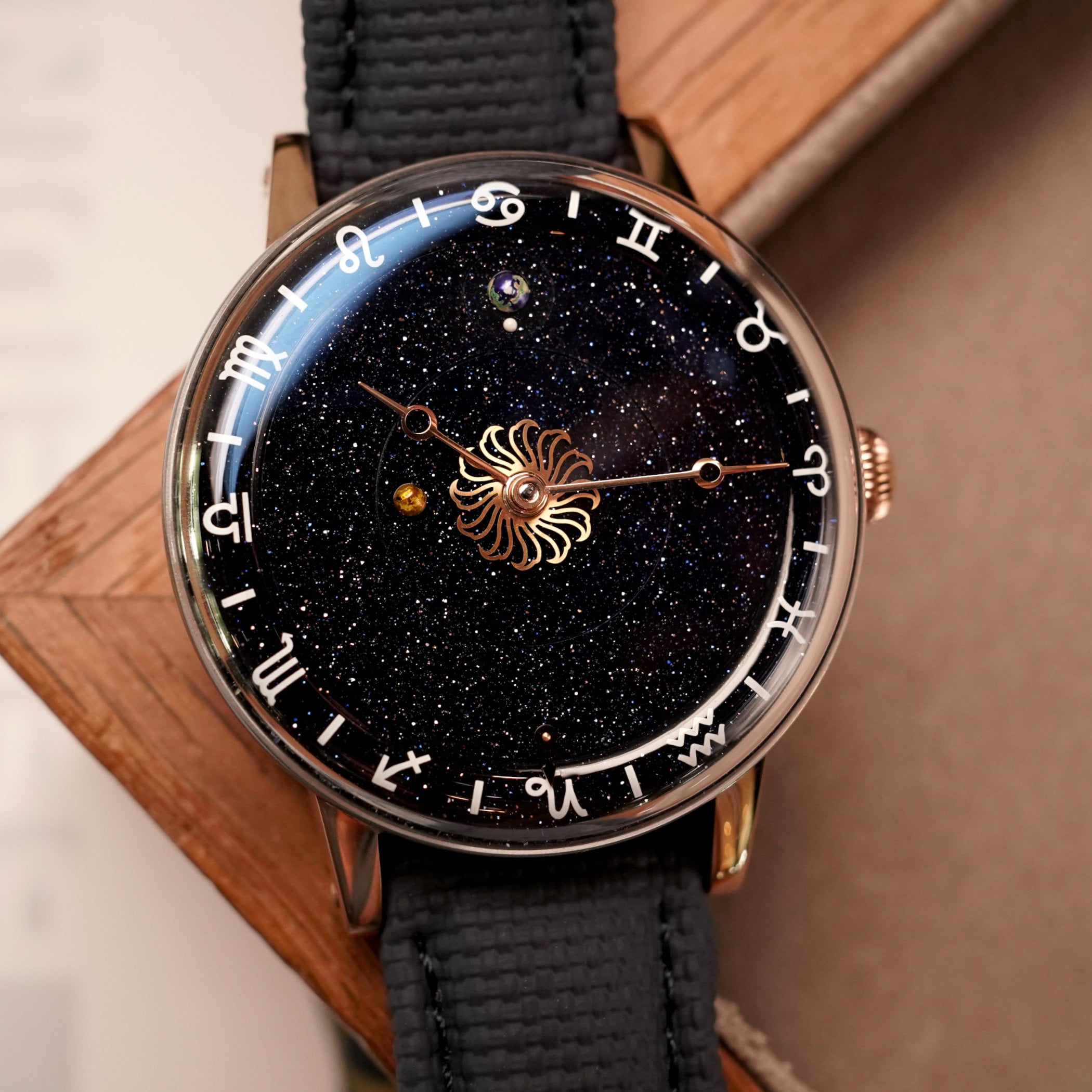
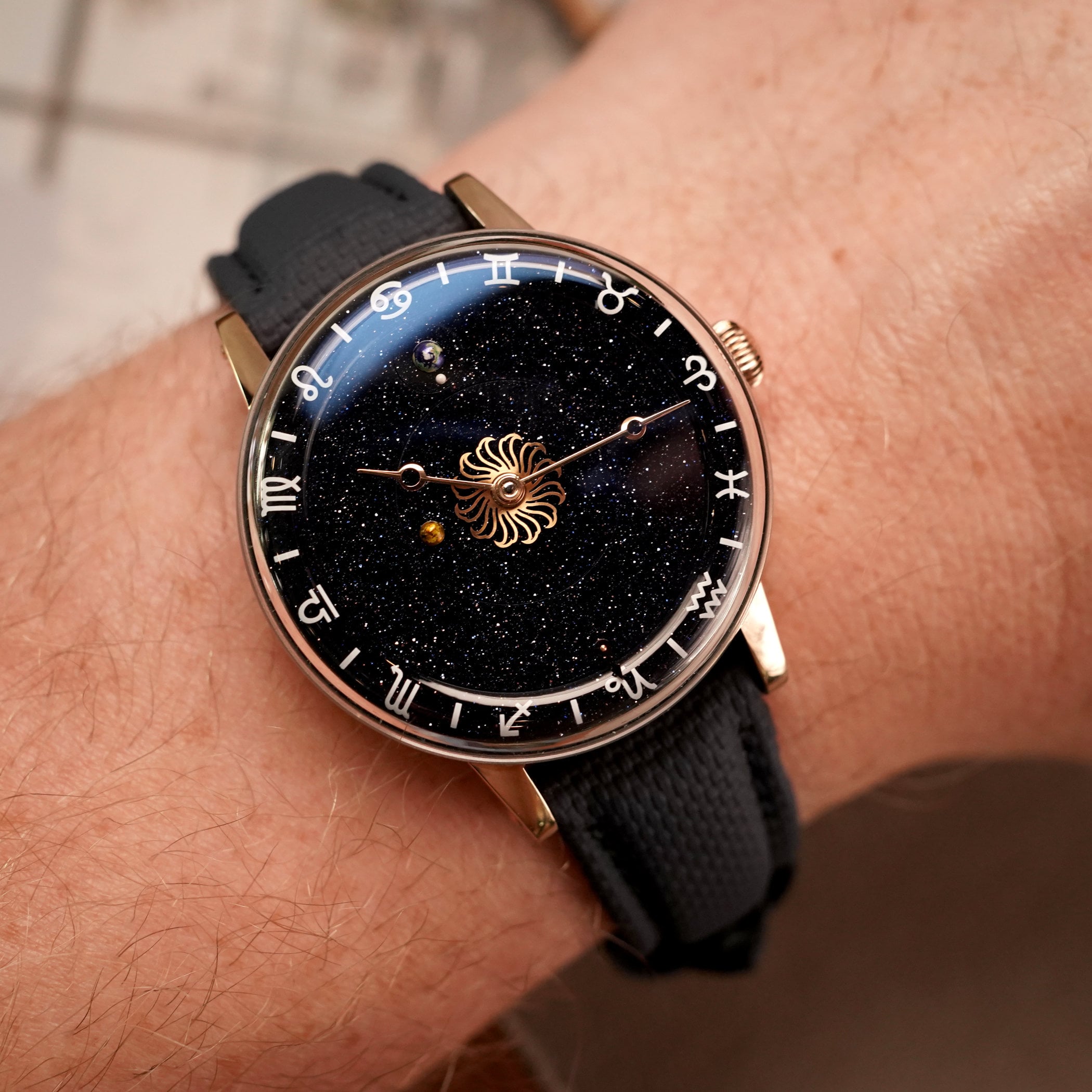
The dial is a working planetarium built from four layers of blue aventurine glass, three of which rotate continuously. A twelve-clawed gold Sun sits at the centre. Around it, separate discs carry Venus, then Earth with the Moon circling it, each moving at its own orbital rate. The aventurine's glitter does practical work here: it hides the seams between the rotating discs, so the dial reads as a single field of sky.
The complications follow from the geometry rather than being printed on top of it. There is no moonphase aperture. When the Moon sits between Earth and the Sun, it is new; when Earth sits between the Moon and the Sun, it is full. The reading takes a moment of orientation the first time and none thereafter. On the periphery, a fixed flange carries the twelve zodiac signs, and a small gold hand riding the nearest disc points at the current one. The markers between signs fall at the transition dates, generally around the 21st of each month.
The time itself is almost an afterthought, by design. Gold Breguet-style hands with open tips circle above the Sun. Precision legibility was not the goal; the brand has never pretended otherwise.
A Strehler base under a Dutch sky
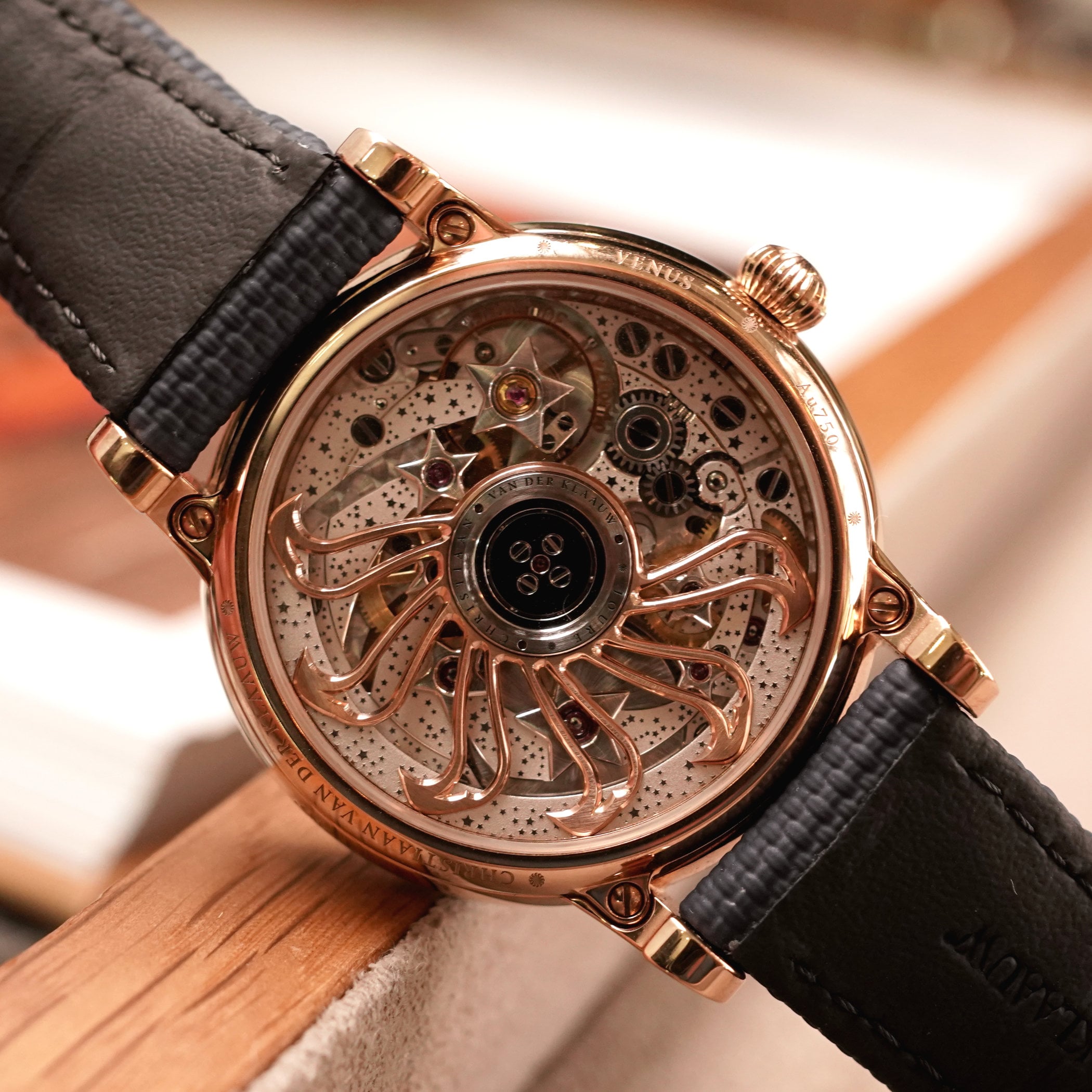
The CKM-01 calibre pairs a base movement by Andreas Strehler with the astronomical Venus module on top. The automatic runs at 21,600 vibrations per hour with a 60-hour power reserve, a freesprung hairspring and a variable-inertia balance, 36 jewels in total. The finishing keeps the theme without getting literal: bridges embossed with stars, main jewels held in five-pointed star settings, and a skeletonised rotor shaped after the atelier's sun logo, rose gold-plated over brass with a tungsten weight.
The case is the restrained part. At 38mm in steel or rose gold, with a near-absent bezel, domed sapphire and straight screwed lugs, the Venus Zodiac stays smaller than most watches carrying far less mechanical astronomy. Many planetarium watches need 44mm to make their point; this one makes it at dress-watch size.
Price and positioning
The steel version, on blue ostrich leather, is EUR 42,200 before VAT. The rose gold, on a blue Sailcloth-embossed FKM strap, sits above EUR 58,000. That is serious money for a small Dutch atelier, and also roughly what a single complication from a major maison costs, without the planetarium. For collectors who measure a watch by how much mechanical thinking sits behind each square millimetre of dial, the Venus Zodiac is dense territory.