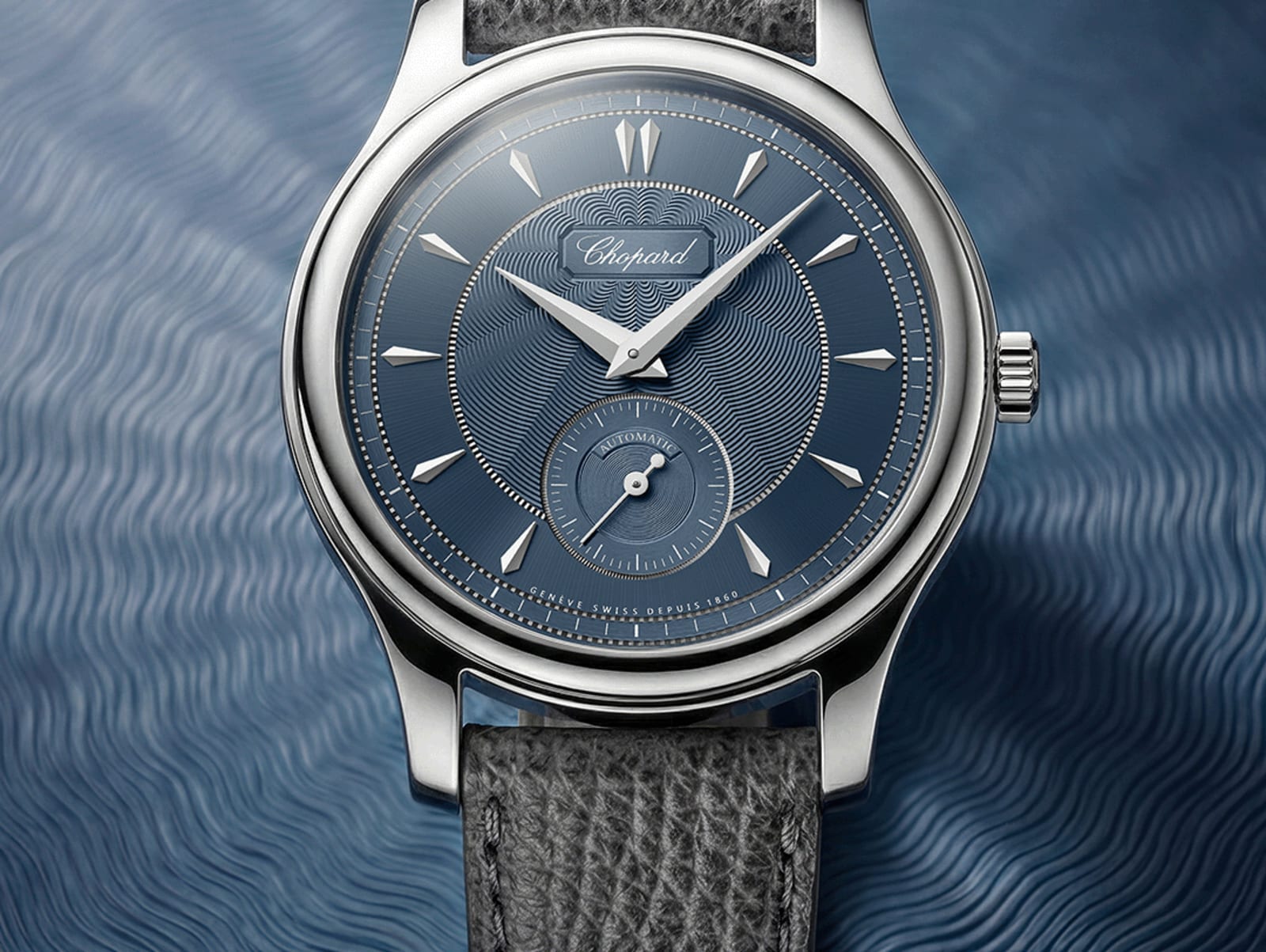
Thirty years ago, Chopard co-president Karl-Friedrich Scheufele opened a small workshop in Fleurier, in the Val-de-Travers valley, and began building what is now one of the few fully integrated movement manufactures in Swiss watchmaking. The L.U.C 1860 was the first watch that came out of it. The anniversary reference Chopard unveiled at Watches and Wonders 2026, the L.U.C 1860 Areuse Blue, is a direct descendant of that original piece, with the same proportions, the same movement architecture, and a new dial colour named after the river that runs past the manufacture door.
Small by choice
The case is 36.5mm in diameter and 8.2mm thick, which makes it, by the numbers, one of the most wearable dress watches currently in production. Monochrome, in its first-look review, noted that the proportions are very close to the 1997 original, which itself was already unusually compact for a mechanical three-hander in the late nineties. Compactness is deliberate. The original L.U.C 1860 was Scheufele's statement that Chopard was going to make adult dress watches, not trend-driven oversized ones.
The case material is Lucent Steel, a proprietary Chopard alloy that the brand says is roughly 50 percent harder than 316L and better at resisting scratches. It is also, visually, slightly whiter than standard stainless, which makes the blue of the dial pop a little more than it would on a conventional case.
Areuse Blue, hand-guilloché
The dial is the most labour-intensive part of the watch. Chopard is hand-guilloching each one on a vintage rose-engine lathe, which means an operator is manually engraving the pattern, one rotation at a time. SJX, in its piece on the release, pointed out that this is not the CNC-driven guilloché that most Swiss brands now use. The lathe work is slower, slightly less uniform, and reads more naturally to the eye.
The colour, Areuse Blue, is tuned to echo the river Areuse, which runs along the edge of Chopard's Fleurier manufacture site. It leans towards ink rather than navy, with enough depth to shift under different lighting. There is no date window, no sub-seconds, no second scale. Two hands, twelve hour markers, and the L.U.C script.
The movement
Inside is the L.U.C calibre 96.40-L, an automatic movement with a 22-karat gold micro-rotor, a 65-hour power reserve, and a full finish grade that Chopard has built a reputation on: chamfered bridges, perlage on the main plate, engraved screw heads. At 3.3mm, the calibre is one of the thinner self-winding movements in its class, which is how the 36.5mm case ends up at 8.2mm overall.
The 96.40-L carries Poincon de Geneve certification. That mark comes with both decorative and chronometric requirements, and it is one of the strongest signals in the industry that a movement has been finished and adjusted to a high standard.
A quiet brand of horology
Chopard has never had the marketing budget of the Swatch Group or Richemont majors, and the L.U.C line has always run quieter than the brand's Mille Miglia or Happy Sport collections. That is part of the appeal. The Areuse Blue is not trying to compete with the centenary Oyster Perpetual or the IWC space watch for headline space. It is trying to mark a thirty-year anniversary with a watch that looks like it could have come out thirty years ago, and will probably still look right in another thirty.
Chopard has not published a firm price at time of release. Fratello and Watch Advice both estimate it will land below the 2024 L.U.C 1860 yellow gold, which was around 26,000 Swiss francs.
Sources: Monochrome, SJX, Worldtempus, Watch Advice, Fratello.