Louis Cartier first drew the Tortue in 1912 to pair with the Tank. It is the quieter of Cartier's shaped watches, with a case shaped like the back of a turtle (hence the name) and none of the vehicular or furniture metaphors of its siblings. Cartier has reissued it in waves, with the last substantial refresh in 2024. The 2026 version, shown at Watches and Wonders on the closing day of the fair, softens the silhouette, moves the whole collection to the in-house 430 MC, and brings the Panthère Métiers d'Art Tortue as the line's technical crown.
The new case profile is the first thing anyone familiar with the last Tortue will notice. Revolution's coverage describes the volumes as softer and rounder than the outgoing 2024 silhouette. Wallpaper's writeup reaches the same read. The bezel is less pronounced, the lugs flow from the case middle rather than interrupting it, and the proportions sit closer in hand than on the prior generation. The Roman numeral dial stays, with Cartier's secret signature hidden inside the X at the ten o'clock position.
The daily-wear collection
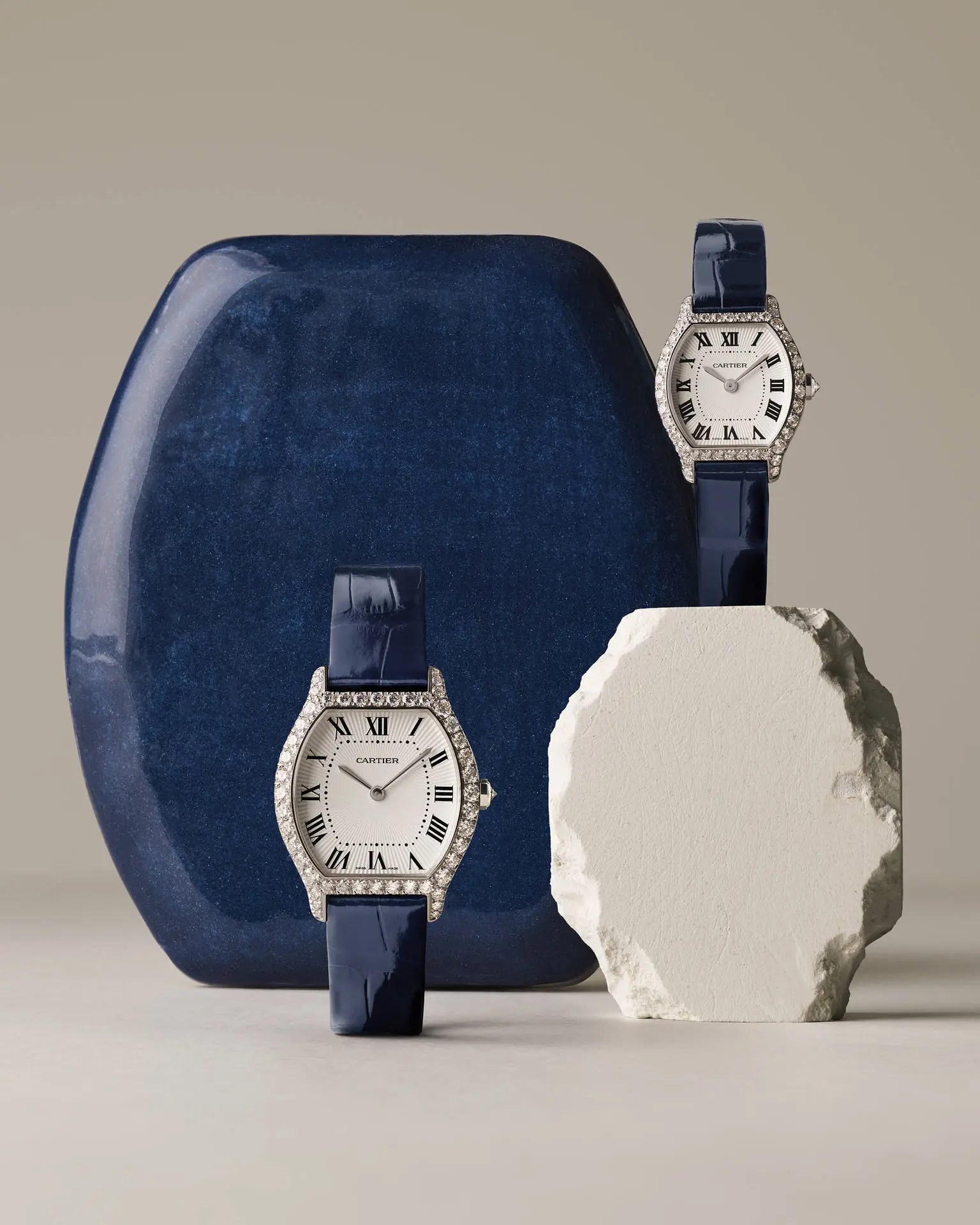
Five references, available in small (41mm x 33mm) or mini (36mm x 28mm), make up the standard line. Cases come in yellow, white, and rose gold. White and rose variants receive a cut-down diamond bezel setting for added brilliance. The straps are alligator, navy blue on the diamond references and matched to case tone on the plain gold references. All five carry the manufacture Caliber 430 MC, a hand-wound movement measuring 20.5mm across and 2.15mm thick.
The 430 MC is not new to Cartier, but it has not previously been the default across a full Tortue range. As aBlogtoWatch explains in its launch piece, standardising on a single in-house movement across the entire collection is a clear break from the mixed-movement Tortue history, where some references ran on ETA-derived bases and others on the manufacture calibre.
The evening watch
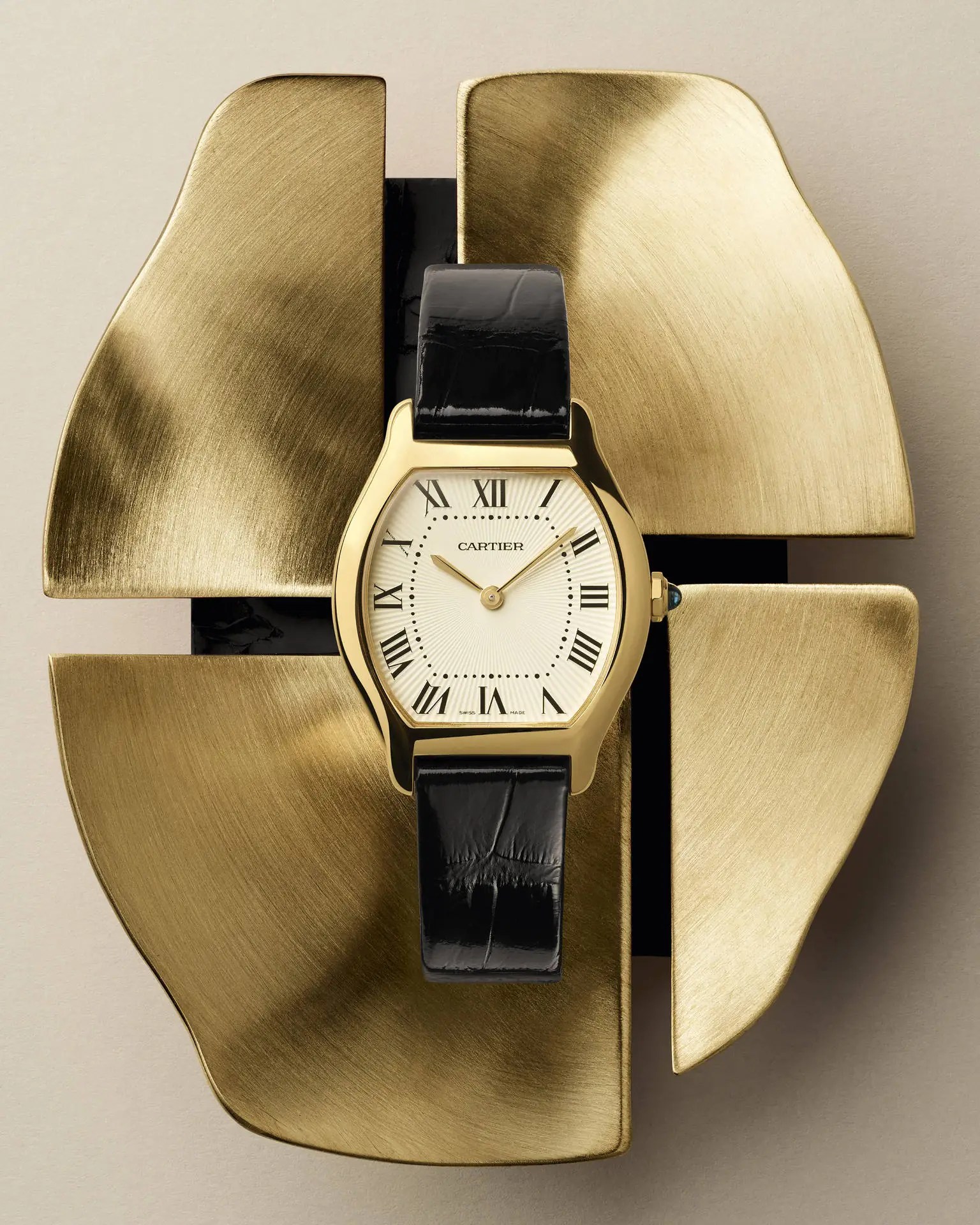
The platinum Tortue sits above the standard collection. Watchilove's technical breakdown lists the specifications: 41mm x 33mm case, 7.2mm thick, running on the hand-wound 430 MC. The bezel carries 46 baguette-cut diamonds totalling 2.7 carats. The octagonal crown holds an inverted brilliant-cut diamond. The double folding clasp on the white gold is set with an additional 32 baguette-cut diamonds, for a total gem weight of 3.41 carats across the watch. The dial is a silvered guilloché pattern read by rhodium-plated apple-shaped hands. No Roman numerals, no minute track beyond a narrow chapter ring; the dial does less so the case setting can do more.
This is the first time Cartier has used baguette diamonds on a full Tortue case in the contemporary collection. The cut itself has been part of Cartier's jewellery language since 1910, which is the frame the brand is drawing on.
The Panthère Métiers d'Art Tortue
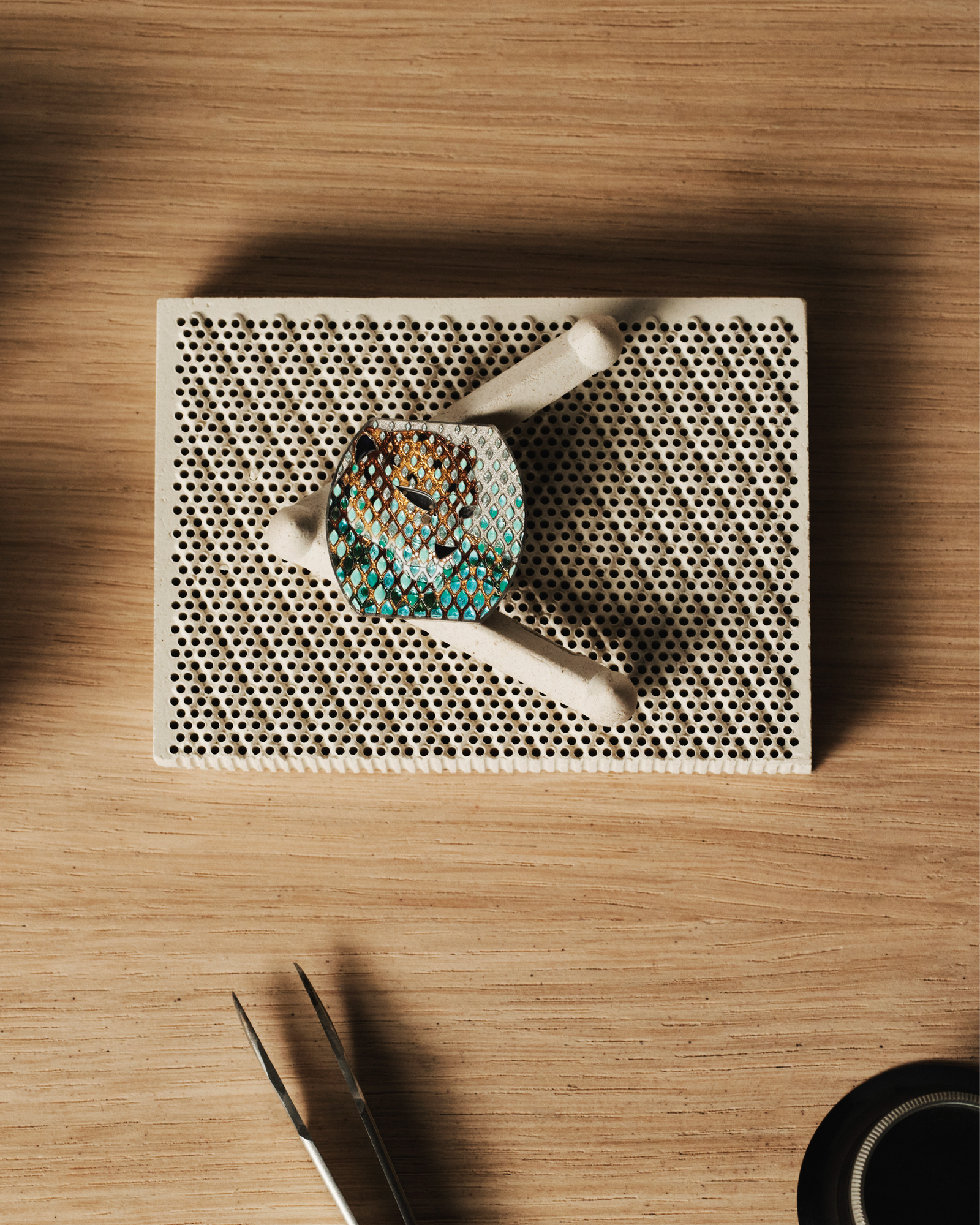
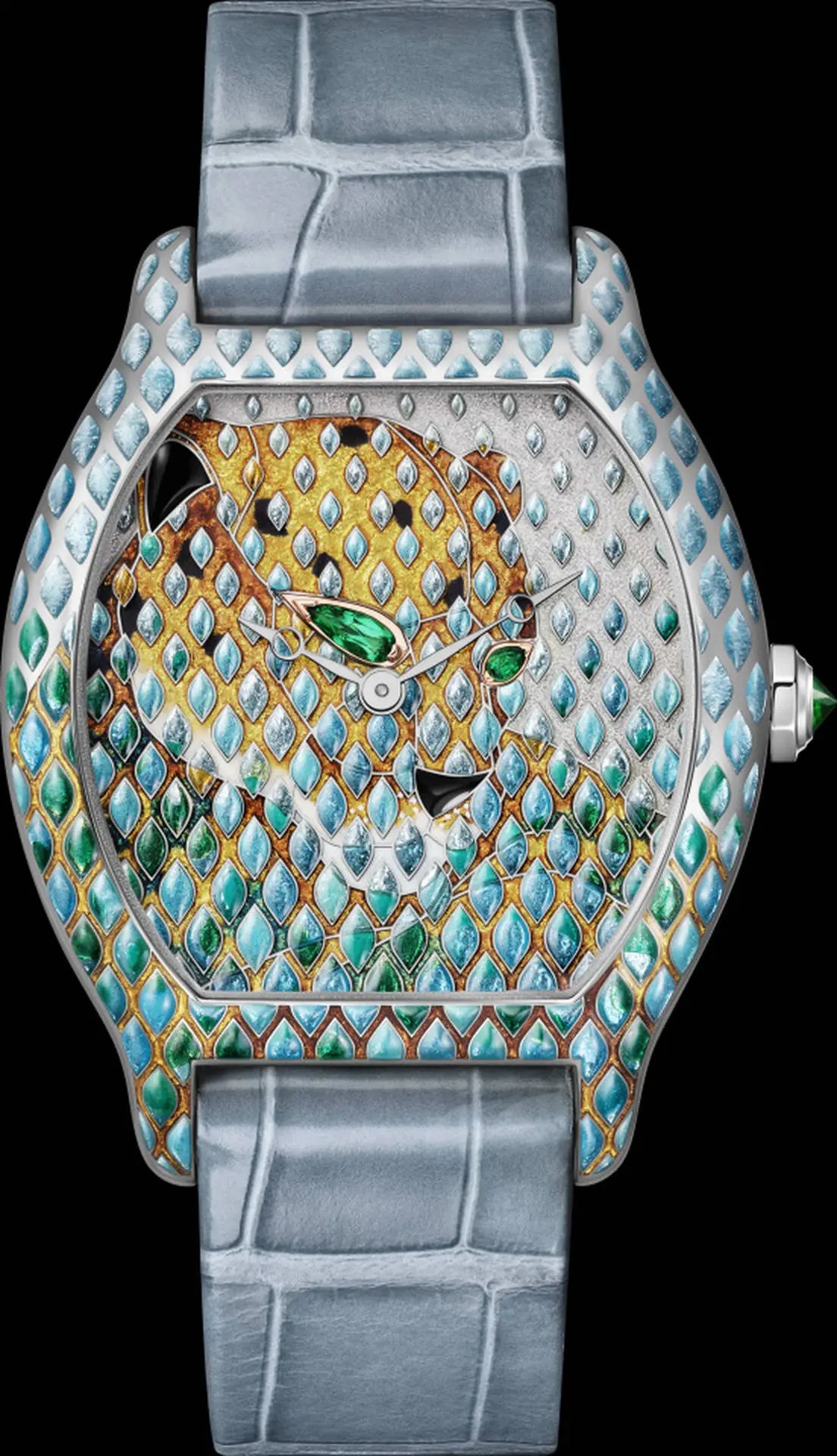
The most technically ambitious piece in the Tortue presentation is the Panthère Métiers d'Art Tortue, produced in two limited editions of 100 numbered pieces each: one in white gold with emerald eyes, one in yellow gold with tsavorite eyes. The construction is unusual. The case is built in two parts so that the champlevé enamel work can extend past the bezel and wrap around the case middle. The effect, as aBlogtoWatch describes, is that the panther's coat continues without interruption from the dial across the flank of the watch. There is no visual boundary between where the dial ends and the case begins.
The enamelling process, documented in Cartier's press material and cited by aBlogtoWatch, requires more than fifteen tones per piece, more than thirty-six separate firings for the dial and case, 80 hours of enamelling on the dial, another 50 hours on the case, and three hours of setting for the two stones that form the panther's eyes. Each piece takes, on the brand's own accounting, several weeks of work inside the Maison des Métiers d'Art in La Chaux-de-Fonds. The reference numbers are CRHPI01811 (white gold, emeralds) and CRHPI01812 (yellow gold, tsavorites).
What the collection adds up to
The 2026 Tortue is the first iteration where the whole range runs on the 430 MC, the first with a softened case profile, and the first with a Panthère métiers d'art treatment that extends to the case middle. As a collection it is narrower than the Tank (which has a dozen configurations in continuous production) and broader than the Crash (which is produced only as privé runs). It slots the Tortue, for the first time in a while, into the middle of Cartier's shaped-watch lineup rather than leaving it as a legacy curiosity.
The standard collection runs from roughly 11,000 euros for yellow gold on strap up to the diamond-set rose and white gold references at the upper end of the everyday range. The platinum evening reference and the two Panthère Métiers d'Art are price on request. Cartier has indicated that the Panthère pieces are being allocated through boutique channels rather than through general authorised retailers, which is consistent with how the Maison handles its most labour-intensive métiers d'art releases.
The frame around this
Cartier came to Watches and Wonders 2026 with the Roadster revival and the Crash skeleton platinum already announced, plus updates to the Baignoire, Santos-Dumont, and the new Myst de Cartier. The Tortue sits in the middle of that programme and does the quiet work. It is the reference that does not trade on shape familiarity the way the Santos or the Tank do, and that is precisely what makes the updated shape worth studying. The difference between the 2024 and 2026 Tortue is subtle enough that a photo will not fully carry it, and obvious enough that a side-by-side at a boutique will.
For a line whose reason for existing is the shape of its case, a quiet shape change is the kind of release that tells you the brand is paying attention.
Sources: Revolution's Cartier at Watches and Wonders 2026 overview; aBlogtoWatch on the Panthère Métiers d'Art Tortue; Watchilove's reference-by-reference breakdown; Wallpaper's Cartier 2026 coverage.