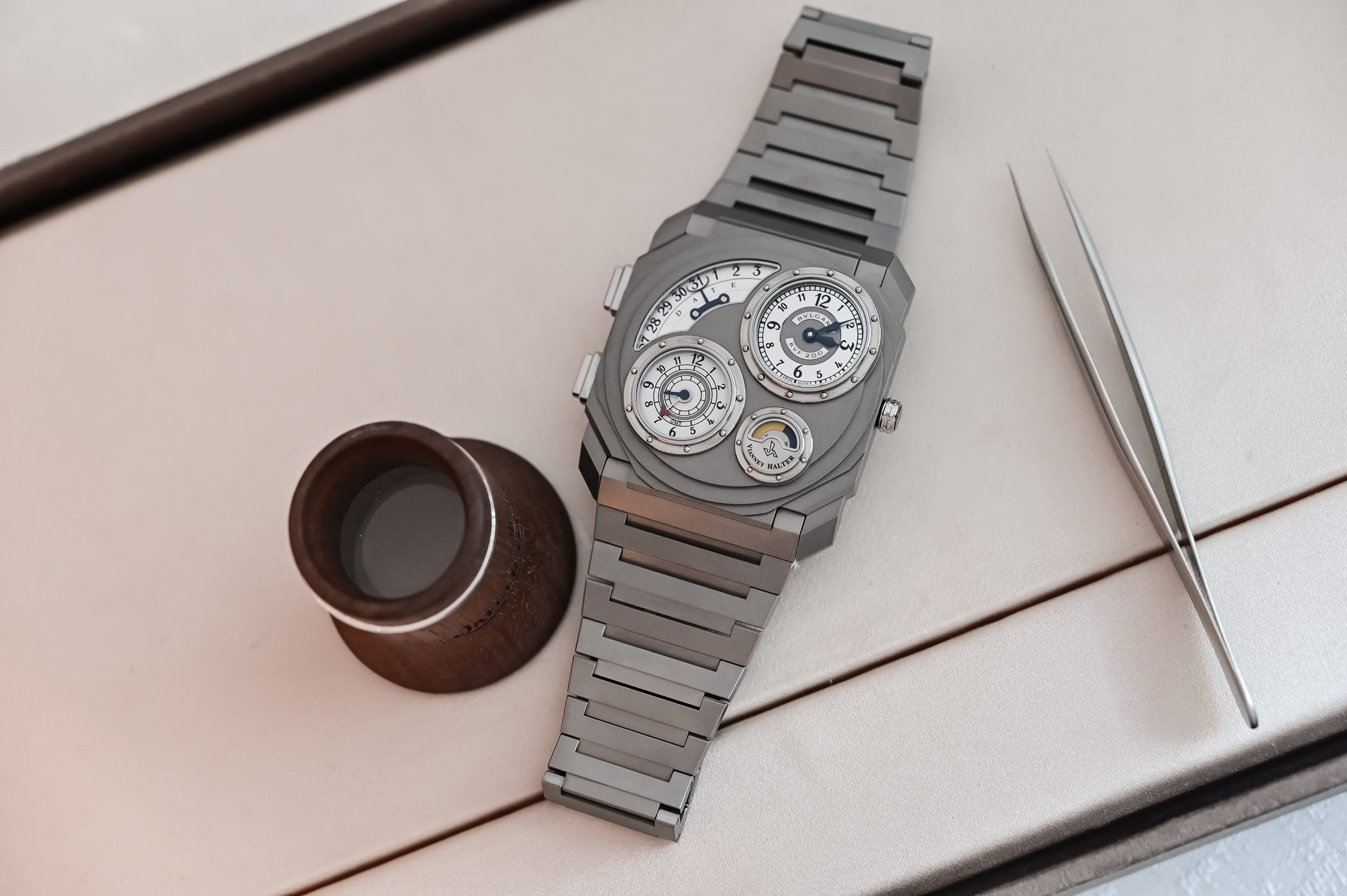
Most brand collaborations settle into one house style. The one Bulgari showed at Geneva Watch Days 2026 does the opposite. It takes the Octo Finissimo, a watch defined by sharp geometry and thinness, and hands it to Vianney Halter, whose own work looks like small machines with portholes and separate dials. The Octo Finissimo Dual Time x Vianney Halter is the result, and it holds both ideas at once. Denis Peshkov covered it for Monochrome on 2 September, and Bulgari lists it at bulgari.com.
Where the design comes from
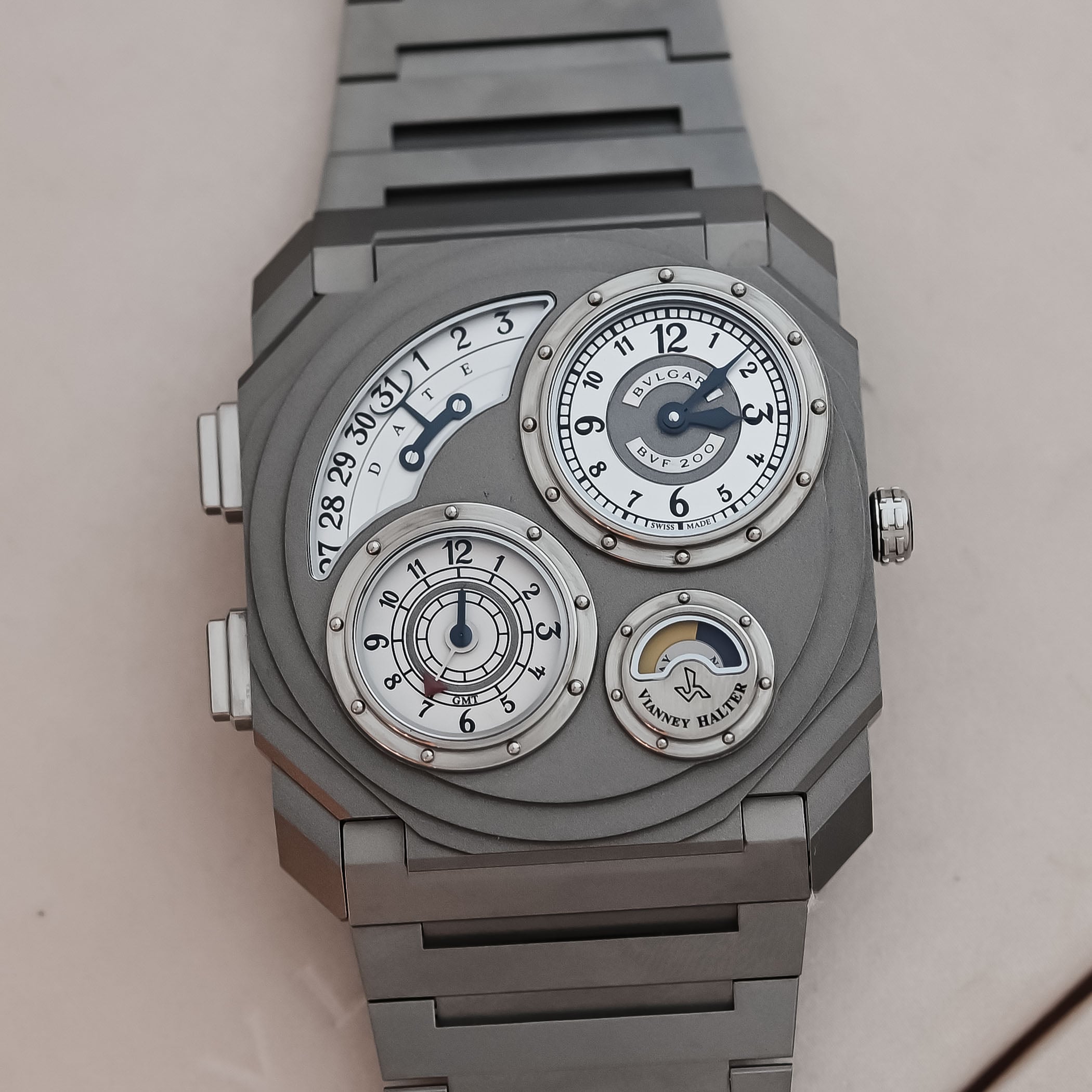
The reference is the Antiqua, the watch Halter developed in the late 1990s with the American designer Jeff Barnes. Its circular displays, porthole bezels, blued hands and Victorian-meets-science-fiction look made it one of the watches that opened the door for independent watchmaking, before MB&F or Urwerk existed. You can see it here in the four separate dials, the riveted rings around them and the star signature Halter uses in place of a logo. What is new is the setting. Instead of a rounded, layered case, the displays sit inside the Octo's eight-sided architecture, and the contrast between the round instruments and the angular case is most of what makes the watch work.
Four dials
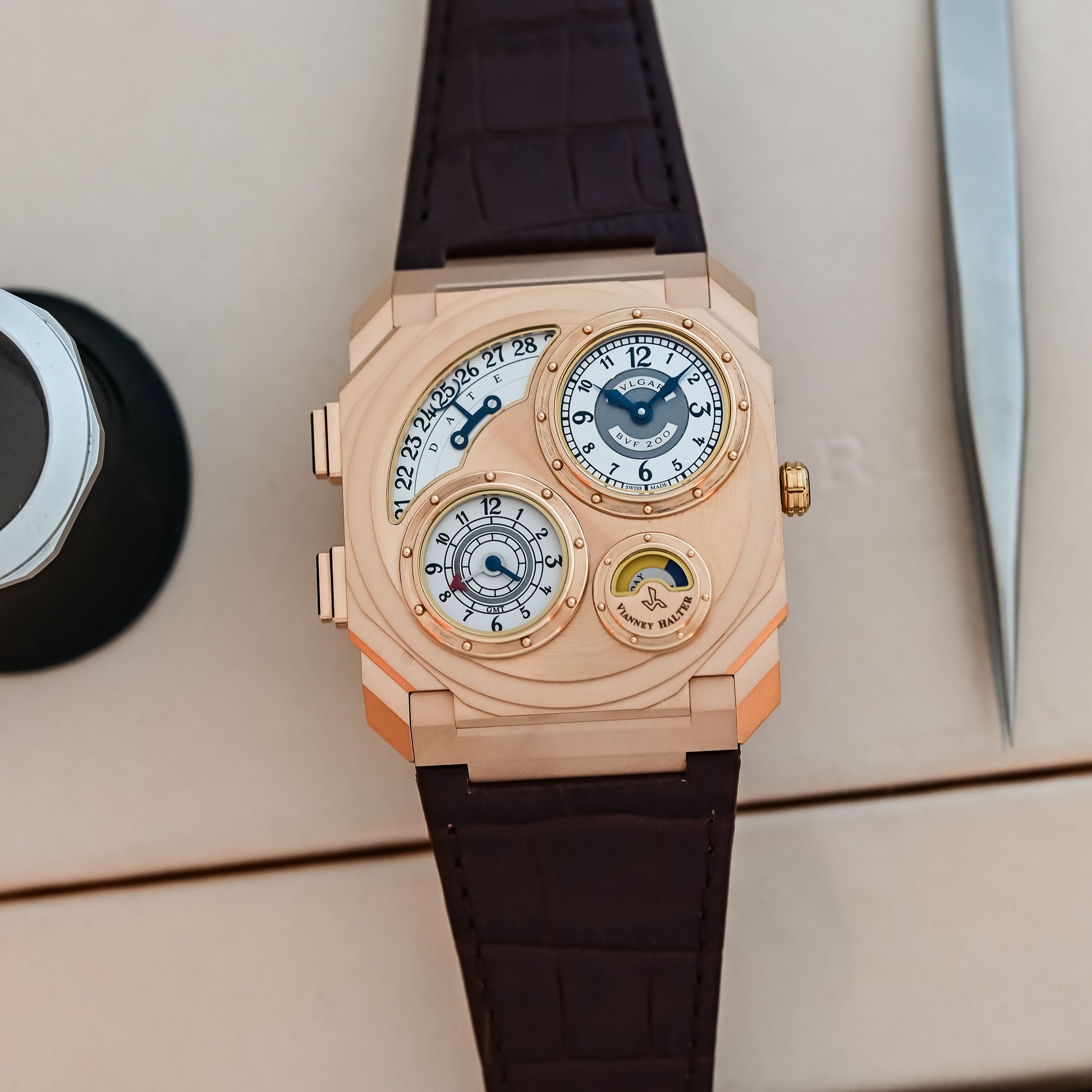
The dial is split into four opaline rhodium-plated elements. Local hours and minutes sit in the largest display at the upper right, marked BVLGARI and BVF 200. A second display at the lower left carries the second time zone and the running seconds on concentric tracks, marked GMT, with a red arrow-tipped hand that reads as a machine part more than a pointer. The date runs along a curved scale at the upper left, marked DATE, and a day/night indicator sits at the lower right under the Vianney Halter signature. The hands are Halter's own shape in blue. It is a lot of information for a watch this thin, and the labels, printed on displays no one would mistake for anything else, are part of the instrument-panel character rather than a concession to legibility.
The BVF 200
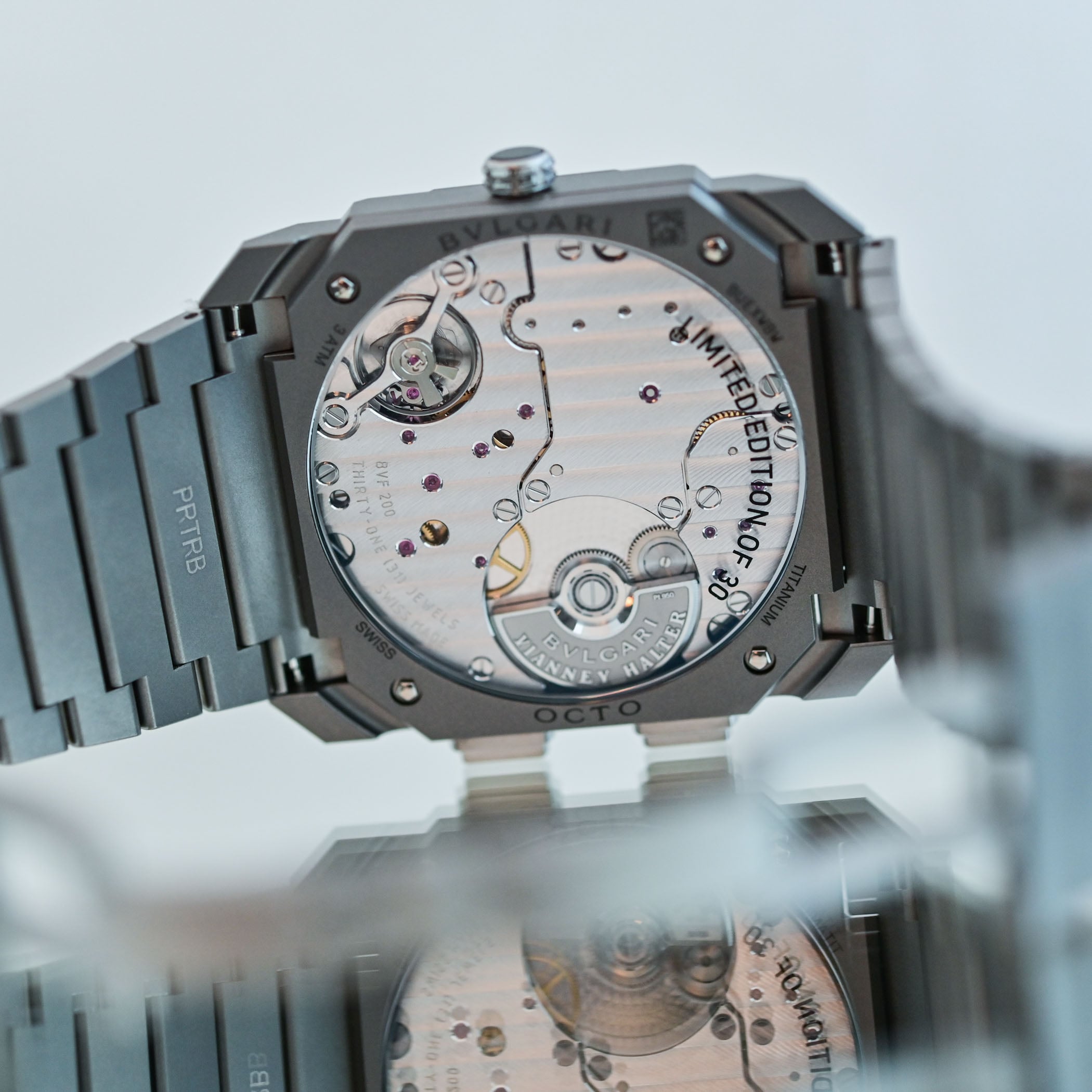
The movement is the new BVF 200, developed and made in-house on the base of the micro-rotor calibre BVL 138 that Bulgari has used to set thinness records. It measures 5.49mm, runs at 21,600 vibrations an hour and holds about 60 hours of reserve, and it drives hours, minutes, the second time zone, running seconds, the date and the day/night display. Through the sapphire caseback you get vertical Côtes de Genève, brushing and perlage, and a micro-rotor in platinum on the titanium watch, engraved with Halter's signature. The case is a 50-part construction, 40.5mm across and 9.7mm thick, or 7.7mm measured from the caseback to the top of the bezel, which is the number that matters given how many layers are stacked inside. The crown has a black ceramic insert, two rectangular pushers on the left set the date and the GMT hand, and water resistance is 30m.
Two versions
There are two executions, and they read differently. The titanium version has a sandblasted case and an integrated titanium bracelet, which keeps the industrial side of the collaboration in front. It is limited to 30 pieces, reference 104356, at CHF 70,000. The rose gold version, reference 104355, pairs a sandblasted case base with a circular-brushed upper section, satin-polished porthole bezels and a brown alligator strap, and moves the watch toward dress territory. It is limited to 15 pieces at CHF 108,000, and its micro-rotor is rose gold rather than platinum.
Neither is a watch many people will handle, at 45 pieces between them. But it is the rare collaboration where you can see exactly what each side brought, and the join between them holds.