Most young watch brands spread themselves thin across shapes and complications while they look for an identity. Bianchet has done the opposite, building almost everything around a single object: an ultra-thin automatic flying tourbillon in a tonneau case with an integrated bracelet. The UltraFino Tonneau, introduced in 2025 to sit alongside the round Rotondo, was the brand's first ultra-thin model, its first self-winding watch and its first integrated bracelet all at once. Since then it has cycled through materials, from grade 5 titanium to sapphire to carbon, and for Geneva Watch Days 2026, as Monochrome reports, it arrives in full high-tech ceramic.
Two ceramics, no dial
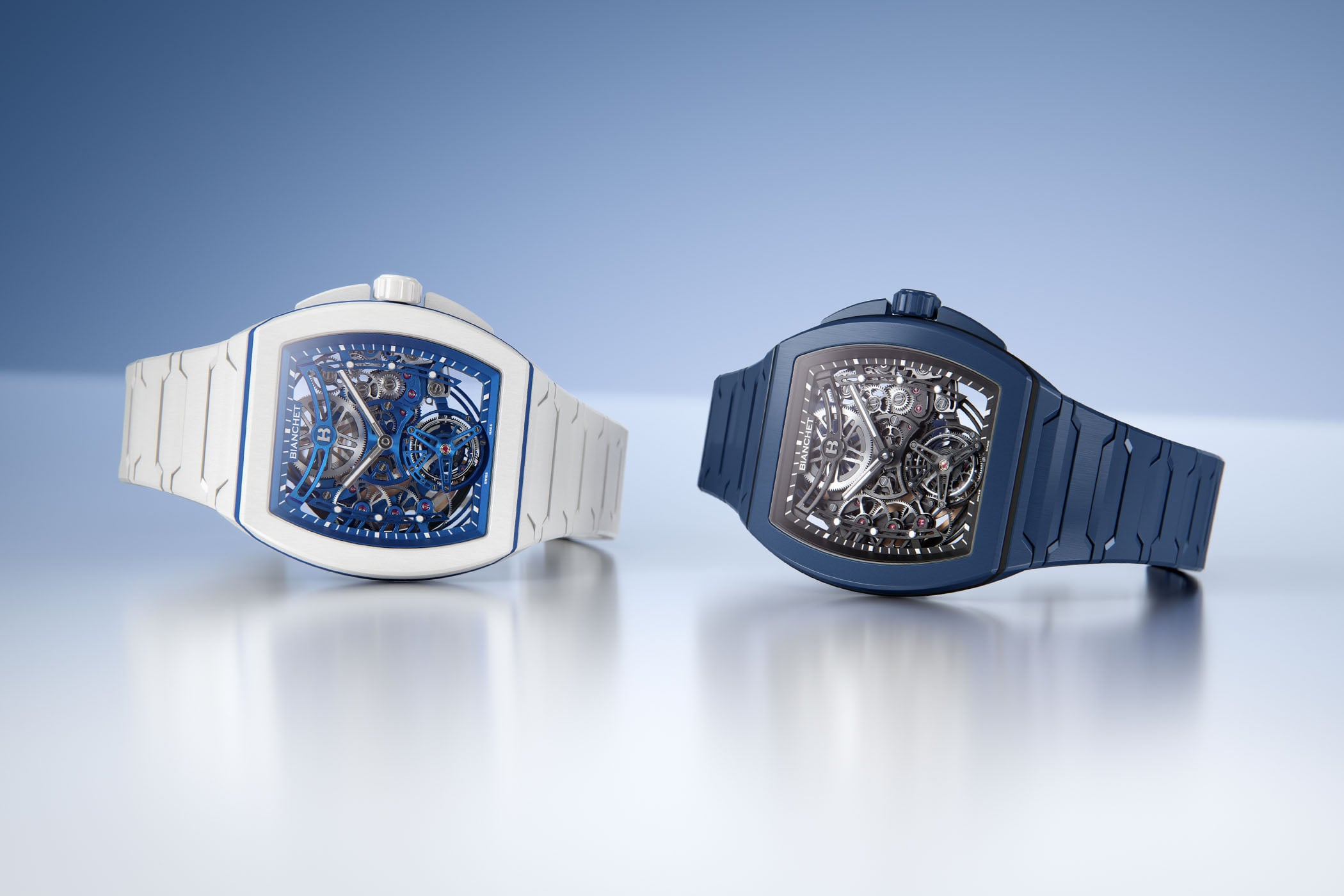
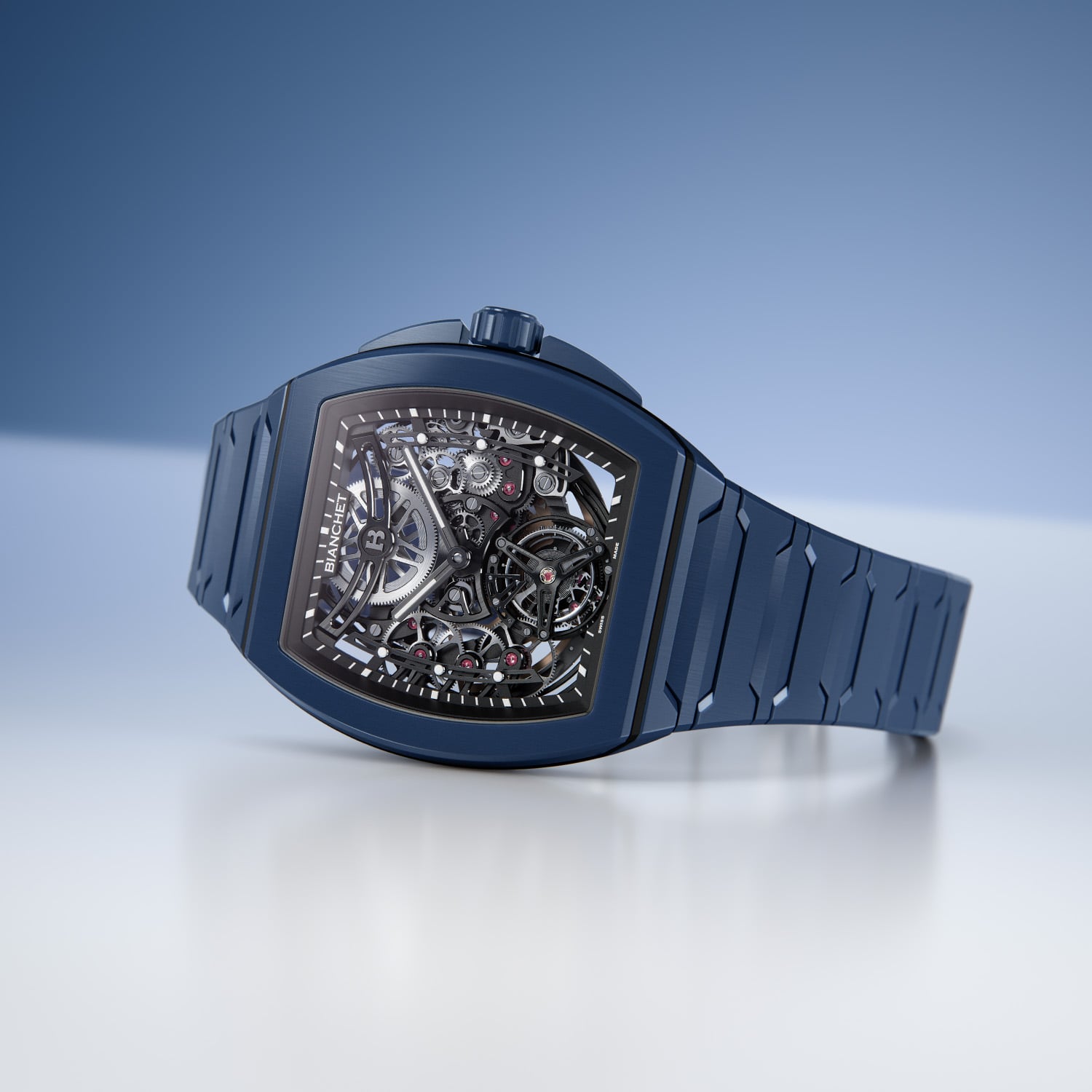
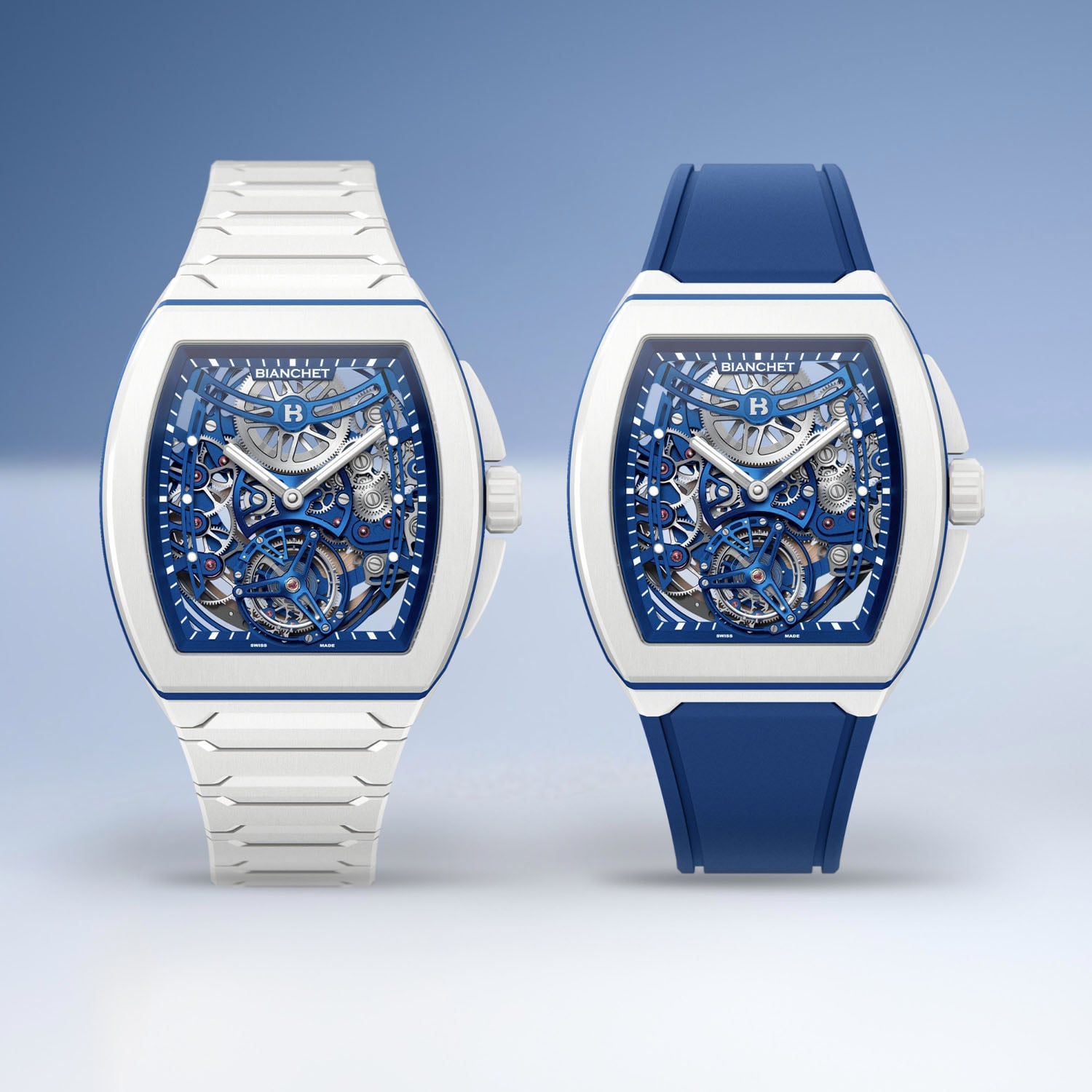
There are two versions. One is full white with dark blue contrasting gaskets, the other deep blue with black gaskets, and both carry the material through to the integrated bracelet. Ceramic is a familiar choice for the integrated sports watch, but Bianchet has kept the finishing it uses on its metal cases: vertically brushed surfaces broken up by polished bevels, which is harder to achieve on ceramic than on steel or titanium. The proportions are unchanged from the original Tonneau, 40mm wide, 47.5mm long and only 8.9mm thick, with sapphire crystals front and back and a modest 50m of water resistance.
There is no dial in the usual sense. The movement is fully exposed on both sides, so the colour work happens on the calibre itself. The deep blue edition treats all bridges and plates in black PVD for a darker, more traditional look; the white edition coats its movement in cobalt blue, which reads as the more contrasted of the two. The flying tourbillon at six is left open on both.
The eight-gram tourbillon
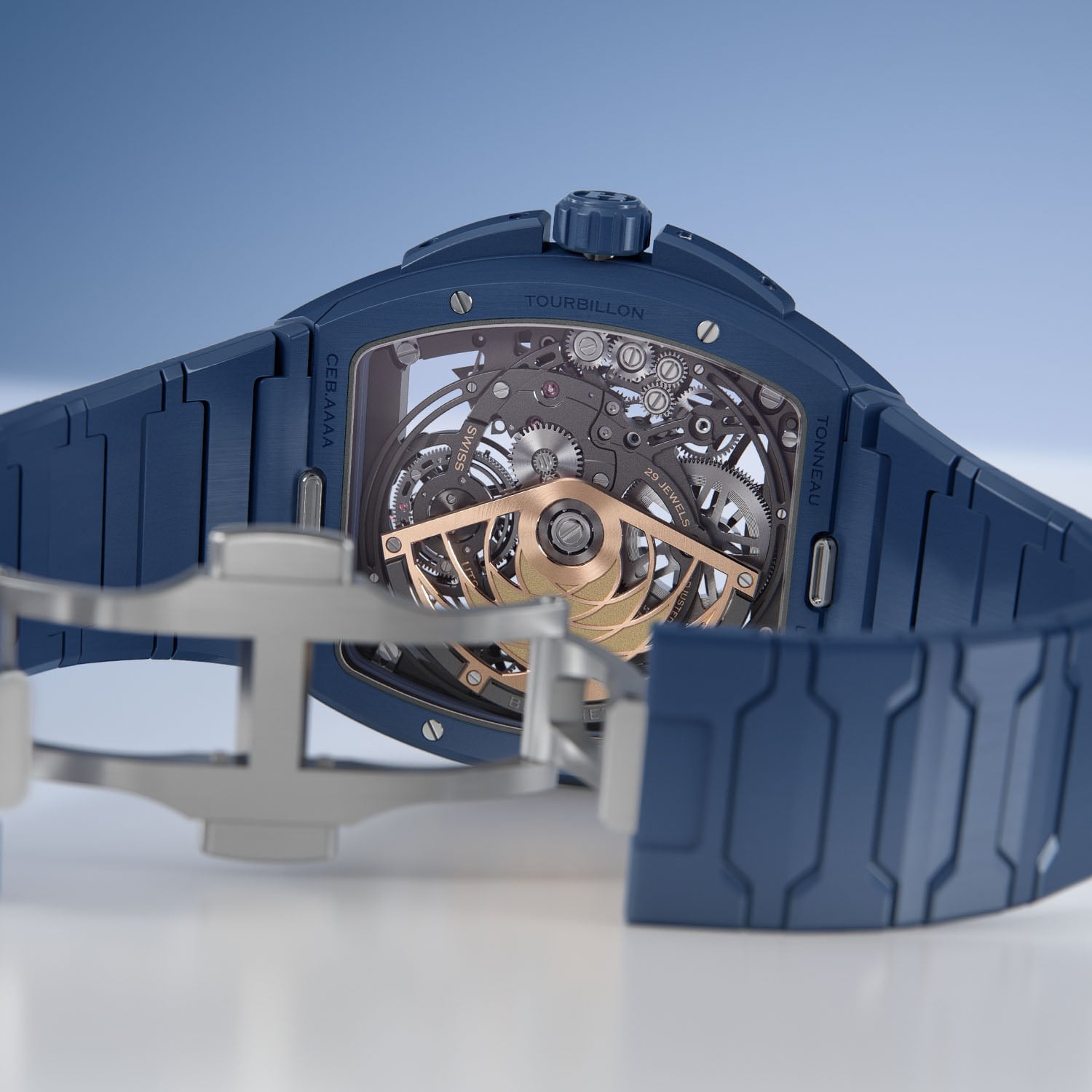
The reason any of this holds together is the movement. The proprietary UT01 is an automatic flying tourbillon just 3.85mm thick and weighing eight grams, which Bianchet describes as one of the lightest self-winding tourbillons in production. It is built entirely from titanium, with a suspended mainspring barrel and a one-minute tourbillon whose cage measures 2.66mm, running at 21,600 vibrations per hour for a 60-hour reserve across 29 jewels. Winding is handled by a gold rotor cut to the proportions of the Golden Ratio, the recurring motif in the brand's name and design. For all its lightness, the movement is rated to withstand shocks of up to 5,000 G, which is the sort of claim that matters more in a watch you actually wear on a bracelet than in a display piece.
Bracelet, strap and price
The ceramic bracelet is finished to match the case, satin-brushed and polished, with a triple folding clasp and a quick-release system. Each watch also ships with an extra rubber strap, black for the Deep Blue and cobalt blue for the White, so the integrated bracelet is not the only option out of the box. Both editions are part of the permanent collection at CHF 72,500 excluding taxes, per Bianchet. That is real money for a watch from a brand only a few years old, and the comments section said as much. The counterargument is on the caseback: an in-house ultra-thin automatic tourbillon, at eight grams, is not a common thing to find at any age.