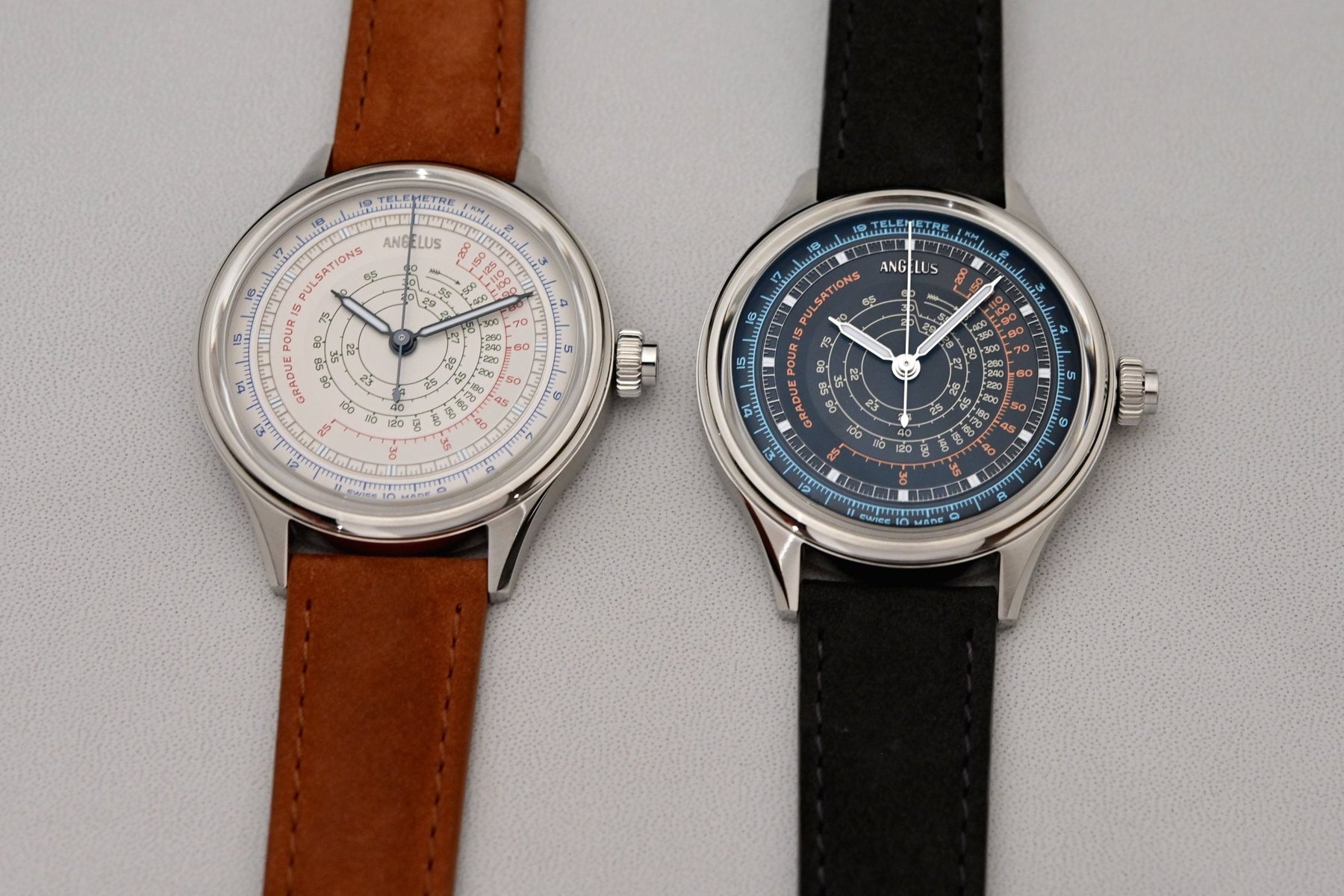
Most chronographs today carry one measuring scale, usually a tachymeter, often there for looks. The new Angelus Instrument de Mesures, introduced on June 11, carries three, and means them. A telemeter, a pulsometer and a tachymeter share one dial, each doing the job it was designed for. It is a deliberately literal reading of the brand's own name.
The watch closes a trilogy. Angelus built its modern reputation in the 1930s and 1940s on chronographs and timing instruments, and its revival under La Joux-Perret has leaned on that history. The Chronographe Médical arrived in 2023, the Instrument de Vitesse in 2024, and the Chronographe Télémètre in 2025, the last of which won the Chronograph prize at the Grand Prix d'Horlogerie de Genève. The Instrument de Mesures folds all three ideas, distance, speed and pulse, into one watch.
Three scales, one dial, no clutter
The achievement is legibility. Rather than crowd the scales onto a flat surface, Angelus built the dial in three dimensions: a domed centre, a sloped intermediate ring and a raised outer edge, each level given to a different function. The telemeter, which estimates the distance to an event from the gap between seeing and hearing it, sits on the outermost level. The pulsometer, calibrated over 15 beats, runs across the angled middle section. A spiral tachymeter for average speeds from 20 to 500 km/h winds toward the centre. The scales are cut directly into the dial structure, and a strict colour code keeps them apart: blue, orange and cream on the ebony-black dial, blue, red and green on the ivory-white one.
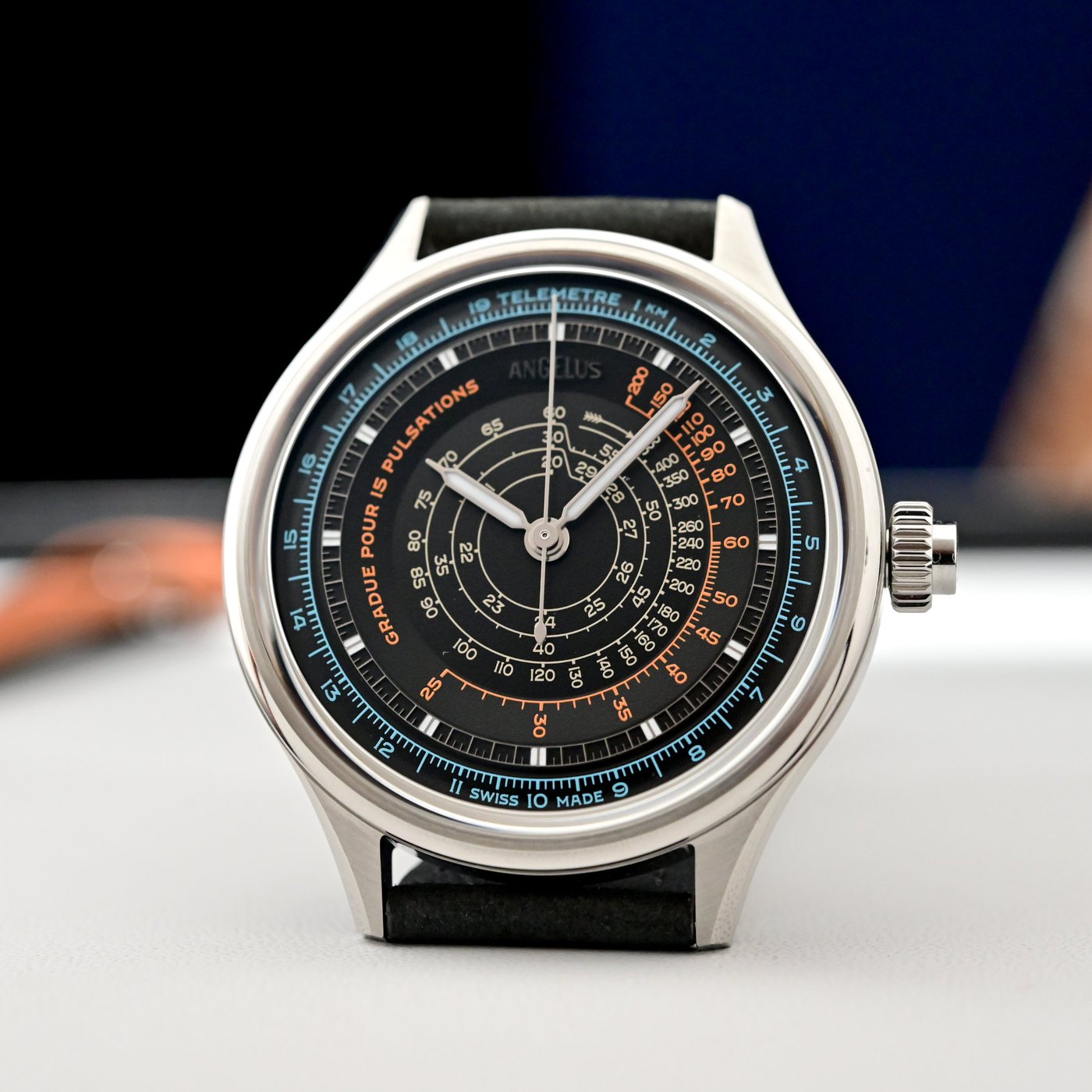
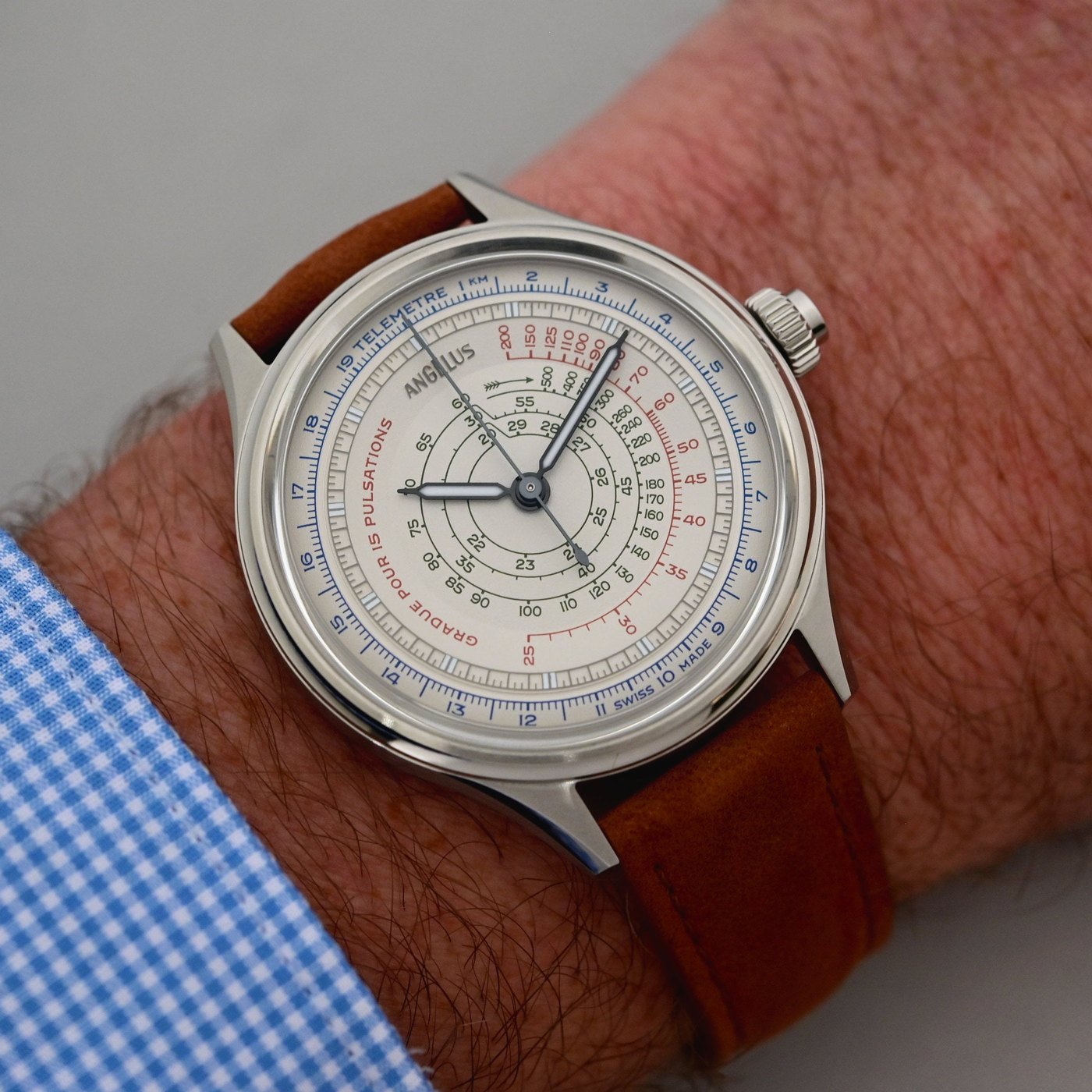
Syringe hands filled with Super-LumiNova read hours and minutes, and a central seconds hand serves whichever scale the wearer needs. All of it is driven by a single pusher set into the crown: one press starts, a second stops, a third resets.
A case that stays out of the way
The proportions are restrained on purpose. The steel case measures 39mm across and just 9.25mm thick, with twisted lugs that flow from the band and a slim, polished bezel that gives the dial as much room as possible. A box-shaped sapphire crystal, coated on both sides, lifts over the dial and reinforces the mid-century feel. Water resistance is a modest 30 metres, which tells you this is a measuring instrument rather than a tool watch.
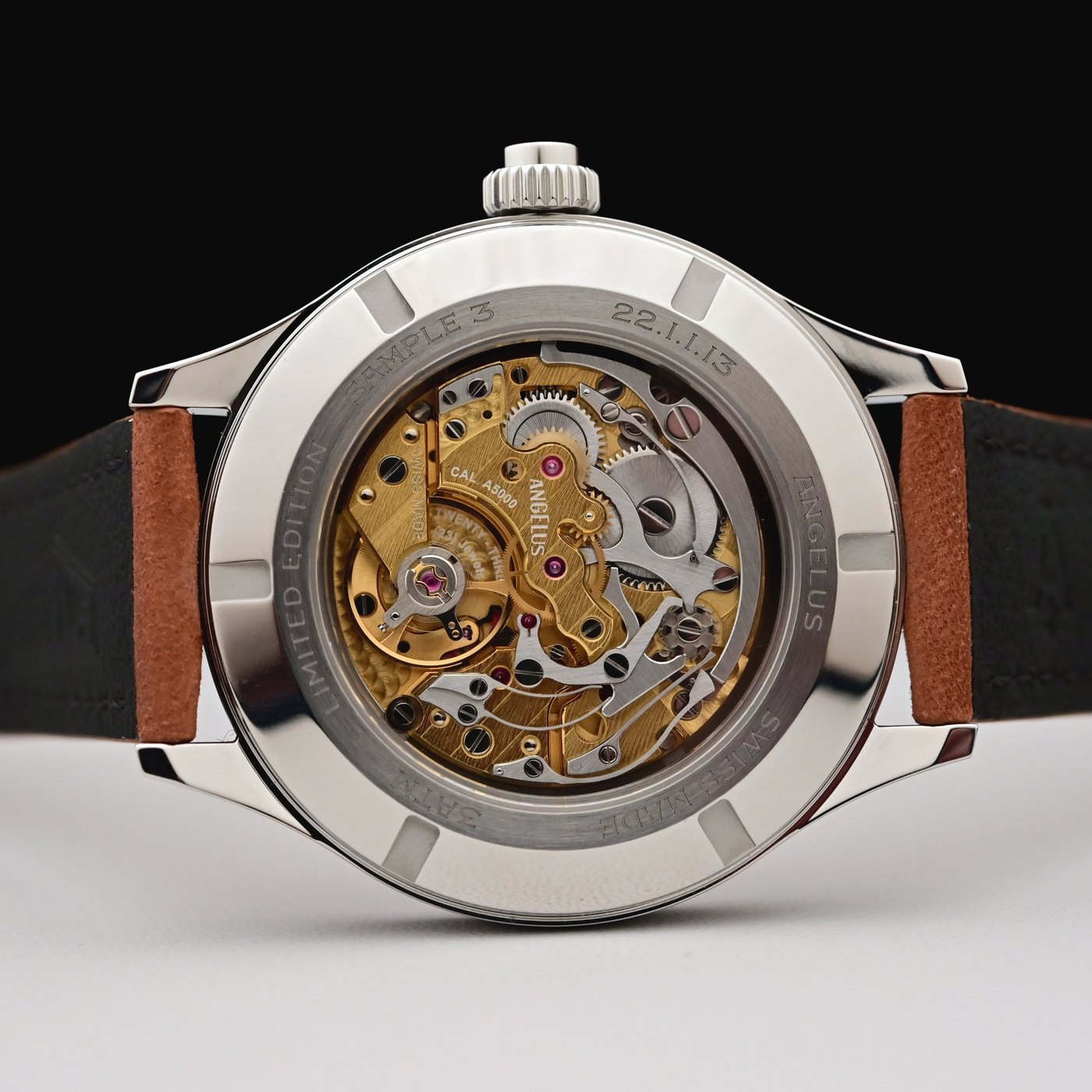
Through the sapphire caseback sits the in-house Calibre A5000, a hand-wound monopusher chronograph that has powered the recent Instrument series. It is built on traditional column-wheel architecture, runs at 21,600 vibrations an hour, carries 23 jewels and holds 42 hours of power reserve. The finishing is where the price shows: 3N gold-toned bridges set against palladium-treated chronograph parts for contrast, with circular graining, Côtes de Genève striping and polished bevels.
What it costs
The Instrument de Mesures comes on a calfskin strap, black for the ebony dial and tobacco brown for the ivory, on a steel pin buckle. Each colour is limited to 25 pieces, references OCHDS.B01A.V1476S and OCHDS.I01A.V1477S, priced at CHF 18,400 including VAT.
That number has drawn some grumbling, since Angelus once sat well below the cost of a car. But the proposition here is specific: a genuine three-scale instrument, finished to a level few brands attempt at this size, in a run of 50 watches total. It is a small, exacting object that does exactly what its name claims, which is rarer than it sounds.