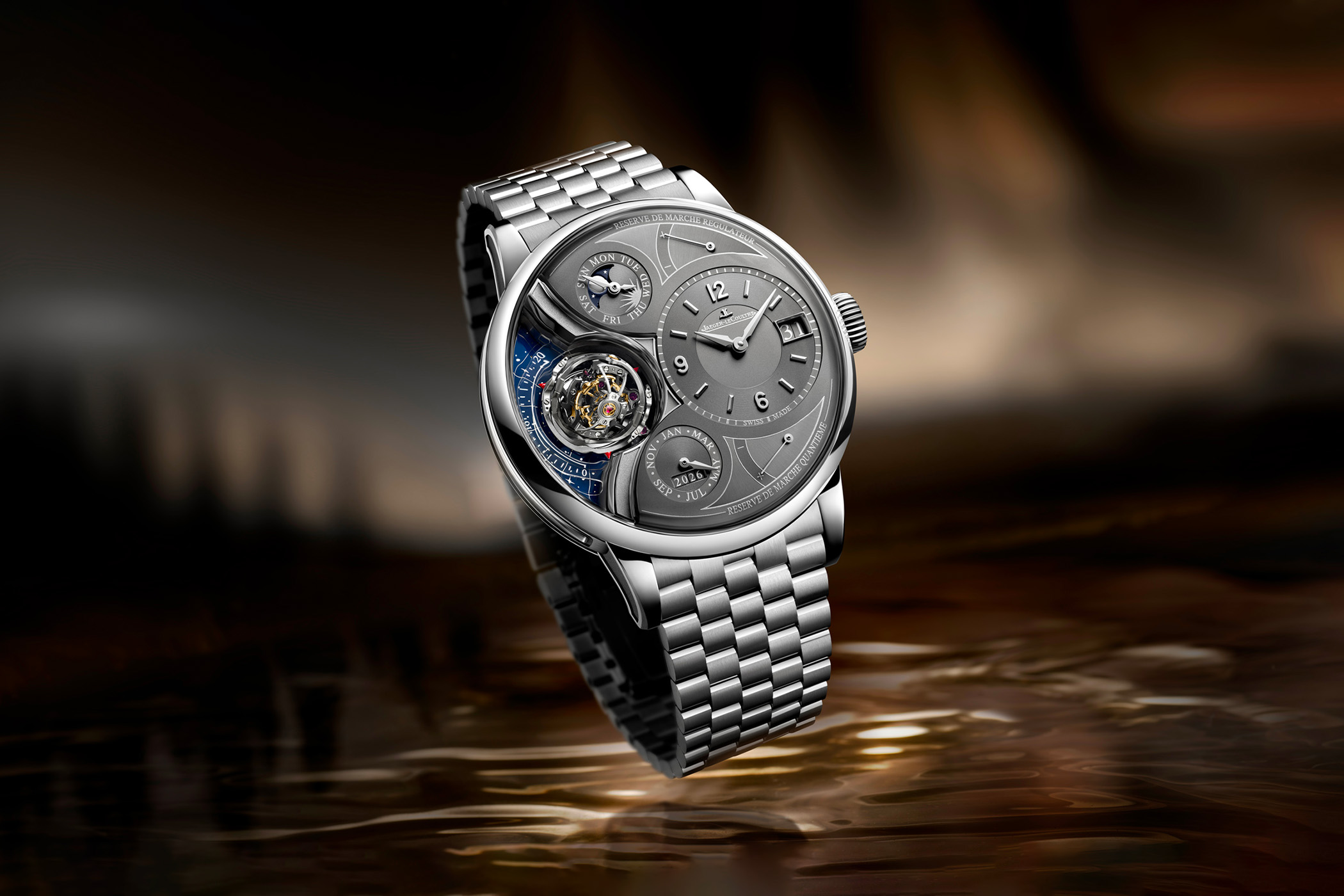
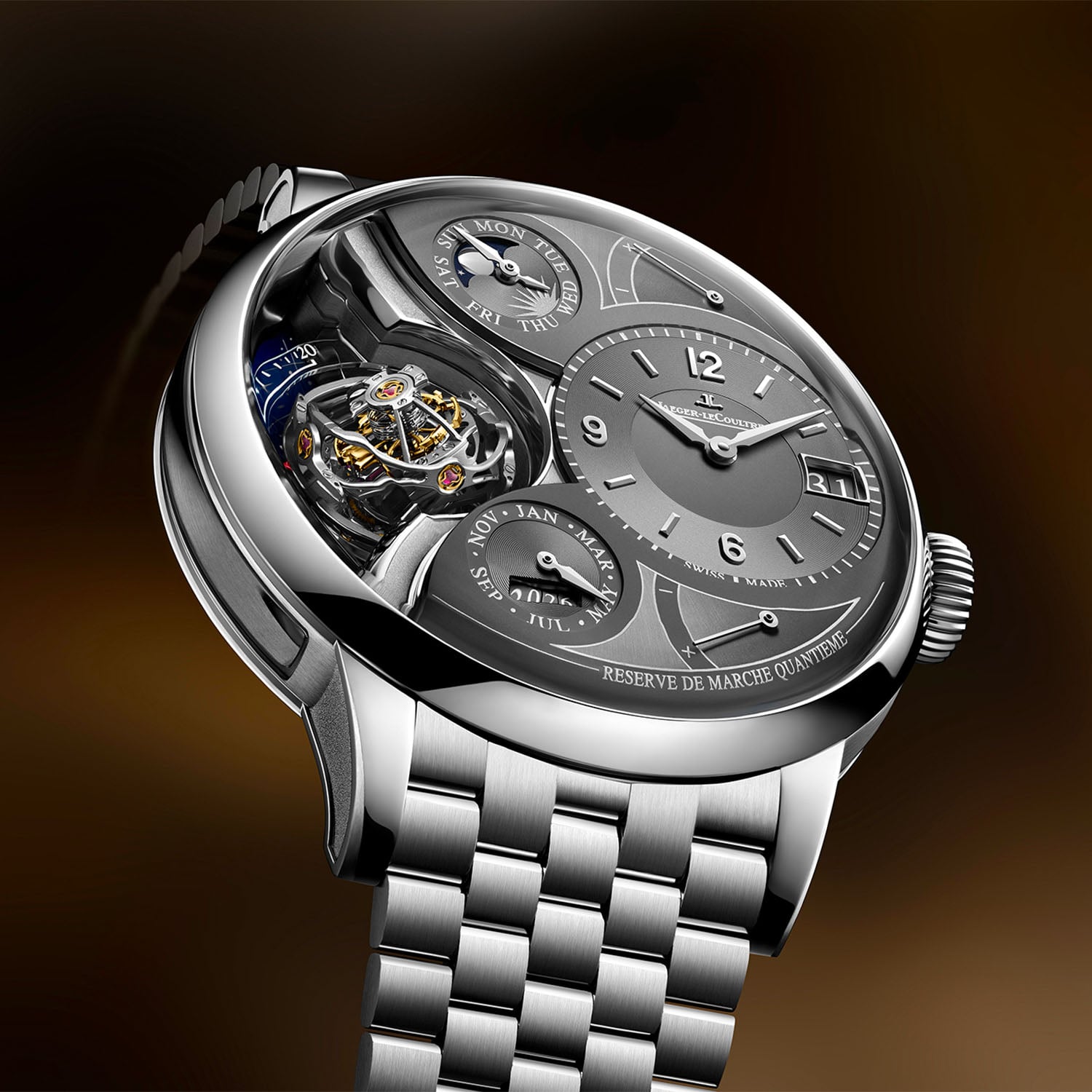
Jaeger-LeCoultre first showed the Duometre Heliotourbillon Perpetual in 2024. It returns now as a platinum case on a platinum bracelet, ref. Q6206150, with a grey dial in place of the original's warmer register. The complication is unchanged. What changed is that the brand's most involved regulator is now attached to a bracelet, which is a more interesting decision than a colour swap usually is.
Two power supplies, one regulator
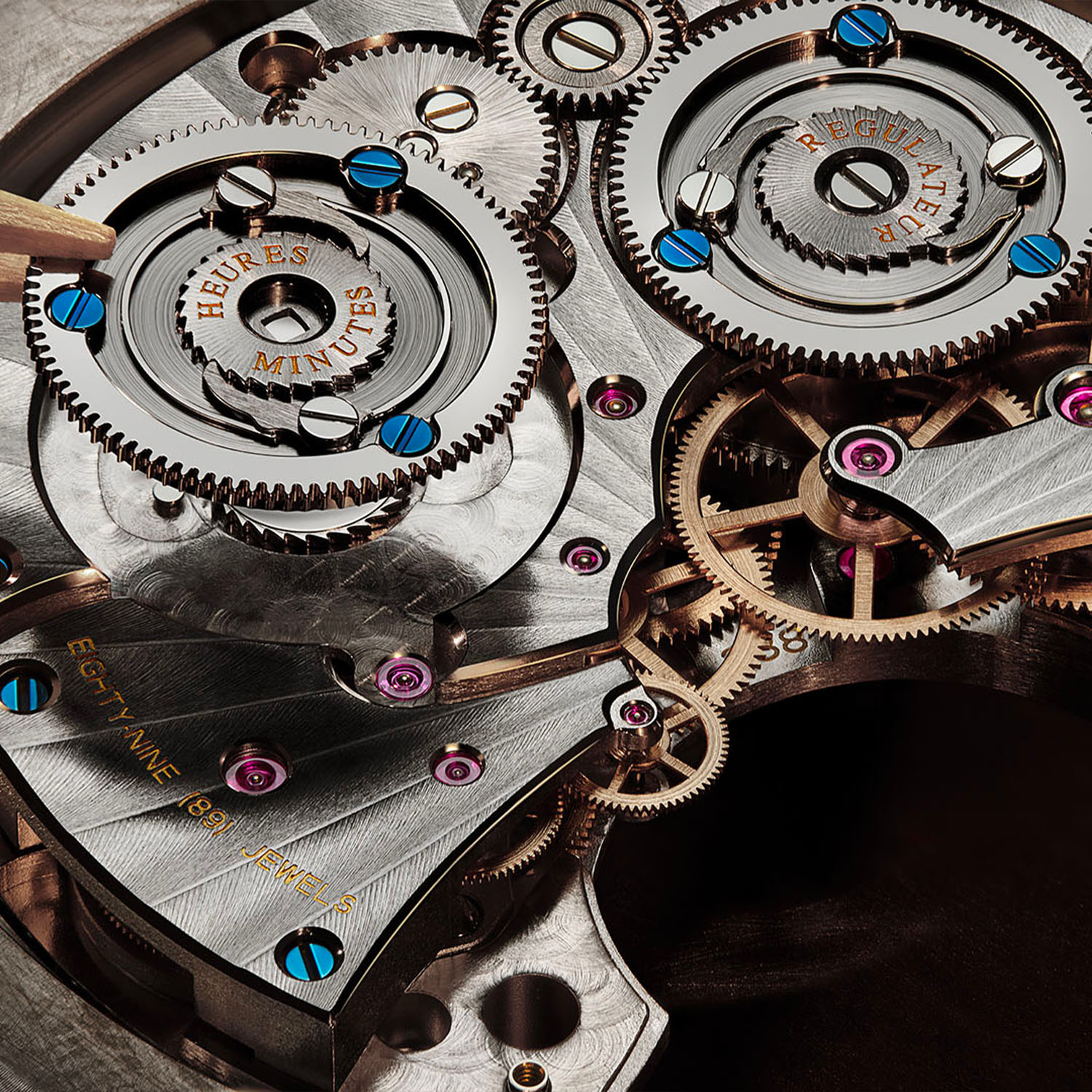
The Duometre idea is the older of the two concepts on this dial, patented by Jaeger-LeCoultre in 2007. The movement carries two mainspring barrels driving two separate gear trains, both linked to a single regulating organ. One train powers the time and calendar displays. The other drives the tourbillon. The point is isolation: setting the date, or the drag of the calendar advancing at midnight, does not pull energy away from the escapement. Each barrel holds 46 hours, and each has its own power reserve indicator on the dial, one above the time sub-dial and one below.
A tourbillon on three axes
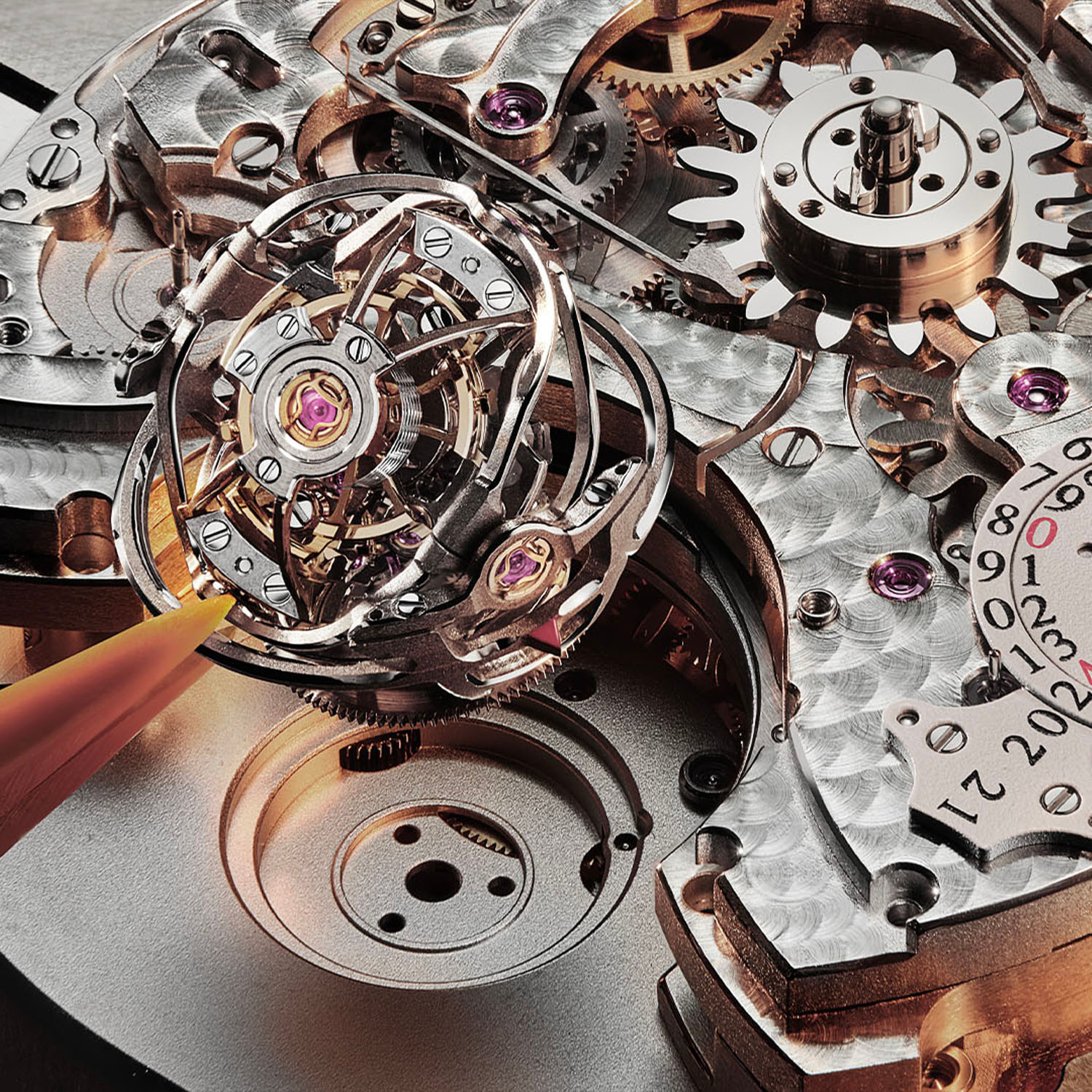
The Heliotourbillon rotates on three axes rather than one. Two of its cages turn once every 30 seconds; the third takes a minute. It is built from 163 components in titanium, supported on ceramic ball bearings to cut friction, and the whole assembly weighs less than 0.7 grams. A cylindrical hairspring sits inside it.
To make any of that visible, the case is cut open. The dial is voided from seven to eleven o'clock, and a second sapphire crystal is set into the left flank of the case so the cages can be watched from the side as well as from above. Behind the tourbillon is a dark blue lacquered starry ground, with a 20-second track printed on the crystal above it and read off three red arrow pointers on the cage itself. A curved platinum bridge divides the open section from the closed one.
The calendar
Calibre 388 adds an integrated perpetual calendar to those two systems. It tracks month lengths and leap years without correction until 2100, and it can be set forwards or backwards without desynchronising, which is not true of every perpetual on the market. There is a Grand Date at three o'clock, inside the large hours and minutes sub-dial. Day of the week and moon phase sit in one sub-dial, month and year in the other. The moon phase is accurate for 122 years. In a leap year, the final digit of the year display turns red, a detail Jaeger-LeCoultre holds a patent on.
The layout reads as a triangle: the big date at the apex, the two calendar sub-dials forming the base, the power reserves stacked above and below the time. The grey dial is worked in opaline, brushed and snailed finishes to keep the indications separated, with applied white gold numerals and indices.
Case, bracelet, movement
The case is 44mm across and 14.8mm thick, in platinum, built from 40 parts, with polished, brushed and micro-blasted surfaces and screwed lugs with recessed interiors. Jaeger-LeCoultre describes the rounded profile as a reading of its 19th-century savonette pocket watches. Water resistance is 30m.
Calibre 388 is manual-winding, 34.3mm by 11.15mm, with 655 components and 89 jewels, running at 28,800vph. Through the sapphire back you get the two barrels and radiating Geneva stripes across the bridges.
The bracelet is the new part: five rows of platinum with a white gold clasp. On a 44mm complication weighing what platinum weighs, a bracelet is a real commitment rather than a styling exercise, and it pushes a watch of this type closer to something worn than something shown.
Availability
Limited to 20 pieces. Price on request. Details at jaeger-lecoultre.com.