Conventional white ceramic is zirconium oxide cooked with metallic oxides until it sets. The result is dense, scratch-resistant, and inert. It also looks like ceramic in the dark, which is to say invisible.
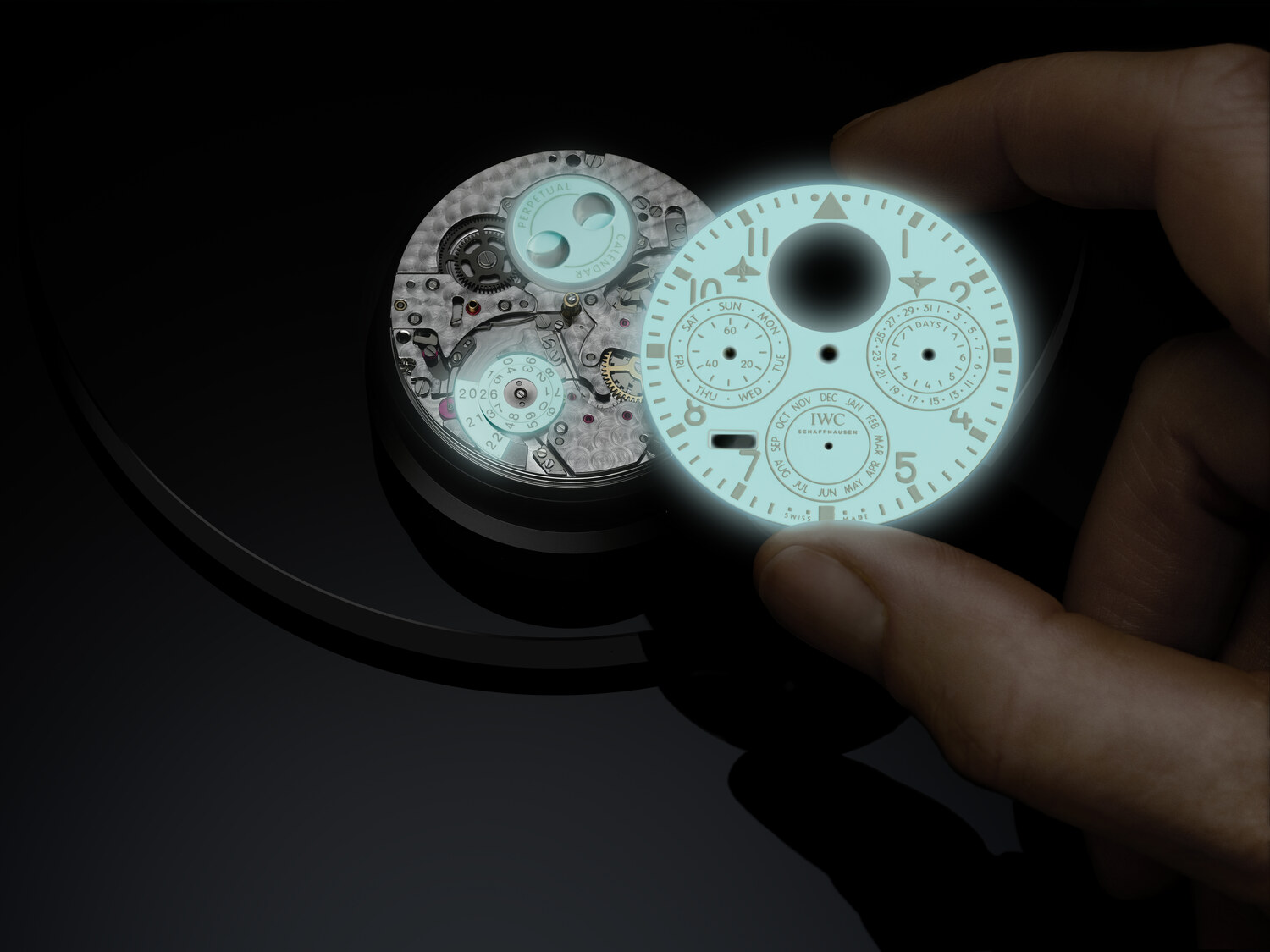
IWC has been working on an alternative since 2022. Ceralume is a white ceramic compound that the brand makes by mixing zirconium oxide powder with Super-LumiNova pigment before sintering. The pigment survives the firing process. The finished case absorbs light during the day and re-emits it through the night, as IWC's press materials describe, with no separate luminous coating to wear off.
The 2026 Big Pilot's Watch Perpetual Calendar Ceralume is the first watch IWC has built using the material at scale, and the first to extend the principle from the case to the strap.
The watch in daylight, the watch at night
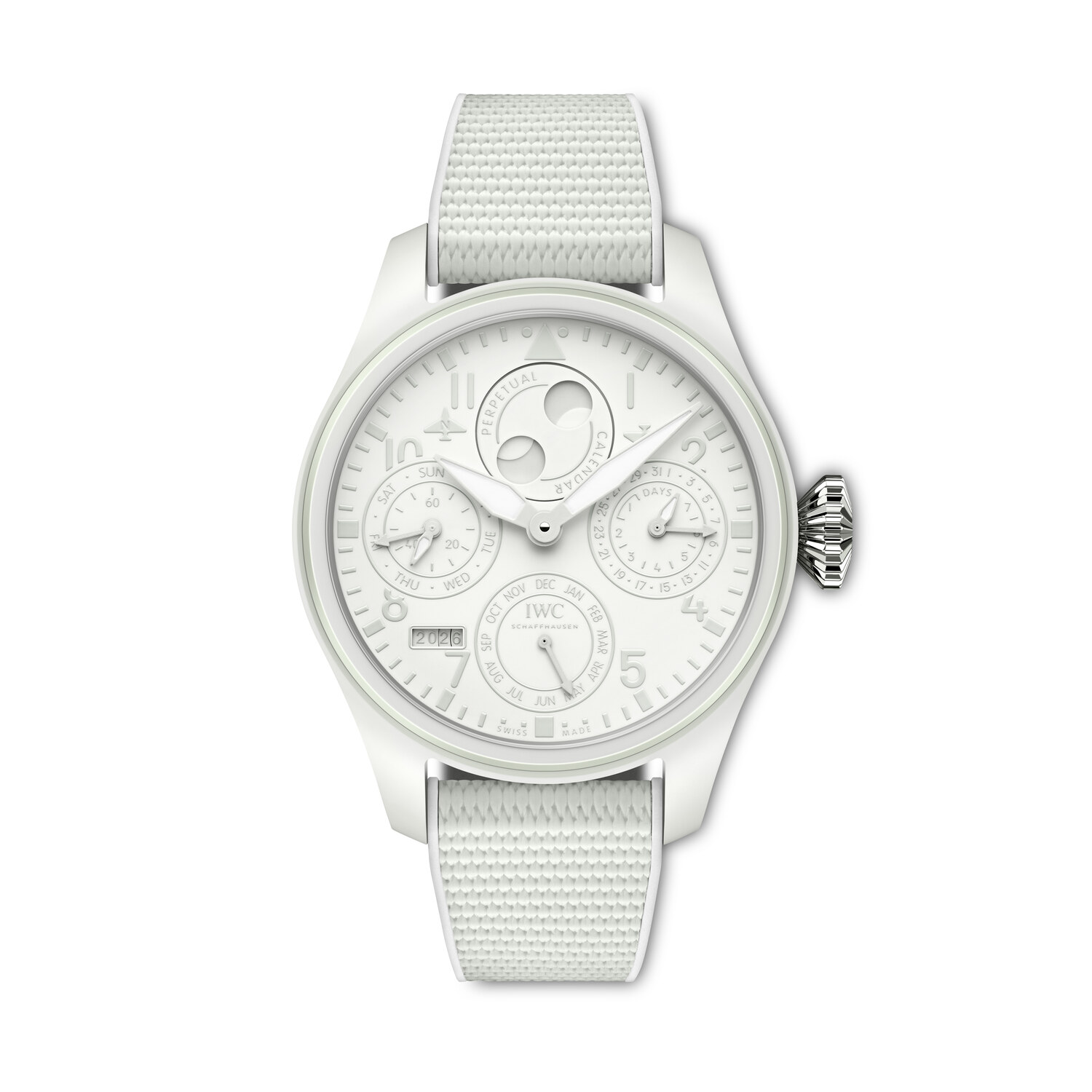
In daylight the Ceralume reads as a slightly warm white. The case is 46.5mm wide, the standard Big Pilot dimension. The dial is white, the rubber strap is white, the hands and applied numerals are blackened. Monochrome's first look describes the visual register as "varying shades of white" with shifts in surface finish: matte ceramic, satin dial, gloss strap.
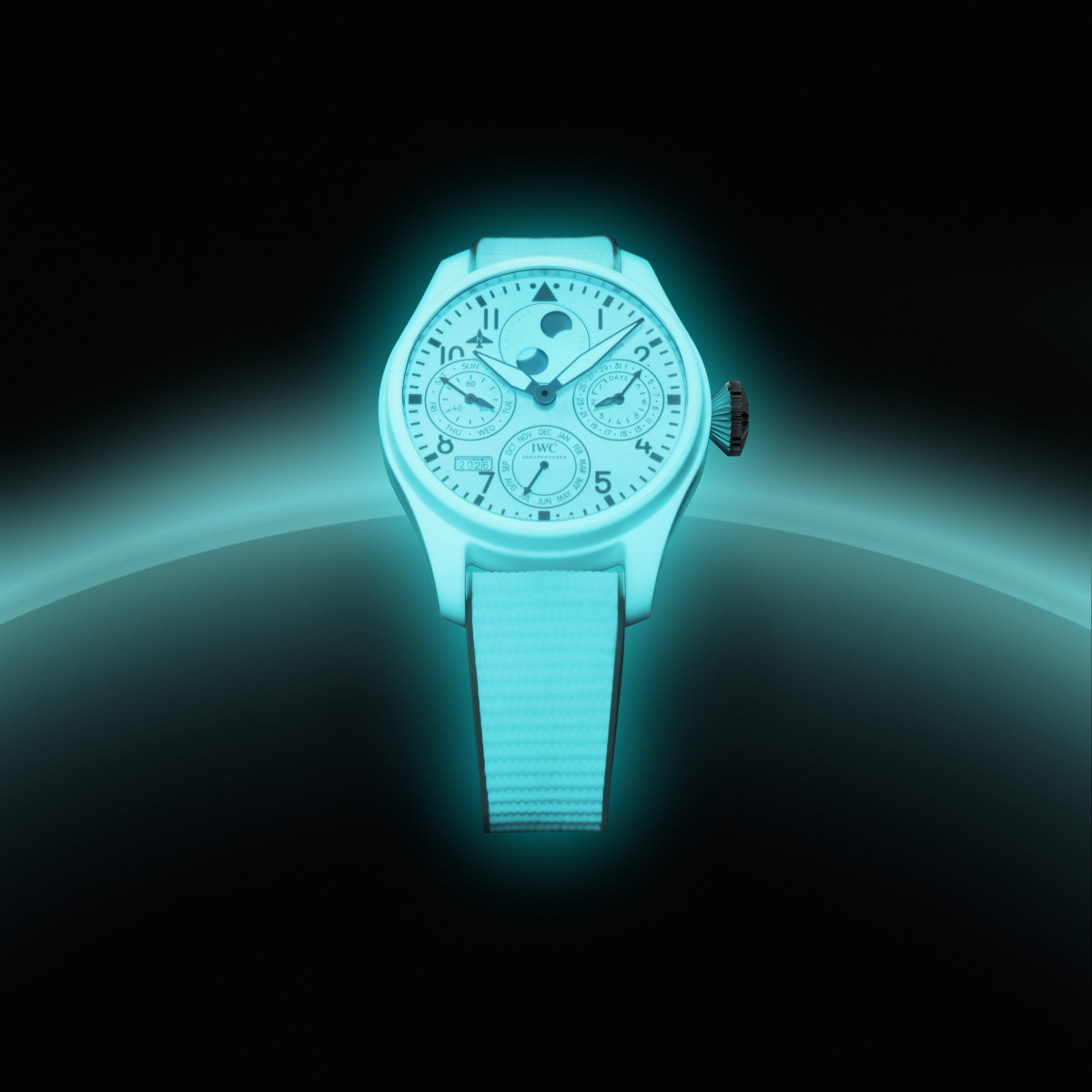
In the dark the same surfaces emit a blue-green glow that holds for around 24 hours after a full charge. Watchonista notes that the case, dial and strap all participate, while the blackened hands and numerals stay dark. The result inverts the usual lume relationship: instead of bright markers on a dark dial, you read dark markers on a bright dial.
The complication: Kurt Klaus's perpetual
The movement is IWC's perpetual calendar, designed by Kurt Klaus in the 1980s. The same architecture has driven the brand's perpetual calendar production for almost forty years. Date, day, month and moon phase live in four sub-dials. The four-digit year sits in an aperture between 7 and 8, programmed to recognise centuries; it will not need correction until 2400.
The complication is set forward via a single crown, with no separate pushers. That detail is unusually buyer-friendly for a perpetual calendar at this complexity, and it has kept the IWC perpetual relevant against more architecturally novel competitors.

Why a 46.5mm case still works in 2026
The Big Pilot has held its dimensions since 2002. The brand has resisted shrinking it, even as the broader market trended towards smaller cases. The 46.5mm spec works for two reasons. The historical reference point, the IWC B-Uhren observer's watch from the 1940s, was 55mm. And the perpetual calendar movement, with its sub-dial layout and four-digit year, needs the dial real estate.
For the Ceralume, the dimension also matters technically. Fratello points out that a luminous ceramic case at 40mm would have less surface area to glow, and the visual effect would be reduced. The 46.5mm case is the canvas the material is meant for.
Pricing
CHF 65,000, around 68,000 euros. Limited to 250 pieces. The reference is IW505801, available through IWC boutiques and authorised retailers from May 2026.
For a brand that has spent the last decade building white ceramic and bronze cases, the Ceralume is the next material in IWC's standing argument. The argument is that an unfamiliar case material, executed at IWC's industrial scale, is more interesting than a fourteenth interpretation of a known case material in a new colour. The Big Pilot Perpetual Calendar Ceralume is the cleanest version of that argument the brand has shipped.
Sources: IWC press release; Monochrome on the Ceralume technology; Watchonista on the day-night register; Fratello on the case dimensions; IWC product page.