If you've ever held a watch up to the light and seen the tiny gears turning behind the dial, you've glimpsed one of the most satisfying aspects of mechanical watches. Understanding what's actually happening in there makes collecting, buying, and maintaining watches much less mysterious.
Let's walk through the main concepts without the technical jargon that makes watch movements sound like rocket science.
What a Watch Movement Actually Does
A watch movement is the mechanism that keeps time. It takes energy, makes it tick at a precise rate, and translates that ticking into the motion of your hands. Everything else on the watch is just packaging around this mechanism.
There are two main types you'll encounter: automatic and manual wind. Both use similar principles, but they get their energy in different ways.
Manual Wind (Hand-Wound) Movements
A manual wind watch requires you to wind the crown periodically to keep it running. When you wind it, you're tightening a spring called the mainspring, which stores mechanical energy like a coiled-up rubber band.
As the mainspring slowly unwinds, it releases that energy in a controlled way. This is where the beauty of watch design comes in. The movement can't just let the spring dump all its power at once. It needs a mechanism to release that energy in tiny, regular pulses.
This regulation happens through something called the escapement. Think of it as the heartbeat of the watch. The escapement creates the ticking sound and the regular back-and-forth motion that makes time advance in predictable increments.
The most common escapement in mechanical watches is the Swiss lever escapement. It uses a component called the balance wheel, which oscillates back and forth at a specific frequency, usually around 4 or 8 times per second depending on the watch.
Automatic Movements
An automatic watch is essentially a manual wind movement with a bonus feature. It has a rotor, which is a weighted component that swings freely when you move your wrist. As you wear the watch, your normal arm movements wind the mainspring automatically.
This is genuinely clever. You're not getting energy from nothing. Your movement is actually converted into that winding action. If an automatic watch sits unworn for a few days, it will run down and stop, just like a manual wind would.
Automatic watches often have a mechanism to prevent overwinding. When the mainspring is fully wound, a clutch or slip spring prevents the rotor from continuing to turn. This protects the watch from damage and is one reason automatics are reasonably durable for daily wear.
Key Components to Know
The balance wheel oscillates back and forth in a regular rhythm. It's one of the most important parts of any mechanical watch. The faster it oscillates, the more accurate the timekeeping can theoretically be, though other factors matter too.
The escapement, as mentioned, releases energy in regulated bursts. The ticking sound you hear is directly related to the escapement doing its job. Different escapement designs sound different and perform differently.
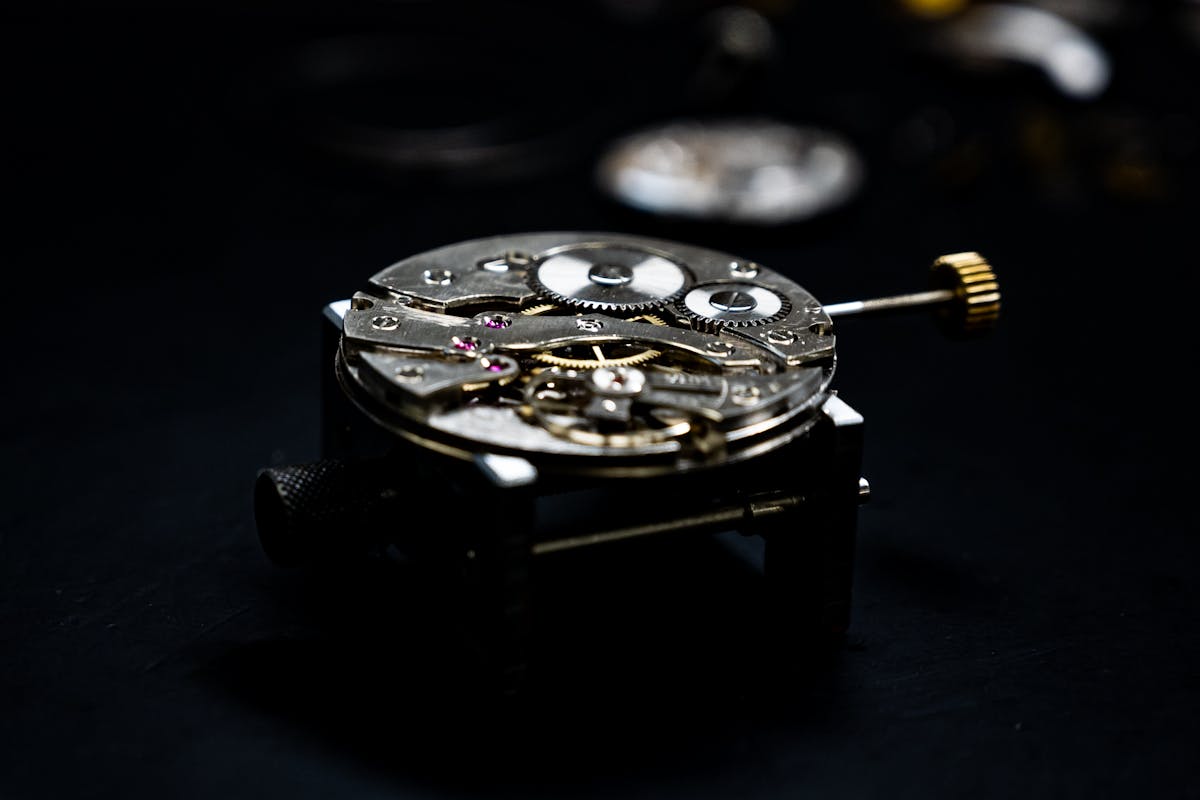
The hairspring (or balance spring) keeps the balance wheel oscillating at the right frequency. It's an incredibly thin, flat coil of metal that works with the balance wheel to regulate time. If you've ever seen a close-up photo of a watch movement, the hairspring is usually that delicate spiral you notice.
The gear train is the system of interlocking gears that translates the oscillations of the balance wheel into the movement of your watch hands. The seconds hand typically makes one full rotation per 60 oscillations of the balance wheel.
The mainspring, as discussed, is your energy storage. It's housed in a barrel, which is basically a cylindrical container that keeps the spring coiled up. As it unwinds, it drives everything else.
Chronometer vs. Standard Movements
You'll sometimes see watches labeled as chronometer-rated. This means the movement has been tested and certified to meet specific accuracy standards, usually losing or gaining no more than a few seconds per day. It's not a type of movement itself, but rather a quality certification.
If you're buying a mechanical watch and accuracy matters to you, a chronometer-certified movement is worth seeking out, but it's not essential. Most mechanical watches are accurate enough for daily wear if they're in good condition.
Jewels and Friction
You might see watch specs mentioning something like "25 jewels." These aren't decorative. They're tiny synthetic sapphire bearings used to reduce friction at critical points in the movement. More jewels generally means better performance and potentially longer lifespan, though the difference between 17 and 25 jewels is often academic for average users.
The jewels reduce wear on the movement's pivots, the small pins that act as axles for the gears. By reducing friction, jewels help the movement run longer between services and often keep it more accurate.
What to Look for When Examining a Movement
If you ever get a chance to see a movement close-up, look for cleanliness. Dust and debris in a movement will cause drag and potentially damage. Look at the finish. Some movements have decorated surfaces with patterns like Geneva stripes or Cotes de Geneve, which are aesthetic but also indicate the quality level of the watch.
Watch out for rust, which appears as discoloration on metal parts. A small amount of oxidation isn't necessarily a deal-breaker, but active rust suggests the watch hasn't been cared for well.
Gears should be intact with no missing teeth. If you see a gear with visible damage, that movement will need service.
The jewels should appear as small colored stones set into the movement. If they're missing or cloudy, the movement needs attention.
Service and Maintenance
A mechanical watch movement should be serviced every five to ten years depending on how much you wear it and the conditions it's exposed to. Service means a professional watchmaker disassembles it completely, cleans every part, replaces any worn components, and reassembles it with proper lubrication.
This is why keeping records of your watches matters, whether you use Aikakone or just a simple spreadsheet. When you sell or pass on a watch, knowing its service history makes it much more valuable to the next owner.
Final Thought
Understanding what's happening inside your watch takes some of the mystery out of mechanical timekeeping. It also helps you appreciate why mechanical watches are still around despite the existence of quartz and digital alternatives. There's something genuinely satisfying about wearing something so carefully engineered that it keeps time using nothing but physics and craftsmanship.
The next time you hold a watch up to the light, you'll recognize those gears and the balance wheel doing exactly what they've been doing for centuries.